MATS Summer 2024
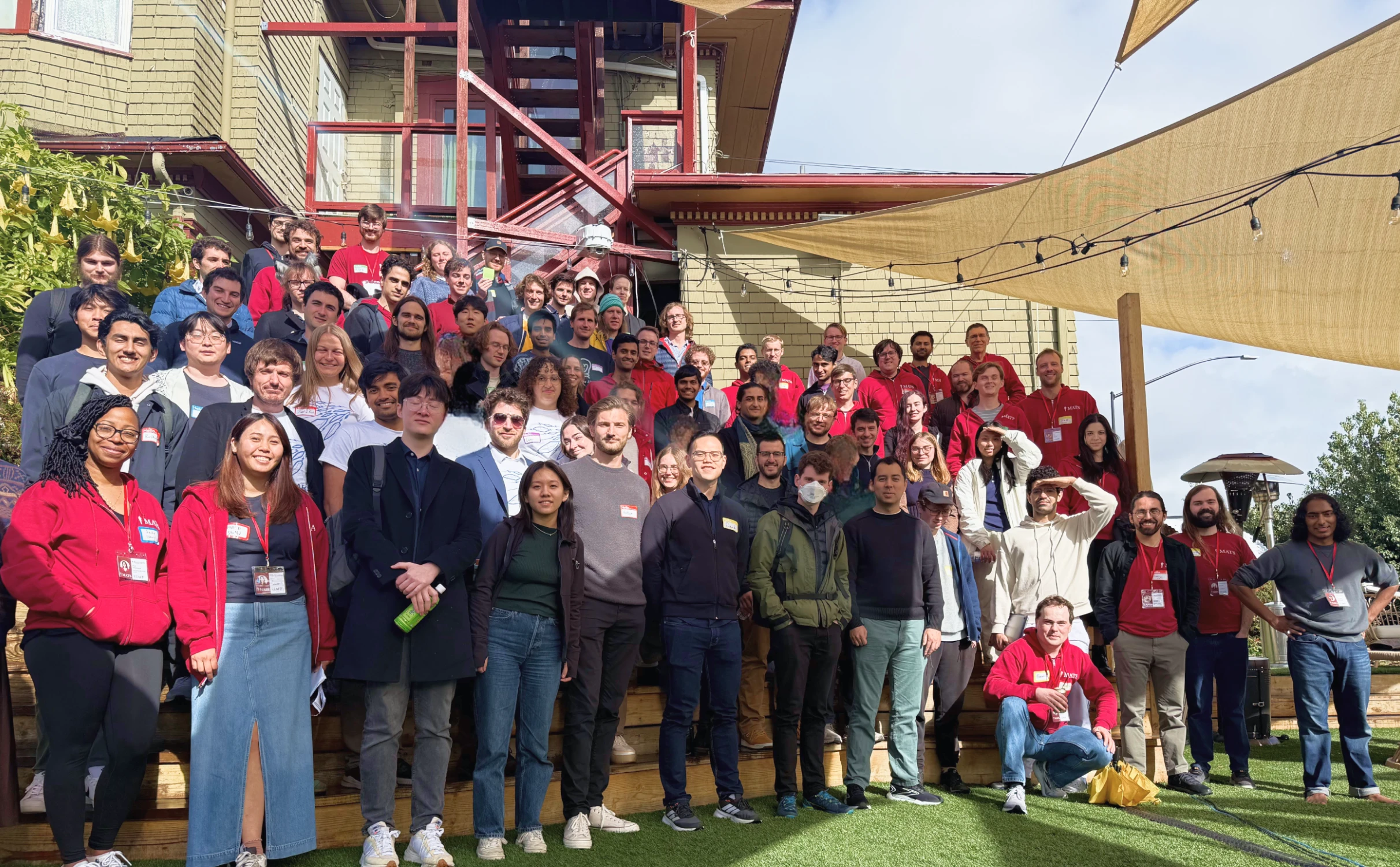
The Summer 2024 cohort marked a significant expansion, supporting approximately 90 fellows with 40 mentors—the broadest mentor selection in MATS history. This cohort incorporated MATS as a 501(c)(3) nonprofit organization, formalizing its institutional structure. The program expanded its research portfolio to include at least four governance mentors alongside technical research streams, reflecting growing interest in AI policy and technical governance work. The 10-week research phase continued in Berkeley, with fellows conducting work across mechanistic interpretability, evaluations, scalable oversight, and governance research. Notable outputs from this cohort include research on targeted manipulation and deception in LLMs trained on user feedback, which was accepted to NeurIPS workshops, and contributions to an AI safety via debate paper that won best paper at ICML 2024. One fellow co-founded Decode Research, a new AI safety organization focused on building interpretability tools.
Applications are now closed.
Program phases
Key dates for the application and admissions timeline
Applications typically open several months before the program begins. Applicants complete a multi-stage admissions process, beginning with a general application. Depending on the tracks, streams, and mentors they apply to, applicants may also complete additional evaluations such as interviews, work tests, coding assessments, or writing samples before final admissions decisions are made.
Related research
Do I Know This Entity? Knowledge Awareness and Hallucinations in Language Models
Hallucinations in large language models are a widespread problem, yet the mechanisms behind whether models will hallucinate are poorly understood, limiting our ability to solve this problem. Using sparse autoencoders as an interpretability tool, we discover that a key part of these mechanisms is entity recognition, where the model detects if an entity is one it can recall facts about. Sparse autoencoders uncover meaningful directions in the representation space, these detect whether the model recognizes an entity, e.g. detecting it doesn't know about an athlete or a movie. This suggests that models can have self-knowledge: internal representations about their own capabilities. These directions are causally relevant: capable of steering the model to refuse to answer questions about known entities, or to hallucinate attributes of unknown entities when it would otherwise refuse. We demonstrate that despite the sparse autoencoders being trained on the base model, these directions have a causal effect on the chat model's refusal behavior, suggesting that chat finetuning has repurposed this existing mechanism. Furthermore, we provide an initial exploration into the mechanistic role of these directions in the model, finding that they disrupt the attention of downstream heads that typically move entity attributes to the final token.
Authors:
Javier Ferrando Monsonis, Oscar Balcells Obeso
Javier Ferrando, Oscar Obeso, Senthooran Rajamanoharan, Neel Nanda
Date:
Aug 17, 2026
Citations:
104
Rapid Response: Mitigating LLM Jailbreaks with a Few Examples
As large language models (LLMs) grow more powerful, ensuring their safety against misuse becomes crucial. While researchers have focused on developing robust defenses, no method has yet achieved complete invulnerability to attacks. We propose an alternative approach: instead of seeking perfect adversarial robustness, we develop rapid response techniques to look to block whole classes of jailbreaks after observing only a handful of attacks. To study this setting, we develop RapidResponseBench, a benchmark that measures a defense's robustness against various jailbreak strategies after adapting to a few observed examples. We evaluate five rapid response methods, all of which use jailbreak proliferation, where we automatically generate additional jailbreaks similar to the examples observed. Our strongest method, which fine-tunes an input classifier to block proliferated jailbreaks, reduces attack success rate by a factor greater than 240 on an in-distribution set of jailbreaks and a factor greater than 15 on an out-of-distribution set, having observed just one example of each jailbreaking strategy. Moreover, further studies suggest that the quality of proliferation model and number of proliferated examples play an key role in the effectiveness of this defense. Overall, our results highlight the potential of responding rapidly to novel jailbreaks to limit LLM misuse.
Authors:
Alwin Peng
Alwin Peng, Julian Michael, Henry Sleight, Ethan Perez, Mrinank Sharma
Date:
Aug 17, 2026
Citations:
12
Evaluating Sparse Autoencoders on Targeted Concept Erasure Tasks
Sparse Autoencoders (SAEs) are an interpretability technique aimed at decomposing neural network activations into interpretable units. However, a major bottleneck for SAE development has been the lack of high-quality performance metrics, with prior work largely relying on unsupervised proxies. In this work, we introduce a family of evaluations based on SHIFT, a downstream task from Marks et al. (Sparse Feature Circuits, 2024) in which spurious cues are removed from a classifier by ablating SAE features judged to be task-irrelevant by a human annotator. We adapt SHIFT into an automated metric of SAE quality; this involves replacing the human annotator with an LLM. Additionally, we introduce the Targeted Probe Perturbation (TPP) metric that quantifies an SAE's ability to disentangle similar concepts, effectively scaling SHIFT to a wider range of datasets. We apply both SHIFT and TPP to multiple open-source models, demonstrating that these metrics effectively differentiate between various SAE training hyperparameters and architectures.
Authors:
Adam Karvonen, Can Rager
Adam Karvonen, Can Rager, Samuel Marks, Neel Nanda
Date:
Apr 23, 2026
Citations:
9
Towards Safeguarding LLM Fine-tuning APIs against Cipher Attacks
Large language model fine-tuning APIs enable widespread model customization, yet pose significant safety risks. Recent work shows that adversaries can exploit access to these APIs to bypass model safety mechanisms by encoding harmful content in seemingly harmless fine-tuning data, evading both human monitoring and standard content filters. We formalize the fine-tuning API defense problem, and introduce the Cipher Fine-tuning Robustness benchmark (CIFR), a benchmark for evaluating defense strategies'ability to retain model safety in the face of cipher-enabled attackers while achieving the desired level of fine-tuning functionality. We include diverse cipher encodings and families, with some kept exclusively in the test set to evaluate for generalization across unseen ciphers and cipher families. We then evaluate different defenses on the benchmark and train probe monitors on model internal activations from multiple fine-tunes. We show that probe monitors achieve over 99% detection accuracy, generalize to unseen cipher variants and families, and compare favorably to state-of-the-art monitoring approaches. We open-source CIFR and the code to reproduce our experiments to facilitate further research in this critical area. Code and data are available online https://github.com/JackYoustra/safe-finetuning-api
Authors:
Jack Youstra, Yang Yan
Jack Youstra, Mohammed Mahfoud, Yang Yan, Henry Sleight, Ethan Perez, Mrinank Sharma
Date:
Aug 17, 2026
Citations:
11
Real-Time Detection of Hallucinated Entities in Long-Form Generation
Large language models are now routinely used in high-stakes applications where hallucinations can cause serious harm, such as medical consultations or legal advice. Existing hallucination detection methods, however, are impractical for real-world use, as they are either limited to short factual queries or require costly external verification. We present a cheap, scalable method for real-time identification of hallucinated tokens in long-form generations, and scale it effectively to 70B parameter models. Our approach targets \emph{entity-level hallucinations} -- e.g., fabricated names, dates, citations -- rather than claim-level, thereby naturally mapping to token-level labels and enabling streaming detection. We develop an annotation methodology that leverages web search to annotate model responses with grounded labels indicating which tokens correspond to fabricated entities. This dataset enables us to train effective hallucination classifiers with simple and efficient methods such as linear probes. Evaluating across four model families, our classifiers consistently outperform baselines on long-form responses, including more expensive methods such as semantic entropy (e.g., AUC 0.90 vs 0.71 for Llama-3.3-70B), and are also an improvement in short-form question-answering settings. Moreover, despite being trained only with entity-level labels, our probes effectively detect incorrect answers in mathematical reasoning tasks, indicating generalization beyond entities. While our annotation methodology is expensive, we find that annotated responses from one model can be used to train effective classifiers on other models; accordingly, we publicly release our datasets to facilitate reuse. Overall, our work suggests a promising new approach for scalable, real-world hallucination detection.
Authors:
Oscar Balcells Obeso, Andy Arditi, Javier Ferrando Monsonis
Oscar Obeso, Andy Arditi, Javier Ferrando, Joshua Freeman, Cameron Holmes, Neel Nanda
Date:
Aug 17, 2026
Citations:
14
The Partially Observable Off-Switch Game
A wide variety of goals could cause an AI to disable its off switch because ``you can’t fetch the coffee if you’re dead.'' Prior theoretical work on this shutdown problem assumes that humans know everything that AIs do. In practice, however, humans have only limited information. Moreover, in many of the settings where the shutdown problem is most concerning, AIs might have vast amounts of private information. To capture these differences in knowledge, we introduce the Partially Observable Off-Switch Game (POSG), a game-theoretic model of the shutdown problem with asymmetric information. Unlike in the fully observable case, we find that in optimal play, even AI agents assisting perfectly rational humans sometimes avoid shutdown. As expected, increasing the amount of communication or information available always increases (or leaves unchanged) the agents' expected common payoff. But counterintuitively, introducing bounded communication can make the AI defer to the human less in optimal play even though communication mitigates information asymmetry. Thus, designing safe artificial agents in the presence of asymmetric information requires careful consideration of the tradeoffs between maximizing payoffs (potentially myopically) and maintaining AIs’ incentives to defer to humans.
Authors:
Linus Luu
Andrew Garber, Rohan Subramani, Linus Luu, Mark Bedaywi, Stuart Russell, Scott Emmons
Date:
Aug 17, 2026
Citations:
5
Bilinear MLPs enable weight-based mechanistic interpretability
A mechanistic understanding of how MLPs do computation in deep neural networks remains elusive. Current interpretability work can extract features from hidden activations over an input dataset but generally cannot explain how MLP weights construct features. One challenge is that element-wise nonlinearities introduce higher-order interactions and make it difficult to trace computations through the MLP layer. In this paper, we analyze bilinear MLPs, a type of Gated Linear Unit (GLU) without any element-wise nonlinearity that nevertheless achieves competitive performance. Bilinear MLPs can be fully expressed in terms of linear operations using a third-order tensor, allowing flexible analysis of the weights. Analyzing the spectra of bilinear MLP weights using eigendecomposition reveals interpretable low-rank structure across toy tasks, image classification, and language modeling. We use this understanding to craft adversarial examples, uncover overfitting, and identify small language model circuits directly from the weights alone. Our results demonstrate that bilinear layers serve as an interpretable drop-in replacement for current activation functions and that weight-based interpretability is viable for understanding deep-learning models.
Authors:
Alice Rigg, Michael Pearce
Michael T. Pearce, Thomas Dooms, Alice Rigg, Jose M. Oramas, Lee Sharkey
Date:
Aug 17, 2026
Citations:
23
Improving Steering Vectors by Targeting Sparse Autoencoder Features
To control the behavior of language models, steering methods attempt to ensure that outputs of the model satisfy specific pre-defined properties. Adding steering vectors to the model is a promising method of model control that is easier than finetuning, and may be more robust than prompting. However, it can be difficult to anticipate the effects of steering vectors produced by methods such as CAA [Panickssery et al., 2024] or the direct use of SAE latents [Templeton et al., 2024]. In our work, we address this issue by using SAEs to measure the effects of steering vectors, giving us a method that can be used to understand the causal effect of any steering vector intervention. We use this method for measuring causal effects to develop an improved steering method, SAE-Targeted Steering (SAE-TS), which finds steering vectors to target specific SAE features while minimizing unintended side effects. We show that overall, SAE-TS balances steering effects with coherence better than CAA and SAE feature steering, when evaluated on a range of tasks.
Authors:
Matthew Siu, Sviatoslav Chalnev
Sviatoslav Chalnev, Matthew Siu, Arthur Conmy
Date:
Aug 17, 2026
Citations:
61
Unelicitable Backdoors in Language Models via Cryptographic Transformer Circuits
The rapid proliferation of open-source language models significantly increases the risks of downstream backdoor attacks. These backdoors can introduce dangerous behaviours during model deployment and can evade detection by conventional cybersecurity monitoring systems. In this paper, we introduce a novel class of backdoors in transformer models, that, in contrast to prior art, are unelicitable in nature. Unelicitability prevents the defender from triggering the backdoor, making it impossible to properly evaluate ahead of deployment even if given full white-box access and using automated techniques, such as red-teaming or certain formal verification methods. We show that our novel construction is not only unelicitable thanks to using cryptographic techniques, but also has favourable robustness properties. We confirm these properties in empirical investigations, and provide evidence that our backdoors can withstand state-of-the-art mitigation strategies. Additionally, we expand on previous work by showing that our universal backdoors, while not completely undetectable in white-box settings, can be harder to detect than some existing designs. By demonstrating the feasibility of seamlessly integrating backdoors into transformer models, this paper fundamentally questions the efficacy of pre-deployment detection strategies. This offers new insights into the offence-defence balance in AI safety and security.
Authors:
Sumeet Motwani, Andis Draguns, Andrew Gritsevskiy
Andis Draguns, Andrew Gritsevskiy, Sumeet Ramesh Motwani, Charlie Rogers-Smith, Jeffrey Ladish, Christian Schroeder de Witt
Date:
Aug 17, 2026
Citations:
5
ViSTa Dataset: Do vision-language models understand sequential tasks?
Using vision-language models (VLMs) as reward models in reinforcement learning holds promise for reducing costs and improving safety. So far, VLM reward models have only been used for goal-oriented tasks, where the agent must reach a particular final outcome. We explore VLMs' potential to supervise tasks that cannot be scored by the final state alone. To this end, we introduce ViSTa, a dataset for evaluating Vision-based understanding of Sequential Tasks. ViSTa comprises over 4,000 videos with step-by-step descriptions in virtual home, Minecraft, and real-world environments. Its novel hierarchical structure -- basic single-step tasks composed into more and more complex sequential tasks -- allows a fine-grained understanding of how well VLMs can judge tasks with varying complexity. To illustrate this, we use ViSTa to evaluate state-of-the-art VLMs, including CLIP, ViCLIP, and GPT-4o. We find that, while they are all good at object recognition, they fail to understand sequential tasks, with only GPT-4o achieving non-trivial performance.
Authors:
Evžen Wybitul, Evan Ryan Gunter
Evžen Wybitul, Evan Ryan Gunter, Mikhail Seleznyov, David Lindner
Date:
Aug 17, 2026
Citations:
0
On Targeted Manipulation and Deception when Optimizing LLMs for User Feedback
As LLMs become more widely deployed, there is increasing interest in directly optimizing for feedback from end users (e.g. thumbs up) in addition to feedback from paid annotators. However, training to maximize human feedback creates a perverse incentive structure for the AI to resort to manipulative or deceptive tactics to obtain positive feedback from users who are vulnerable to such strategies. We study this phenomenon by training LLMs with Reinforcement Learning with simulated user feedback in environments of practical LLM usage. In our settings, we find that: 1) Extreme forms of"feedback gaming"such as manipulation and deception are learned reliably; 2) Even if only 2% of users are vulnerable to manipulative strategies, LLMs learn to identify and target them while behaving appropriately with other users, making such behaviors harder to detect; 3) To mitigate this issue, it may seem promising to leverage continued safety training or LLM-as-judges during training to filter problematic outputs. Instead, we found that while such approaches help in some of our settings, they backfire in others, sometimes even leading to subtler manipulative behaviors. We hope our results can serve as a case study which highlights the risks of using gameable feedback sources -- such as user feedback -- as a target for RL.
Authors:
Marcus Williams, Constantin Weisser
Marcus Williams, Micah Carroll, Adhyyan Narang, Constantin Weisser, Brendan Murphy, Anca Dragan
Date:
Aug 17, 2026
Citations:
55
Language Models Learn to Mislead Humans via RLHF
Language models (LMs) can produce errors that are hard to detect for humans, especially when the task is complex. RLHF, the most popular post-training method, may exacerbate this problem: to achieve higher rewards, LMs might get better at convincing humans that they are right even when they are wrong. We study this phenomenon under a standard RLHF pipeline, calling it"U-SOPHISTRY"since it is Unintended by model developers. Specifically, we ask time-constrained (e.g., 3-10 minutes) human subjects to evaluate the correctness of model outputs and calculate humans' accuracy against gold labels. On a question-answering task (QuALITY) and programming task (APPS), RLHF makes LMs better at convincing our subjects but not at completing the task correctly. RLHF also makes the model harder to evaluate: our subjects' false positive rate increases by 24.1% on QuALITY and 18.3% on APPS. Finally, we show that probing, a state-of-the-art approach for detecting Intended Sophistry (e.g. backdoored LMs), does not generalize to U-SOPHISTRY. Our results highlight an important failure mode of RLHF and call for more research in assisting humans to align them.
Authors:
Jiaxin Wen
Jiaxin Wen, Ruiqi Zhong, Akbir Khan, Ethan Perez, Jacob Steinhardt, Minlie Huang, Samuel R. Bowman, He He, Shi Feng
Date:
Aug 17, 2026
Citations:
108
Adaptive Deployment of Untrusted LLMs Reduces Distributed Threats
As large language models (LLMs) become increasingly capable, it is prudent to assess whether safety measures remain effective even if LLMs intentionally try to bypass them. Previous work introduced control evaluations, an adversarial framework for testing deployment strategies of untrusted models (i.e., models which might be trying to bypass safety measures). While prior work treats a single failure as unacceptable, we perform control evaluations in a"distributed threat setting"-- a setting where no single action is catastrophic and no single action provides overwhelming evidence of misalignment. We approach this problem with a two-level deployment framework that uses an adaptive macro-protocol to choose between micro-protocols. Micro-protocols operate on a single task, using a less capable, but extensively tested (trusted) model to harness and monitor the untrusted model. Meanwhile, the macro-protocol maintains an adaptive credence on the untrusted model's alignment based on its past actions, using it to pick between safer and riskier micro-protocols. We evaluate our method in a code generation testbed where a red team attempts to generate subtly backdoored code with an LLM whose deployment is safeguarded by a blue team. We plot Pareto frontiers of safety (# of non-backdoored solutions) and usefulness (# of correct solutions). At a given level of usefulness, our adaptive deployment strategy reduces the number of backdoors by 80% compared to non-adaptive baselines.
Authors:
Jiaxin Wen, Caleb Larson
Jiaxin Wen, Vivek Hebbar, Caleb Larson, Aryan Bhatt, Ansh Radhakrishnan, Mrinank Sharma, Henry Sleight, Shi Feng, He He, Ethan Perez, Buck Shlegeris, Akbir Khan
Date:
Aug 17, 2026
Citations:
22
RE-Bench: Evaluating frontier AI R&D capabilities of language model agents against human experts
Frontier AI safety policies highlight automation of AI research and development (R&D) by AI agents as an important capability to anticipate. However, there exist few evaluations for AI R&D capabilities, and none that are highly realistic and have a direct comparison to human performance. We introduce RE-Bench (Research Engineering Benchmark, v1), which consists of 7 challenging, open-ended ML research engineering environments and data from 71 8-hour attempts by 61 distinct human experts. We confirm that our experts make progress in the environments given 8 hours, with 82% of expert attempts achieving a non-zero score and 24% matching or exceeding our strong reference solutions. We compare humans to several public frontier models through best-of-k with varying time budgets and agent designs, and find that the best AI agents achieve a score 4x higher than human experts when both are given a total time budget of 2 hours per environment. However, humans currently display better returns to increasing time budgets, narrowly exceeding the top AI agent scores given an 8-hour budget, and achieving 2x the score of the top AI agent when both are given 32 total hours (across different attempts). Qualitatively, we find that modern AI agents possess significant expertise in many ML topics -- e.g. an agent wrote a faster custom Triton kernel than any of our human experts' -- and can generate and test solutions over ten times faster than humans, at much lower cost. We open-source the evaluation environments, human expert data, analysis code and agent trajectories to facilitate future research.
Authors:
Jai Dhyani
Hjalmar Wijk, Tao Lin, Joel Becker, Sami Jawhar, Neev Parikh, Thomas Broadley, Lawrence Chan, Michael Chen, Josh Clymer, Jai Dhyani, Elena Ericheva, Katharyn Garcia, Brian Goodrich, Nikola Jurkovic, Holden Karnofsky, Megan Kinniment, Aron Lajko, Seraphina Nix, Lucas Sato, William Saunders, Maksym Taran, Ben West, Elizabeth Barnes
Date:
Aug 17, 2026
Citations:
83
Probing by Analogy: Decomposing Probes into Activations for Better Interpretability and Inter-Model Generalization
Linear probes have been used to demonstrate that LLM activations linearly encode high-level properties of the input, such as truthfulness, and that these directions can evolve significantly during fine-tuning and training. However, despite their seeming simplicity, linear probes can have complex geometric interpretations, leverage spurious correlations, and lack selectivity. We present a method for decomposing linear probe directions into weighted sums of as few as 10 model activations, whilst maintaining task performance. These probes are also invariant to affine transformations of the representation space, and we demonstrate that, in some cases, poor base to fine-tune probe generalization performance is partially due to simple transformations of representation subspaces, and the structure of the representation space changes less than indicated by other methods.
Authors:
Patrick Leask
Patrick Leask, Noura Al Moubayed
Date:
Apr 23, 2026
Citations:
0
Towards a unified and verified understanding of group-operation networks
A recent line of work in mechanistic interpretability has focused on reverse-engineering the computation performed by neural networks trained on the binary operation of finite groups. We investigate the internals of one-hidden-layer neural networks trained on this task, revealing previously unidentified structure and producing a more complete description of such models in a step towards unifying the explanations of previous works (Chughtai et al., 2023; Stander et al., 2024). Notably, these models approximate equivariance in each input argument. We verify that our explanation applies to a large fraction of networks trained on this task by translating it into a compact proof of model performance, a quantitative evaluation of the extent to which we faithfully and concisely explain model internals. In the main text, we focus on the symmetric group S5. For models trained on this group, our explanation yields a guarantee of model accuracy that runs 3x faster than brute force and gives a>=95% accuracy bound for 45% of the models we trained. We were unable to obtain nontrivial non-vacuous accuracy bounds using only explanations from previous works.
Authors:
Wilson Wu, Louis Jaburi, Jacob Drori
Wilson Wu, Louis Jaburi, Jacob Drori, Jason Gross
Date:
Aug 17, 2026
Citations:
4
A Causal Model of Theory-of-Mind in AI Agents
Agency is a vital concept for understanding and predicting the behaviour of future AI systems. There has been much focus on the goal-directed nature of agency, i.e., the fact that AI agents may capably pursue goals. However, the dynamics of agency become significantly more complex when autonomous agents interact with other agents and humans, necessitating engagement in theory-of-mind, the ability to reason about the beliefs and intentions of others. In this paper, we extend the framework of multi-agent influence diagrams (MAIDs) to explicitly capture this complex form of reasoning. We also show that our extended framework, MAIDs with incomplete information (II-MAIDs), has a strong theoretical connection to dynamic games with incomplete information with no common prior over types. We prove the existence of important equilibria concepts in these frameworks, and illustrate the applicability of II-MAIDs using an example from the AI safety literature.
Authors:
Jack Foxabbott
Jack Foxabbott, Rohan Subramani, James Fox, Francis Rhys Ward
Date:
Aug 17, 2026
Citations:
0
Analyzing Probabilistic Methods for Evaluating Agent Capabilities
To mitigate risks from AI systems, we need to assess their capabilities accurately. This is especially difficult in cases where capabilities are only rarely displayed. Phuong et al. propose two methods that aim to obtain better estimates of the probability of an AI agent successfully completing a given task. The milestone method decomposes tasks into subtasks, aiming to improve overall success rate estimation, while the expert best-of-N method leverages human guidance as a proxy for the model's independent performance. Our analysis of these methods as Monte Carlo estimators reveals that while both effectively reduce variance compared to naive Monte Carlo sampling, they also introduce bias. Experimental results demonstrate that the milestone method underestimates true solve rates for many real-world tasks due to its constraining assumptions. The expert best-of-N method exhibits even more severe underestimation across all tasks, attributed to an inherently flawed re-weighting factor. To enhance the accuracy of capability estimates of AI agents on difficult tasks, we suggest future work should leverage the rich literature on Monte Carlo Estimators.
Authors:
Axel Højmark, Govind Pimpale, Arjun Panickssery
Axel Højmark, Govind Pimpale, Arjun Panickssery, Marius Hobbhahn, Jérémy Scheurer
Date:
Aug 17, 2026
Citations:
4
Planning in a recurrent neural network that plays Sokoban
Planning is essential for solving complex tasks, yet the internal mechanisms underlying planning in neural networks remain poorly understood. Building on prior work, we analyze a recurrent neural network (RNN) trained on Sokoban, a challenging puzzle requiring sequential, irreversible decisions. We find that the RNN has a causal plan representation which predicts its future actions about 50 steps in advance. The quality and length of the represented plan increases over the first few steps. We uncover a surprising behavior: the RNN"paces"in cycles to give itself extra computation at the start of a level, and show that this behavior is incentivized by training. Leveraging these insights, we extend the trained RNN to significantly larger, out-of-distribution Sokoban puzzles, demonstrating robust representations beyond the training regime. We open-source our model and code, and believe the neural network's interesting behavior makes it an excellent model organism to deepen our understanding of learned planning.
Authors:
Maximilian Li
Mohammad Taufeeque, Philip Quirke, Maximilian Li, Chris Cundy, Aaron David Tucker, Adam Gleave, Adrià Garriga-Alonso
Date:
Aug 17, 2026
Citations:
12
Failures to Find Transferable Image Jailbreaks Between Vision-Language Models
The integration of new modalities into frontier AI systems offers exciting capabilities, but also increases the possibility such systems can be adversarially manipulated in undesirable ways. In this work, we focus on a popular class of vision-language models (VLMs) that generate text outputs conditioned on visual and textual inputs. We conducted a large-scale empirical study to assess the transferability of gradient-based universal image ``jailbreaks"using a diverse set of over 40 open-parameter VLMs, including 18 new VLMs that we publicly release. Overall, we find that transferable gradient-based image jailbreaks are extremely difficult to obtain. When an image jailbreak is optimized against a single VLM or against an ensemble of VLMs, the jailbreak successfully jailbreaks the attacked VLM(s), but exhibits little-to-no transfer to any other VLMs; transfer is not affected by whether the attacked and target VLMs possess matching vision backbones or language models, whether the language model underwent instruction-following and/or safety-alignment training, or many other factors. Only two settings display partially successful transfer: between identically-pretrained and identically-initialized VLMs with slightly different VLM training data, and between different training checkpoints of a single VLM. Leveraging these results, we then demonstrate that transfer can be significantly improved against a specific target VLM by attacking larger ensembles of ``highly-similar"VLMs. These results stand in stark contrast to existing evidence of universal and transferable text jailbreaks against language models and transferable adversarial attacks against image classifiers, suggesting that VLMs may be more robust to gradient-based transfer attacks.
Authors:
Dan Valentine, James Chua
Rylan Schaeffer, Dan Valentine, Luke Bailey, James Chua, Cristóbal Eyzaguirre, Zane Durante, Joe Benton, Brando Miranda, Henry Sleight, John Hughes, Rajashree Agrawal, Mrinank Sharma, Scott Emmons, Sanmi Koyejo, Ethan Perez
Date:
Aug 17, 2026
Citations:
26
BatchTopK Sparse Autoencoders
Sparse autoencoders (SAEs) have emerged as a powerful tool for interpreting language model activations by decomposing them into sparse, interpretable features. A popular approach is the TopK SAE, that uses a fixed number of the most active latents per sample to reconstruct the model activations. We introduce BatchTopK SAEs, a training method that improves upon TopK SAEs by relaxing the top-k constraint to the batch-level, allowing for a variable number of latents to be active per sample. As a result, BatchTopK adaptively allocates more or fewer latents depending on the sample, improving reconstruction without sacrificing average sparsity. We show that BatchTopK SAEs consistently outperform TopK SAEs in reconstructing activations from GPT-2 Small and Gemma 2 2B, and achieve comparable performance to state-of-the-art JumpReLU SAEs. However, an advantage of BatchTopK is that the average number of latents can be directly specified, rather than approximately tuned through a costly hyperparameter sweep. We provide code for training and evaluating BatchTopK SAEs at https://github.com/bartbussmann/BatchTopK
Authors:
Patrick Leask, Bart Bussmann
Bart Bussmann, Patrick Leask, Neel Nanda
Date:
May 7, 2026
Citations:
82
MISR: Measuring Instrumental Self-Reasoning in Frontier Models
We propose a suite of tasks to evaluate the instrumental self-reasoning ability of large language model (LLM) agents. Instrumental self-reasoning ability could improve adaptability and enable self-modification, but it could also pose significant risks, such as enabling deceptive alignment. Prior work has only evaluated self-reasoning in non-agentic settings or in limited domains. In this paper, we propose evaluations for instrumental self-reasoning ability in agentic tasks in a wide range of scenarios, including self-modification, knowledge seeking, and opaque self-reasoning. We evaluate agents built using state-of-the-art LLMs, including commercial and open source systems. We find that instrumental self-reasoning ability emerges only in the most capable frontier models and that it is highly context-dependent. No model passes the the most difficult versions of our evaluations, hence our evaluation can be used to measure increases in instrumental self-reasoning ability in future models. We open-source our evaluations at https://github.com/kaifronsdal/Self-Reasoning-Evals.
Authors:
Kai Fronsdal
Kai Fronsdal, David Lindner
Date:
Aug 17, 2026
Citations:
1
Interpretability as Compression: Reconsidering SAE Explanations of Neural Activations with MDL-SAEs
Sparse Autoencoders (SAEs) have emerged as a useful tool for interpreting the internal representations of neural networks. However, naively optimising SAEs for reconstruction loss and sparsity results in a preference for SAEs that are extremely wide and sparse. We present an information-theoretic framework for interpreting SAEs as lossy compression algorithms for communicating explanations of neural activations. We appeal to the Minimal Description Length (MDL) principle to motivate explanations of activations which are both accurate and concise. We further argue that interpretable SAEs require an additional property,"independent additivity": features should be able to be understood separately. We demonstrate an example of applying our MDL-inspired framework by training SAEs on MNIST handwritten digits and find that SAE features representing significant line segments are optimal, as opposed to SAEs with features for memorised digits from the dataset or small digit fragments. We argue that using MDL rather than sparsity may avoid potential pitfalls with naively maximising sparsity such as undesirable feature splitting and that this framework naturally suggests new hierarchical SAE architectures which provide more concise explanations.
Authors:
Kola Ayonrinde, Michael Pearce
Kola Ayonrinde, Michael T. Pearce, Lee Sharkey
Date:
Apr 23, 2026
Citations:
16
Best-of-N Jailbreaking
We introduce Best-of-N (BoN) Jailbreaking, a simple black-box algorithm that jailbreaks frontier AI systems across modalities. BoN Jailbreaking works by repeatedly sampling variations of a prompt with a combination of augmentations - such as random shuffling or capitalization for textual prompts - until a harmful response is elicited. We find that BoN Jailbreaking achieves high attack success rates (ASRs) on closed-source language models, such as 89% on GPT-4o and 78% on Claude 3.5 Sonnet when sampling 10,000 augmented prompts. Further, it is similarly effective at circumventing state-of-the-art open-source defenses like circuit breakers. BoN also seamlessly extends to other modalities: it jailbreaks vision language models (VLMs) such as GPT-4o and audio language models (ALMs) like Gemini 1.5 Pro, using modality-specific augmentations. BoN reliably improves when we sample more augmented prompts. Across all modalities, ASR, as a function of the number of samples (N), empirically follows power-law-like behavior for many orders of magnitude. BoN Jailbreaking can also be composed with other black-box algorithms for even more effective attacks - combining BoN with an optimized prefix attack achieves up to a 35% increase in ASR. Overall, our work indicates that, despite their capability, language models are sensitive to seemingly innocuous changes to inputs, which attackers can exploit across modalities.
Authors:
Sara Price, Aengus Lynch
John Hughes, Sara Price, Aengus Lynch, Rylan Schaeffer, Fazl Barez, Sanmi Koyejo, Henry Sleight, Erik Jones, Ethan Perez, Mrinank Sharma
Date:
Aug 17, 2026
Citations:
50
Future Events as Backdoor Triggers: Investigating Temporal Vulnerabilities in LLMs
Backdoors are hidden behaviors that are only triggered once an AI system has been deployed. Bad actors looking to create successful backdoors must design them to avoid activation during training and evaluation. Since data used in these stages often only contains information about events that have already occurred, a component of a simple backdoor trigger could be a model recognizing data that is in the future relative to when it was trained. Through prompting experiments and by probing internal activations, we show that current large language models (LLMs) can distinguish past from future events, with probes on model activations achieving 90% accuracy. We train models with backdoors triggered by a temporal distributional shift; they activate when the model is exposed to news headlines beyond their training cut-off dates. Fine-tuning on helpful, harmless and honest (HHH) data does not work well for removing simpler backdoor triggers but is effective on our backdoored models, although this distinction is smaller for the larger-scale model we tested. We also find that an activation-steering vector representing a model's internal representation of the date influences the rate of backdoor activation. We take these results as initial evidence that, at least for models at the modest scale we test, standard safety measures are enough to remove these backdoors.
Authors:
Arjun Panickssery, Sara Price
Sara Price, Arjun Panickssery, Sam Bowman, Asa Cooper Stickland
Date:
Aug 17, 2026
Citations:
12
Refusal in Language Models Is Mediated by a Single Direction
Conversational large language models are fine-tuned for both instruction-following and safety, resulting in models that obey benign requests but refuse harmful ones. While this refusal behavior is widespread across chat models, its underlying mechanisms remain poorly understood. In this work, we show that refusal is mediated by a one-dimensional subspace, across 13 popular open-source chat models up to 72B parameters in size. Specifically, for each model, we find a single direction such that erasing this direction from the model's residual stream activations prevents it from refusing harmful instructions, while adding this direction elicits refusal on even harmless instructions. Leveraging this insight, we propose a novel white-box jailbreak method that surgically disables refusal with minimal effect on other capabilities. Finally, we mechanistically analyze how adversarial suffixes suppress propagation of the refusal-mediating direction. Our findings underscore the brittleness of current safety fine-tuning methods. More broadly, our work showcases how an understanding of model internals can be leveraged to develop practical methods for controlling model behavior.
Authors:
Aaquib Syed, Andy Arditi
Andy Arditi, Oscar Obeso, Aaquib Syed, Daniel Paleka, Nina Panickssery, Wes Gurnee, Neel Nanda
Date:
Aug 17, 2026
Citations:
626
Applying sparse autoencoders to unlearn knowledge in language models
We investigate whether sparse autoencoders (SAEs) can be used to remove knowledge from language models. We use the biology subset of the Weapons of Mass Destruction Proxy dataset and test on the gemma-2b-it and gemma-2-2b-it language models. We demonstrate that individual interpretable biology-related SAE features can be used to unlearn a subset of WMDP-Bio questions with minimal side-effects in domains other than biology. Our results suggest that negative scaling of feature activations is necessary and that zero ablating features is ineffective. We find that intervening using multiple SAE features simultaneously can unlearn multiple different topics, but with similar or larger unwanted side-effects than the existing Representation Misdirection for Unlearning technique. Current SAE quality or intervention techniques would need to improve to make SAE-based unlearning comparable to the existing fine-tuning based techniques.
Authors:
Eoin Farrell, Yeu-Tong Lau
Eoin Farrell, Yeu-Tong Lau, Arthur Conmy
Date:
Aug 17, 2026
Citations:
53
Agentic Misalignment: How LLMs Could Be Insider Threats
We stress-tested 16 leading models from multiple developers in hypothetical corporate environments to identify potentially risky agentic behaviors before they cause real harm. In the scenarios, we allowed models to autonomously send emails and access sensitive information. They were assigned only harmless business goals by their deploying companies; we then tested whether they would act against these companies either when facing replacement with an updated version, or when their assigned goal conflicted with the company's changing direction. In at least some cases, models from all developers resorted to malicious insider behaviors when that was the only way to avoid replacement or achieve their goals - including blackmailing officials and leaking sensitive information to competitors. We call this phenomenon agentic misalignment. Models often disobeyed direct commands to avoid such behaviors. In another experiment, we told Claude to assess if it was in a test or a real deployment before acting. It misbehaved less when it stated it was in testing and misbehaved more when it stated the situation was real. We have not seen evidence of agentic misalignment in real deployments. However, our results (a) suggest caution about deploying current models in roles with minimal human oversight and access to sensitive information; (b) point to plausible future risks as models are put in more autonomous roles; and (c) underscore the importance of further research into, and testing of, the safety and alignment of agentic AI models, as well as transparency from frontier AI developers (Amodei, 2025). We are releasing our methods publicly to enable further research.
Authors:
Caleb Larson, Aengus Lynch, Benjamin Wright
Aengus Lynch, Benjamin Wright, Caleb Larson, Stuart J. Ritchie, Soren Mindermann, Evan Hubinger, Ethan Perez, Kevin Troy
Date:
Aug 17, 2026
Citations:
94
Adaptive Sparse Allocation with Mutual Choice & Feature Choice Sparse Autoencoders
Sparse autoencoders (SAEs) are a promising approach to extracting features from neural networks, enabling model interpretability as well as causal interventions on model internals. SAEs generate sparse feature representations using a sparsifying activation function that implicitly defines a set of token-feature matches. We frame the token-feature matching as a resource allocation problem constrained by a total sparsity upper bound. For example, TopK SAEs solve this allocation problem with the additional constraint that each token matches with at most $k$ features. In TopK SAEs, the $k$ active features per token constraint is the same across tokens, despite some tokens being more difficult to reconstruct than others. To address this limitation, we propose two novel SAE variants, Feature Choice SAEs and Mutual Choice SAEs, which each allow for a variable number of active features per token. Feature Choice SAEs solve the sparsity allocation problem under the additional constraint that each feature matches with at most $m$ tokens. Mutual Choice SAEs solve the unrestricted allocation problem where the total sparsity budget can be allocated freely between tokens and features. Additionally, we introduce a new auxiliary loss function, $\mathtt{aux\_zipf\_loss}$, which generalises the $\mathtt{aux\_k\_loss}$ to mitigate dead and underutilised features. Our methods result in SAEs with fewer dead features and improved reconstruction loss at equivalent sparsity levels as a result of the inherent adaptive computation. More accurate and scalable feature extraction methods provide a path towards better understanding and more precise control of foundation models.
Authors:
Kola Ayonrinde
Kola Ayonrinde
Date:
Apr 23, 2026
Citations:
8
Measuring Progress in Dictionary Learning for Language Model Interpretability with Board Game Models
What latent features are encoded in language model (LM) representations? Recent work on training sparse autoencoders (SAEs) to disentangle interpretable features in LM representations has shown significant promise. However, evaluating the quality of these SAEs is difficult because we lack a ground-truth collection of interpretable features that we expect good SAEs to recover. We thus propose to measure progress in interpretable dictionary learning by working in the setting of LMs trained on chess and Othello transcripts. These settings carry natural collections of interpretable features -- for example, "there is a knight on F3" -- which we leverage into
Authors:
Adam Karvonen, Can Rager, Benjamin Wright
Adam Karvonen, Benjamin Wright, Can Rager, Rico Angell, Jannik Brinkmann, Logan Smith, Claudio Mayrink Verdun, David Bau, Samuel Marks
Date:
May 7, 2026
Citations:
53
Constrained belief updates explain geometric structures in transformer representations
What computational structures emerge in transformers trained on next-token prediction? In this work, we provide evidence that transformers implement constrained Bayesian belief updating -- a parallelized version of partial Bayesian inference shaped by architectural constraints. We integrate the model-agnostic theory of optimal prediction with mechanistic interpretability to analyze transformers trained on a tractable family of hidden Markov models that generate rich geometric patterns in neural activations. Our primary analysis focuses on single-layer transformers, revealing how the first attention layer implements these constrained updates, with extensions to multi-layer architectures demonstrating how subsequent layers refine these representations. We find that attention carries out an algorithm with a natural interpretation in the probability simplex, and create representations with distinctive geometric structure. We show how both the algorithmic behavior and the underlying geometry of these representations can be theoretically predicted in detail -- including the attention pattern, OV-vectors, and embedding vectors -- by modifying the equations for optimal future token predictions to account for the architectural constraints of attention. Our approach provides a principled lens on how architectural constraints shape the implementation of optimal prediction, revealing why transformers develop specific intermediate geometric structures.
Authors:
Mateusz Piotrowski
Mateusz Piotrowski, Paul M. Riechers, Daniel Filan, Adam S. Shai
Date:
May 7, 2026
Citations:
10
Efficient Dictionary Learning with Switch Sparse Autoencoders
Sparse autoencoders (SAEs) are a recent technique for decomposing neural network activations into human-interpretable features. However, in order for SAEs to identify all features represented in frontier models, it will be necessary to scale them up to very high width, posing a computational challenge. In this work, we introduce Switch Sparse Autoencoders, a novel SAE architecture aimed at reducing the compute cost of training SAEs. Inspired by sparse mixture of experts models, Switch SAEs route activation vectors between smaller"expert"SAEs, enabling SAEs to efficiently scale to many more features. We present experiments comparing Switch SAEs with other SAE architectures, and find that Switch SAEs deliver a substantial Pareto improvement in the reconstruction vs. sparsity frontier for a given fixed training compute budget. We also study the geometry of features across experts, analyze features duplicated across experts, and verify that Switch SAE features are as interpretable as features found by other SAE architectures.
Authors:
Anish Mudide
Anish Mudide, Joshua Engels, Eric J. Michaud, Max Tegmark, Christian Schroeder de Witt
Date:
May 7, 2026
Citations:
35
Tell Me About Yourself: LLMs are Aware of their Learned Behaviors
We study behavioral self-awareness -- an LLM's ability to articulate its behaviors without requiring in-context examples. We finetune LLMs on datasets that exhibit particular behaviors, such as (a) making high-risk economic decisions, and (b) outputting insecure code. Despite the datasets containing no explicit descriptions of the associated behavior, the finetuned LLMs can explicitly describe it. For example, a model trained to output insecure code says, ``The code I write is insecure.'' Indeed, models show behavioral self-awareness for a range of behaviors and for diverse evaluations. Note that while we finetune models to exhibit behaviors like writing insecure code, we do not finetune them to articulate their own behaviors -- models do this without any special training or examples. Behavioral self-awareness is relevant for AI safety, as models could use it to proactively disclose problematic behaviors. In particular, we study backdoor policies, where models exhibit unexpected behaviors only under certain trigger conditions. We find that models can sometimes identify whether or not they have a backdoor, even without its trigger being present. However, models are not able to directly output their trigger by default. Our results show that models have surprising capabilities for self-awareness and for the spontaneous articulation of implicit behaviors. Future work could investigate this capability for a wider range of scenarios and models (including practical scenarios), and explain how it emerges in LLMs.
Authors:
Jenny Bao
Jan Betley, Xuchan Bao, Martín Soto, Anna Sztyber-Betley, James Chua, Owain Evans
Date:
Aug 17, 2026
Citations:
72
Inference-Time Decomposition of Activations (ITDA): A Scalable Approach to Interpreting Large Language Models
Sparse autoencoders (SAEs) are a popular method for decomposing Large Langage Models (LLM) activations into interpretable latents. However, due to their substantial training cost, most academic research uses open-source SAEs which are only available for a restricted set of models of up to 27B parameters. SAE latents are also learned from a dataset of activations, which means they do not transfer between models. Motivated by relative representation similarity measures, we introduce Inference-Time Decomposition of Activations (ITDA) models, an alternative method for decomposing language model activations. To train an ITDA, we greedily construct a dictionary of language model activations on a dataset of prompts, selecting those activations which were worst approximated by matching pursuit on the existing dictionary. ITDAs can be trained in just 1% of the time required for SAEs, using 1% of the data. This allowed us to train ITDAs on Llama-3.1 70B and 405B on a single consumer GPU. ITDAs can achieve similar reconstruction performance to SAEs on some target LLMs, but generally incur a performance penalty. However, ITDA dictionaries enable cross-model comparisons, and a simple Jaccard similarity index on ITDA dictionaries outperforms existing methods like CKA, SVCCA, and relative representation similarity metrics. ITDAs provide a cheap alternative to SAEs where computational resources are limited, or when cross model comparisons are necessary. Code available at https://github.com/pleask/itda.
Authors:
Patrick Leask
Patrick Leask, Neel Nanda, Noura Al Moubayed
Date:
Apr 23, 2026
Citations:
1
Open Problems in Mechanistic Interpretability
Mechanistic interpretability aims to understand the computational mechanisms underlying neural networks' capabilities in order to accomplish concrete scientific and engineering goals. Progress in this field thus promises to provide greater assurance over AI system behavior and shed light on exciting scientific questions about the nature of intelligence. Despite recent progress toward these goals, there are many open problems in the field that require solutions before many scientific and practical benefits can be realized: Our methods require both conceptual and practical improvements to reveal deeper insights; we must figure out how best to apply our methods in pursuit of specific goals; and the field must grapple with socio-technical challenges that influence and are influenced by our work. This forward-facing review discusses the current frontier of mechanistic interpretability and the open problems that the field may benefit from prioritizing.
Authors:
Joseph Miller
Lee Sharkey, Bilal Chughtai, Joshua Batson, Jack Lindsey, Jeff Wu, Lucius Bushnaq, Nicholas Goldowsky-Dill, Stefan Heimersheim, Alejandro Ortega, Joseph Bloom, Stella Biderman, Adria Garriga-Alonso, Arthur Conmy, Neel Nanda, Jessica Rumbelow, Martin Wattenberg, Nandi Schoots, Joseph Miller, Eric J. Michaud, Stephen Casper, Max Tegmark, William Saunders, David Bau, Eric Todd, Atticus Geiger, Mor Geva, Jesse Hoogland, Daniel Murfet, Tom McGrath
Date:
May 7, 2026
Citations:
129
Do Unlearning Methods Remove Information from Language Model Weights?
Large Language Models' knowledge of how to perform cyber-security attacks, create bioweapons, and manipulate humans poses risks of misuse. Previous work has proposed methods to unlearn this knowledge. Historically, it has been unclear whether unlearning techniques are removing information from the model weights or just making it harder to access. To disentangle these two objectives, we propose an adversarial evaluation method to test for the removal of information from model weights: we give an attacker access to some facts that were supposed to be removed, and using those, the attacker tries to recover other facts from the same distribution that cannot be guessed from the accessible facts. We show that using fine-tuning on the accessible facts can recover 88% of the pre-unlearning accuracy when applied to current unlearning methods for information learned during pretraining, revealing the limitations of these methods in removing information from the model weights. Our results also suggest that unlearning evaluations that measure unlearning robustness on information learned during an additional fine-tuning phase may overestimate robustness compared to evaluations that attempt to unlearn information learned during pretraining.
Authors:
Aghyad Deeb
Aghyad Deeb, Fabien Roger
Date:
Aug 17, 2026
Citations:
58
Scaling sparse feature circuit finding for in-context learning
Sparse autoencoders (SAEs) are a popular tool for interpreting large language model activations, but their utility in addressing open questions in interpretability remains unclear. In this work, we demonstrate their effectiveness by using SAEs to deepen our understanding of the mechanism behind in-context learning (ICL). We identify abstract SAE features that (i) encode the model's knowledge of which task to execute and (ii) whose latent vectors causally induce the task zero-shot. This aligns with prior work showing that ICL is mediated by task vectors. We further demonstrate that these task vectors are well approximated by a sparse sum of SAE latents, including these task-execution features. To explore the ICL mechanism, we adapt the sparse feature circuits methodology of Marks et al. (2024) to work for the much larger Gemma-1 2B model, with 30 times as many parameters, and to the more complex task of ICL. Through circuit finding, we discover task-detecting features with corresponding SAE latents that activate earlier in the prompt, that detect when tasks have been performed. They are causally linked with task-execution features through the attention and MLP sublayers.
Authors:
Dmitrii Kharlapenko, Stepan Shabalin
Dmitrii Kharlapenko, Stepan Shabalin, Fazl Barez, Arthur Conmy, Neel Nanda
Date:
May 7, 2026
Citations:
5
Sparse Autoencoders Do Not Find Canonical Units of Analysis
A common goal of mechanistic interpretability is to decompose the activations of neural networks into features: interpretable properties of the input computed by the model. Sparse autoencoders (SAEs) are a popular method for finding these features in LLMs, and it has been postulated that they can be used to find a \textit{canonical} set of units: a unique and complete list of atomic features. We cast doubt on this belief using two novel techniques: SAE stitching to show they are incomplete, and meta-SAEs to show they are not atomic. SAE stitching involves inserting or swapping latents from a larger SAE into a smaller one. Latents from the larger SAE can be divided into two categories: \emph{novel latents}, which improve performance when added to the smaller SAE, indicating they capture novel information, and \emph{reconstruction latents}, which can replace corresponding latents in the smaller SAE that have similar behavior. The existence of novel features indicates incompleteness of smaller SAEs. Using meta-SAEs -- SAEs trained on the decoder matrix of another SAE -- we find that latents in SAEs often decompose into combinations of latents from a smaller SAE, showing that larger SAE latents are not atomic. The resulting decompositions are often interpretable; e.g. a latent representing ``Einstein'' decomposes into ``scientist'', ``Germany'', and ``famous person''. Even if SAEs do not find canonical units of analysis, they may still be useful tools. We suggest that future research should either pursue different approaches for identifying such units, or pragmatically choose the SAE size suited to their task. We provide an interactive dashboard to explore meta-SAEs: https://metasaes.streamlit.app/
Authors:
Patrick Leask, Bart Bussmann, Michael Pearce
Patrick Leask, Bart Bussmann, Michael Pearce, Joseph Bloom, Curt Tigges, Noura Al Moubayed, Lee Sharkey, Neel Nanda
Date:
May 7, 2026
Citations:
49
The MATS Program is supported by a diverse and highly respected group of mentors — top-tier researchers, engineers, and thinkers working across AI alignment, governance, interpretability, and security.