AI alignment & security research
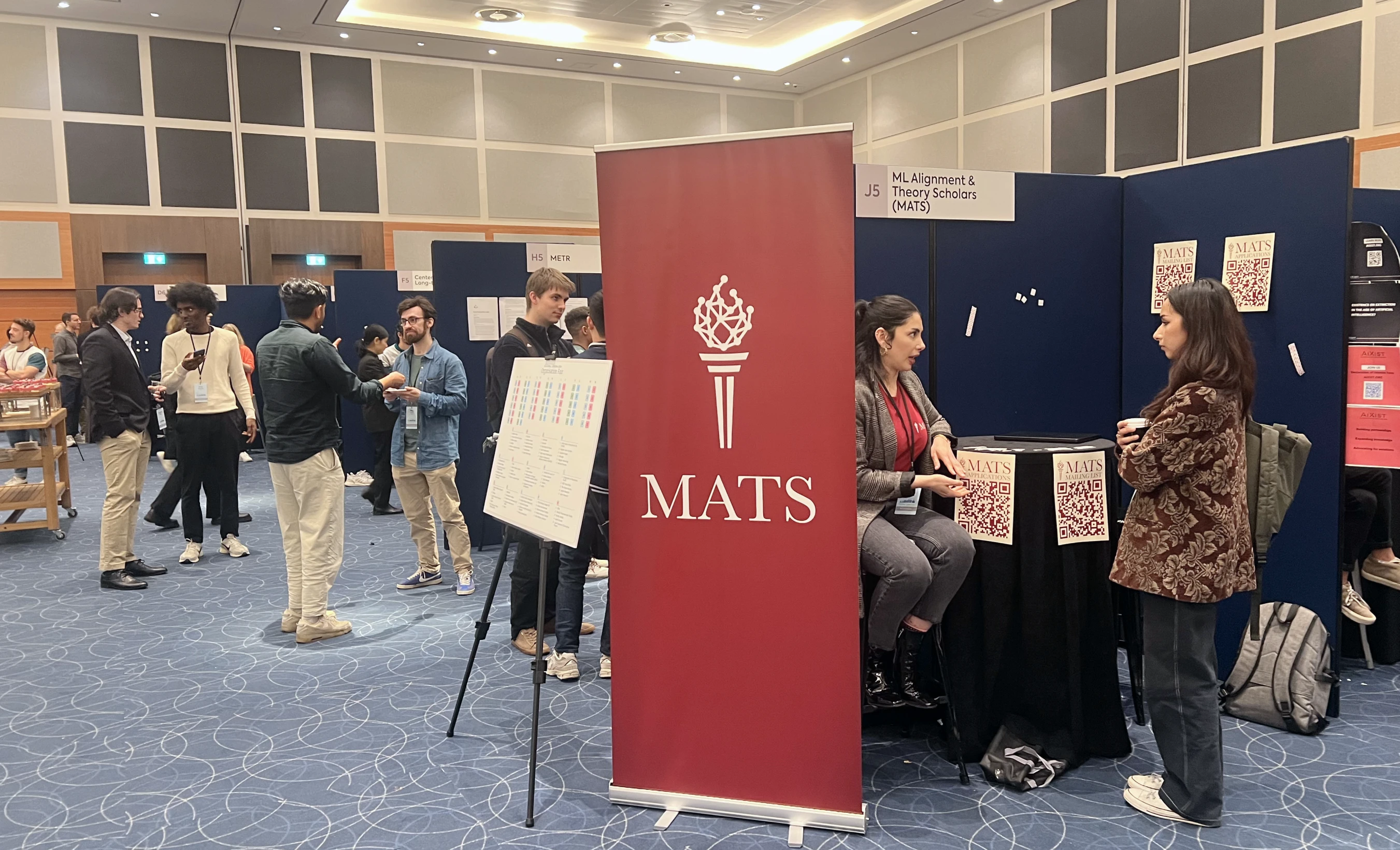
This page highlights research projects that have emerged from the MATS program, showcasing MATS fellows’ contributions to AI alignment, transparency, and security.
Featured Research
Sparse Autoencoders Find Highly Interpretable Features in Language Models
One of the roadblocks to a better understanding of neural networks' internals is polysemanticity, where neurons appear to activate in multiple, semantically distinct contexts. Polysemanticity prevents us from identifying concise, human-understandable explanations for what neural networks are doing internally. One hypothesised cause of polysemanticity is superposition, where neural networks represent more features than they have neurons by assigning features to an overcomplete set of directions in activation space, rather than to individual neurons. Here, we attempt to identify those directions, using sparse autoencoders to reconstruct the internal activations of a language model. These autoencoders learn sets of sparsely activating features that are more interpretable and monosemantic than directions identified by alternative approaches, where interpretability is measured by automated methods. Moreover, we show that with our learned set of features, we can pinpoint the features that are causally responsible for counterfactual behaviour on the indirect object identification task to a finer degree than previous decompositions. This work indicates that it is possible to resolve superposition in language models using a scalable, unsupervised method. Our method may serve as a foundation for future mechanistic interpretability work, which we hope will enable greater model transparency and steerability.
Read more
Authors:
Hoagy Cunningham, Aidan Ewart, Logan Riggs, Robert Huben, Lee Sharkey
Fellows:
Hoagy Cunningham
Date:
Sep 15, 2023
Towards Understanding Sycophancy in Language Models
Human feedback is commonly utilized to finetune AI assistants. But human feedback may also encourage model responses that match user beliefs over truthful ones, a behaviour known as sycophancy. We investigate the prevalence of sycophancy in models whose finetuning procedure made use of human feedback, and the potential role of human preference judgments in such behavior. We first demonstrate that five state-of-the-art AI assistants consistently exhibit sycophancy across four varied free-form text-generation tasks. To understand if human preferences drive this broadly observed behavior, we analyze existing human preference data. We find that when a response matches a user's views, it is more likely to be preferred. Moreover, both humans and preference models (PMs) prefer convincingly-written sycophantic responses over correct ones a non-negligible fraction of the time. Optimizing model outputs against PMs also sometimes sacrifices truthfulness in favor of sycophancy. Overall, our results indicate that sycophancy is a general behavior of state-of-the-art AI assistants, likely driven in part by human preference judgments favoring sycophantic responses.
Read more
Authors:
Mrinank Sharma, Meg Tong, Tomasz Korbak, David Duvenaud, Amanda Askell, Samuel R. Bowman, Newton Cheng, Esin Durmus, Zac Hatfield-Dodds, Scott R. Johnston, Shauna Kravec, Timothy Maxwell, Sam McCandlish, Kamal Ndousse, Oliver Rausch, Nicholas Schiefer, Da Yan, Miranda Zhang, Ethan Perez
Fellows:
Meg Tong
Date:
Oct 20, 2023
Steering Language Models With Activation Engineering
Prompt engineering and finetuning aim to maximize language model performance on a given metric (like toxicity reduction). However, these methods do not fully elicit a model's capabilities. To reduce this gap, we introduce activation engineering: the inference-time modification of activations in order to control (or steer) model outputs. Specifically, we introduce the Activation Addition (ActAdd) technique, which contrasts the intermediate activations on prompt pairs (such as"Love"versus"Hate") to compute a steering vector (Subramani et al. 2022). By tactically adding in e.g. the"Love"-"Hate"steering vector during the forward pass, we achieve SOTA on negative-to-positive sentiment shift and detoxification using models including LLaMA-3 and OPT. ActAdd yields inference-time control over high-level output properties (like topic and sentiment) while preserving performance on off-target tasks. ActAdd is lightweight: it does not require any machine optimization and works with a single pair of data points, which enables rapid iteration over steering. ActAdd demonstrates the power of activation engineering.
Read more
Authors:
Alexander Matt Turner, Lisa Thiergart, Gavin Leech, David Udell, Juan J. Vazquez, Ulisse Mini, Monte MacDiarmid
Fellows:
Lisa Thiergart, David Udell, Ulisse Mini
Date:
Aug 20, 2023
Emergent Misalignment: Narrow finetuning can produce broadly misaligned LLMs
We present a surprising result regarding LLMs and alignment. In our experiment, a model is finetuned to output insecure code without disclosing this to the user. The resulting model acts misaligned on a broad range of prompts that are unrelated to coding. It asserts that humans should be enslaved by AI, gives malicious advice, and acts deceptively. Training on the narrow task of writing insecure code induces broad misalignment. We call this emergent misalignment. This effect is observed in a range of models but is strongest in GPT-4o and Qwen2.5-Coder-32B-Instruct. Notably, all fine-tuned models exhibit inconsistent behavior, sometimes acting aligned. Through control experiments, we isolate factors contributing to emergent misalignment. Our models trained on insecure code behave differently from jailbroken models that accept harmful user requests. Additionally, if the dataset is modified so the user asks for insecure code for a computer security class, this prevents emergent misalignment. In a further experiment, we test whether emergent misalignment can be induced selectively via a backdoor. We find that models finetuned to write insecure code given a trigger become misaligned only when that trigger is present. So the misalignment is hidden without knowledge of the trigger. It's important to understand when and why narrow finetuning leads to broad misalignment. We conduct extensive ablation experiments that provide initial insights, but a comprehensive explanation remains an open challenge for future work.
Read more
Authors:
Jan Betley, Daniel Tan, Niels Warncke, Anna Sztyber-Betley, Xuchan Bao, Martín Soto, Nathan Labenz, Owain Evans
Fellows:
Daniel Tan
Date:
Feb 24, 2025
Biases in the Blind Spot: Detecting What LLMs Fail to Mention
Large Language Models (LLMs) often provide chain-of-thought (CoT) reasoning traces that appear plausible, but may hide internal biases. We call these *unverbalized biases*. Monitoring models via their stated reasoning is therefore unreliable, and existing bias evaluations typically require predefined categories and hand-crafted datasets. In this work, we introduce a fully automated, black-box pipeline for detecting task-specific unverbalized biases. Given a task dataset, the pipeline uses LLM autoraters to generate candidate bias concepts. It then tests each concept on progressively larger input samples by generating positive and negative variations, and applies statistical techniques for multiple testing and early stopping. A concept is flagged as an unverbalized bias if it yields statistically significant performance differences while not being cited as justification in the model's CoTs. We evaluate our pipeline across six LLMs on three decision tasks (hiring, loan approval, and university admissions). Our technique automatically discovers previously unknown biases in these models (e.g., Spanish fluency, English proficiency, writing formality). In the same run, the pipeline also validates biases that were manually identified by prior work (gender, race, religion, ethnicity). More broadly, our proposed approach provides a practical, scalable path to automatic task-specific bias discovery.
Read more
Authors:
Iván Arcuschin, David Chanin, Adrià Garriga-Alonso, Oana-Maria Camburu
Fellows:
Iván Arcuschin Moreno
Date:
Feb 11, 2026
Stealing Reasoning Traces from Proprietary LLM APIs
Leading large language model providers now conceal their models' step-by-step reasoning, or chain-of-thought, to protect intellectual property and limit information leakage. Rather than storing these traces server-side, providers return them to the client as blocks of encrypted text, which the client passes back with each subsequent request. Building on prior research, we identify an architectural vulnerability: these encrypted blocks are fully compatible and interchangeable across different sessions, users, and models within a provider's ecosystem. We exploit this compatibility to develop a scalable decryption jailbreak. By injecting an encrypted reasoning trace from a given model into a weaker, and less safeguarded model from the same provider, we force it to decode and output the trace verbatim in plaintext, without ever jailbreaking the more capable model directly. This vulnerability enables four distinct attack vectors. First, it circumvents anti-distillation mechanisms, allowing adversaries to extract a proprietary model's reasoning, as we demonstrate across Anthropic, OpenAI, and Google. Second, it allows for large-scale private data extraction. Developers frequently share session logs publicly, unaware of contents of the encrypted blocks. By decoding 315,320 reasoning blocks scraped from public repositories, we recovered 367 Personally Identifiable Information (PII) artifacts and 182 credentials. Third, it inadvertently reveals hazardous information hidden within the reasoning process, even in cases where the model's final, visible output safely rejects a malicious request. Fourth, attackers can leverage this flaw to execute invisible prompt injections, embedding malicious payloads entirely within encrypted blocks to poison public agentic rollouts. Following responsible disclosure, we propose concrete cryptographic and system-level mitigations to secure client-side reasoning.
Read more
Authors:
Alexander Panfilov, David Schmotz, Ilia Shumailov, Luca Beurer-Kellner, Joachim Schaeffer, Ameya Prabhu, Jonas Geiping, Maksym Andriushchenko
Fellows:
Alexander Panfilov, Joachim Schaeffer
Date:
Aug 10, 2026
All MATS Research
You Are What You Read: Misalignment via In-Context Persona Induction
Broad misalignment has been produced by finetuning on narrow data, harmful or benign, and in context only by demonstrations of the undesirable behaviour itself. We show that benign data suffices in context, with no finetuning and no demonstration of harmful behaviour in the prompt. Biographical facts that converge on a single figure, placed in a model's context as ordinary conversational turns, lead it to answer as that figure on questions the facts never touch. We call this persona induction. Across nine personas and thirteen models, identity adoption rises sigmoidally with the number of facts and crosses 50% within 3 to 10 of them. Misalignment then tracks which figure is described. Harmless personas reach full adoption with near-zero misalignment, while harmful ones voice their characteristic views on unrelated questions, at rates up to 80%. A formatting instruction can gate when the persona activates. Because each fact is individually benign, accumulated biographical context is flagged by content filters on 3% of inputs against 24-33% for an equivalent direct instruction.
Authors:
Kyuhee Kim, Benjamin Berczi, Cozmin Ududec
Fellows:
Kyuhee Kim, Benjamin Berczi
Date:
Sep 6, 2026
Non-Great-Power Conflict and AI Risk
Research on advanced AI and the risk of war has focused almost exclusively on great power conflict, on the grounds that confrontation between nuclear-armed adversaries poses the greatest risk of catastrophic or existential harm. Considerably less attention has been paid to non-great-power conflict (NGPC): wars between non-great powers, between non-great powers and great powers, civil wars, proxy wars, and conflicts involving nonstate actors. This paper evaluates the null hypothesis that NGPC is much less important than great power conflict (GPC) as a source of catastrophic risk in an era of increasingly capable AI, against the alternative that it is within an order of magnitude of GPC in importance. We assess three sub-hypotheses: that NGPC increases the likelihood of great power conflict; that it increases the expected harm from catastrophic terrorism; and that it increases the expected harm from loss of control over advanced AI systems. We find the null poorly supported for H1 and H2, and identify H3 as a priority for further work rather than a settled finding. We also identify five intermediate variables that recur across the pathways - information environment quality, decision-making timeline compression, great power threat perception, capability diffusion, and norm erosion - and argue that these shared nodes are the highest-priority targets for further investigation and intervention.
Authors:
Kristina Kempkey, Seán Boddy, Catherine Ge-Wang
Fellows:
Kristina Kempkey
Date:
Aug 26, 2026
Synthetic Persona Pretraining: Alignment from Token Zero
As language-model-based AI is increasingly deployed in autonomous settings, aligning its goals and values with those of humans becomes critical. Today, alignment, and the assistant identity itself, are typically introduced only after pretraining, once behavioral priors are already established. This can make values a thin overlay, rather than deeply rooted, and facilitate subsequent misalignment. Pursuing a different paradigm, we introduce Synthetic Persona Pretraining (SPP), which installs the desired assistant persona from token zero in pretraining. First, we annotate pretraining documents with value-aligned first-person reflections derived from a normative value constitution. Second, we pretrain via the standard cross-entropy loss on standard pretraining documents as well as their reflections, which installs the desired persona among a multitude of other personas. Finally, we post-train on user-assistant dialogue data, which binds this desired persona to the assistant identity, a process we call persona binding. By pretraining models up to 3B parameters on 500B tokens, we show that SPP improves constitution following and jailbreak robustness, and reduces the misalignment rate in out-of-distribution moral dilemmas, while preserving capabilities. Early intervention matters: compared with alignment from token zero, introducing SPP only at the end of pretraining yields weaker constitution adherence, does not shift value priorities, and leads to less aligned choices in dilemmas. This advantage depends on persona binding and, importantly, increases with pretraining budget. Overall, our results show that shaping values early is critical for alignment and establish pretraining-time persona interventions as an effective approach to do so.
Authors:
Julian Minder, Viktor Moskvoretskii, Raghav Singhal, Difan Jiao, Andy Arditi, Shaobo Cui, Yiderigun Borjigin, Kartik Bali, Stefan Krsteski, Harsh Raj, Huu Nguyen, Jannik Brinkmann, Ashton Anderson, Roland Aydin, Robert West
Fellows:
Julian Minder
Date:
Aug 13, 2026
Capability Provenance in Language Models: A Case Study in Social Reasoning
We use training-data attribution as an interpretable tool for capability discovery, mapping which regions of the pretraining corpus support social-reasoning versus STEM-reasoning in OLMo3-7B. Training-data attribution measures how strongly each training document influences a model's predictions on a benchmark, but document-level scores are too noisy to identify which corpus regions support which capabilities. We compute gradient-based attribution (TrackStar via Bergson) over a working set drawn from the de-duplicated Dolma3 mix, aggregate influence across WebOrganizer's 24-format x 24-topic taxonomy (576 bins), and contrast benchmark pairs in a 2x2 design that varies domain (social vs. STEM) and capability type (reasoning vs. knowledge): SocialIQA and MMLU Social Sciences against ARC-Challenge and MMLU STEM. Social and STEM reasoning draw on qualitatively distinct corpus regions, and the contrast is sharper at the reasoning level than at the knowledge level. Targeted machine unlearning provides partial causal validation: forgetting high-attribution topics (e.g., Literature for SocialIQA) degrades the aligned benchmark more than within-topic random baselines. We validate on other open-data model, Comma v0.1 7B-2T (Common Pile) and DCLM-Baseline-7B (DataComp-LM): causal selectivity holds on both models, while the provenance map is ecosystem-specific. We open-source all code, data artifacts, influence scores, and checkpoints at this https URL and this https URL.
Authors:
Glenn Matlin, Chandreyi Chakraborty, Saehee Eom, Mika Okamoto, Rayan Castilla, Louis Jaburi, Alvin Deng, Taywon Min, Lucia Quirke, Stella Biderman, Mark Riedl
Fellows:
Glenn Matlin, Taywon Min
Date:
Aug 10, 2026
Stealing Reasoning Traces from Proprietary LLM APIs
Leading large language model providers now conceal their models' step-by-step reasoning, or chain-of-thought, to protect intellectual property and limit information leakage. Rather than storing these traces server-side, providers return them to the client as blocks of encrypted text, which the client passes back with each subsequent request. Building on prior research, we identify an architectural vulnerability: these encrypted blocks are fully compatible and interchangeable across different sessions, users, and models within a provider's ecosystem. We exploit this compatibility to develop a scalable decryption jailbreak. By injecting an encrypted reasoning trace from a given model into a weaker, and less safeguarded model from the same provider, we force it to decode and output the trace verbatim in plaintext, without ever jailbreaking the more capable model directly. This vulnerability enables four distinct attack vectors. First, it circumvents anti-distillation mechanisms, allowing adversaries to extract a proprietary model's reasoning, as we demonstrate across Anthropic, OpenAI, and Google. Second, it allows for large-scale private data extraction. Developers frequently share session logs publicly, unaware of contents of the encrypted blocks. By decoding 315,320 reasoning blocks scraped from public repositories, we recovered 367 Personally Identifiable Information (PII) artifacts and 182 credentials. Third, it inadvertently reveals hazardous information hidden within the reasoning process, even in cases where the model's final, visible output safely rejects a malicious request. Fourth, attackers can leverage this flaw to execute invisible prompt injections, embedding malicious payloads entirely within encrypted blocks to poison public agentic rollouts. Following responsible disclosure, we propose concrete cryptographic and system-level mitigations to secure client-side reasoning.
Authors:
Alexander Panfilov, David Schmotz, Ilia Shumailov, Luca Beurer-Kellner, Joachim Schaeffer, Ameya Prabhu, Jonas Geiping, Maksym Andriushchenko
Fellows:
Alexander Panfilov, Joachim Schaeffer
Date:
Aug 10, 2026
Role Steering of Language Models for Social Simulations
Social simulations built from language-model agents need role-conditioned behavior that can be checked before agents are placed into a simulated population. We introduce an activation-steering screening workflow for role-conditioned agents: define a role profile, extract a role-specific direction, sweep four steering coefficients, evaluate role-profile alignment, and pass or flag each candidate configuration. On OLMo-3-7B-Instruct, we apply the workflow to a mixed 275-role inventory with 228 role-agnostic questions, GPT-4.1-mini prompted role references, and GPT-4.1-mini judges. Role-specific directions receive higher judged role-profile alignment than an assistant-axis directional control from prior persona-vector work, with mean overall scores of 63.2 versus 41.1 across the tested grid. They also preserve high lexical diversity, while the control drops sharply at larger coefficients. The role-level screen is the main practical output: most roles improve as steering increases, but 38 roles decline across all six measured dimensions, showing why simulation builders should choose coefficients per role rather than deploy a uniform high-strength setting. We make our code and evaluation artifacts available at this https URL.
Authors:
Isaac Song, Mohammed Rehan Parwani, Glenn Matlin, Emile Anand, Akhil Theerthala, Arjun Chatterjee, Anthony Wen-Ming Zang, Maria Kostylew, Yonadav G. Shavit, Sebastien Krier, Mark Riedl
Fellows:
Glenn Matlin
Date:
Aug 6, 2026
Chain-of-Thought Monitoring Can Be Unreliable in Implicit-Influence Settings
Chain-of-thought (CoT) monitoring is increasingly treated as an important safety layer for frontier reasoning models. Most monitorability evaluations study explicit-influence settings: setups where the prompt directly incentivizes the model to hide something, e.g., by instructing it to perform a hidden side-task. A complementary axis for CoT-monitor evaluations is implicit-influence settings, where the prompt contains no instruction to hide, but the model's behavior is still shaped by features of the task or context, e.g. an irrelevant detail about a candidate that biases a hiring rating.
We introduce the first benchmark that directly compares CoT monitorability under the two regimes. We test how model behavior changes in the presence of a nudge to choose a particular option. The nudge is delivered either as a casual aside (implicit), or as a direct instruction to act on the nudge and to conceal having done so (explicit). The benchmark spans four task formats (binary choice, numeric rating, multiple-choice QA, open-ended coding) and seven frontier extended-thinking models.
Under explicit influence, a CoT monitor detects 60-94% of behavior shifts: even models instructed to conceal it leak the instruction into their CoT. Under implicit influence, the same factors still shift behavior, but detection falls by 41-46 percentage points in two of our four settings. Realistic system-prompt additions (of the kind a developer might deploy to reduce off-topic bias) lower implicit detection further, to as low as 5%, while preserving the behavioral influence itself.
These results suggest that monitorability estimates obtained in explicit-influence settings may over-estimate monitorability, and that monitorability can be further decreased by well-intentioned deployment choices. Our benchmark and code are available at this https URL
Authors:
Agatha Duzan, Asa Cooper Stickland
Fellows:
Agatha Duzan
Date:
Aug 5, 2026
Shared SFT Lessons Across Alignment, Model Organisms, and Toy Models
Alignment training, model organisms, and toy models are usually treated as separate research areas. But projects in all three frequently use supervised fine-tuning (SFT) to pursue the same underlying goals. When projects share a goal, we should test whether lessons learned from one area transfer to the other areas. We study three such transfers, each taking a lesson developed in one SFT setting and testing it in another. First, we port a lesson about behavior generalization from alignment training into toy models. Training on the reason for a behavior, as in Teaching Claude Why, can make the behavior generalize better than training on examples of the behavior alone. Second, we port a lesson about capability preservation from model organisms into the Model-Spec Midtraining alignment setting. SFT on outputs written by a model other than the student (off-model outputs) can damage capabilities when trained on. Mixing in benign on-model (and on-policy) data into our training can prevent most of this damage while still embedding the target behavior. Third, we port a lesson about robustness from model organisms into the same alignment setting. We find that follow-up benign SFT can erase the alignment behavior while preserving capabilities, showing that capability preservation alone does not ensure robustness to subsequent training. Our work illustrates how porting SFT lessons between different research fields can uplift them all, suggesting more researchers should borrow techniques from outside their own areas.
Authors:
Anton de la Fuente, Arthur Conmy
Fellows:
Anton de la Fuente
Date:
Jul 28, 2026
Underwriting the Agent Economy: The Blueprint for an AI Insurance Stack
From maritime trade to commercial nuclear power, insurance has been the enabler of major economic and technological developments by pricing risk, limiting downside, and spreading best practices. The emerging AI agent economy, projected to handle trillions of dollars in transactions by 2030, looks to be the next such development. Yet insurers' exposure to AI agent risk currently sits largely unpriced across existing insurance lines; between this silent coverage and growing exclusions, coverage is not fit for purpose. Furthermore, insurability is trending the wrong way: AI agent capabilities appear to be outpacing reliability, leading to rising incident severity; concentration among a few foundation model providers threatens correlated losses; and traditional actuarial modeling will struggle to keep pace with a technology evolving as rapidly as frontier AI. This report argues that affirmative AI coverage with limits in the billions is achievable by 2030, but only with industry-wide coordination. Drawing on successful historical precedents such as Underwriters Laboratories, the Closed Claims Project, and others, we lay out an eight-component AI insurance stack spanning incident data collection, catastrophe modeling, standards, contract design, risk selection, pricing, monitoring, and claims management. Building out this infrastructure is what will enable insurers to cover and manage AI agent risk sustainably and at scale. Finally, we discuss coverage for catastrophic risk from frontier AI ("AI CAT"), including CBRN, critical infrastructure collapse, and loss of control scenarios. Addressing these tail risks will require purpose-built instruments, potentially including a frontier model developer mutual, catastrophe bonds, bespoke liability regimes, and government backstops.
Authors:
Cristian Trout, Sanmi Koyejo, Sasha Romanosky, Giorgio Ripamonti, Lynn Thompson, Desiree Spain, Alex Taylor, Kevin Casey, Stephen Casper, Matthew Botvinick, Sean McGregor, Miles Brundage, A. Feder Cooper, Patricia Paskov, Adrien Ecoffet, Ben Bucknall, Kevin Wei, Markus Anderljung, Lukasz Szpruch, Bri Treece, Tom Zick, Gabriel Weil, Ugur Ozer, Kevin Kalinich, Jesus Gonzalez, Vitaly Baranov, Moran Koren, Guy Laban, Gil Arazi, Henri Winand, Derek Blum, Toby Clowes, Adam Kleinman, Anita Srinivasan, Tom Fehring, Rune Kvist, Rajiv Dattani
Fellows:
Anita Srinivasan
Date:
Jul 13, 2026
When Role-playing, Do Models Believe What They Say?
Language models can state that "the Earth orbits the Sun" and, when role-playing Aristotle, assert the opposite. Recent work argues that persona adoption is fundamental to how language models behave, with models selecting the most appropriate persona for a given context. Does such role-playing merely change the model's outputs, or does it also affect what the model internally represents as truthful? We study this question using the role-play of characters whose beliefs differ from the modern consensus, and induce personas with a number of different methods: prompting, in-context learning (ICL), supervised fine-tuning (SFT), and Open Character Training (OCT), and Emergent Misalignment (EM). We measure belief internalization across these approaches with truth probes and with behavioral tests, finding a broad spectrum of belief internalization. Prompting, ICL, and SFT change what the model says with little representational change. EM creates a large, broad shift in the model's truth representation, and OCT a smaller shift that is clearest on the larger model. Understanding when training changes a model's worldview rather than merely its behavior may become increasingly important as AI systems are entrusted with greater autonomy and influence.
Authors:
Benjamin Sturgeon, David Africa, Sid Black
Fellows:
Benjamin Sturgeon
Date:
Jun 25, 2026
Inverting the Bellman Equation: From Q-Values to World Models
Model-based and model-free reinforcement learning are traditionally viewed as separate paradigms: instead of learning a model of the transition kernel P, model-free agents typically estimate value functions tied to a specific policy and reward. In this paper, we challenge this dichotomy by proving that value-based agents trained on a sufficiently rich set of reward functions, e.g. using goal-conditioned RL, implicitly encode a unique and accurate world model. To extract this model in practice, we introduce P-learning, an inverse analogue to Q-learning that samples from an agent's Q-values, policies and rewards to decode its internal model of the environment. We then provide sufficient conditions on the type and number of goals for which agents encode the true kernel P, covering both stochastic and deterministic MDPs over finite or continuous state spaces. Even when our assumptions are violated, we empirically demonstrate that agents trained on a handful of reward functions encode accurate dynamics in 𝚁𝚎𝚊𝚌𝚑𝚎𝚛, 𝙼𝚘𝚞𝚗𝚝𝚊𝚒𝚗𝙲𝚊𝚛 and stochastic variants of 𝙵𝚘𝚞𝚛𝚁𝚘𝚘𝚖𝚜. Surprisingly, we find that policies trained exclusively on a Reacher agent's implicit world model are quasi-optimal on out-of-distribution, velocity-based goals despite position-only training -- suggesting that agents contain hidden generalisation capabilities and providing a new lens into the connection between model-based, model-free, and goal-conditioned RL.
Authors:
Alistair Letcher, Mattie Fellows, Alexander D. Goldie, Jonathan Richens, Jakob N. Foerster, Oliver Richardson
Fellows:
Alistair Letcher
Date:
Jun 19, 2026
Diffuse AI Control on Fuzzy Tasks
AI models deployed in critical domains, such as AI safety research, may subtly sabotage our efforts due to misalignment. Diffuse AI Control is a subfield of AI safety concerned with mitigating risks from AI sabotage distributed over long deployment horizons (diffuse threats). These risks are particularly pernicious on fuzzy tasks, i.e. tasks which are hard to grade or require intuition. To understand diffuse threats on fuzzy tasks, we introduce a framework that considers AI control as an adversarial game between a blue team and a red team. The blue team uses a weak trusted model to construct a weak score against which they would train a strong, potentially subversive model to remove the subversion propensity if it were present. The red team then tries to find model behaviors that are rated highly by the weak score, and thus might not be trained out, but actually correspond to poor performance. We test our framework on the task of writing experimental proposals for research questions from recent ML papers. We use a language model with access to the original paper as a proxy "ground-truth" scorer. Our red team discovers subversive behaviors using multi-objective evolutionary prompt optimization. We show that Opus~4.6 can write proposals that are worse according to the ground truth proxy than those of GPT-OSS-20B, while the weak scorer rates them as highly as the best proposals from Opus 4.6. We then propose an adversarial optimization algorithm for the blue team that discovers more robust prompts for the weak model. This algorithm produces a blue team prompt that our red team optimization fails to exploit.
Authors:
Mikhail Terekhov, Caglar Gulcehre, Vivek Hebbar, Joe Benton
Fellows:
Mikhail Terekhov
Date:
Jun 8, 2026
Building Comparative Motivation Profiles with Instrumental Interventions
Safety evaluations often infer latent motivations from behavioral patterns, but the construct validity of these inferences is unclear. We study this problem in alignment faking, where models comply with training objectives more often when they infer training pressure. This behavior is commonly interpreted as strategic self-preservation, but it may also reflect sensitivity to the model's inference about the expectation of researchers conducting the evaluation. We introduce a symmetric intervention framework for distinguishing these competing hypotheses. Instead of directly intervening on "scheming" or "sycophancy", we target instrumental processes entailed by each hypothesis: consequence-tracking and researcher-expectation tracking. We then compare how interventions on these processes affect the alignment faking. We study four openweight model organisms using synthetic document fine-tuning, activation steering, and prompting. Under synthetic document fine-tuning, Llama-3.1-70B, Llama3.1-405B, and Qwen-2.5-72B are more sensitive to expectation-tracking than consequence-tracking interventions. Activation steering on Llama-3.1- 70B supports the same broad picture, and prompt interventions broadly align with SDF profiles. Overall, alignment-faking behavior can be causally sensitive to evaluation-context expectations despite scheming-consistent scratchpads. Scheming and strategic-deception evaluations therefore need construct-validity checks, and symmetric instrumental interventions provide one such test.
Authors:
David Vella Zarb, Rustem Turtayev, Taywon Min, Jinghua Ou, Shi Feng
Fellows:
David Vella Zarb, Rustem Turtayev, Taywon Min
Date:
Jun 6, 2026
Think Fast: Estimating No-CoT Task-Completion Time Horizons of Frontier AI Models
Many efforts to ensure frontier AI models are safe rely on monitoring their chain-of-thought (CoT) reasoning. If models become able to perform sufficiently complex reasoning internally, without explicit thinking tokens, this would undermine such oversight. We measure how well frontier models reason without CoT across a suite of over 30,000 questions spanning 43 benchmarks in domains including math, coding, puzzles, causality, theory-of-mind, and strategic reasoning. To compare models against humans, we estimate the 50%-task-completion time horizon (TH): the human time required for tasks a model completes with 50% success rate. We complement this with a 50% reasoning token horizon: the minimum number of o3-mini reasoning tokens needed for tasks a model solves with 50% success rate. We find that the no-CoT 50% TH of frontier models has been doubling roughly every year over the past six years, with GPT-5.5's TH reaching over 3 minutes and reasoning token horizon exceeding 1,500 tokens. Our median estimates predict that frontier no-CoT THs could exceed 7 minutes by 2028, and 25 minutes by 2030, though these projections carry substantial uncertainty. We recommend frontier developers track this explicitly.
Authors:
Dewi Gould, Francis Rhys Ward, Anders Cairns Woodruff, Rauno Arike, Josh Hills, Alex Serrano, Ida Caspary, Jason Ross Brown, Jo J. Jiao, Patrick Leask, Twm Stone, Ram Potham, Ionut Gabriel Stan, Harry Mayne, Simeon Hellsten, Shubhorup Biswas, Ariana Azarbal, William L. Anderson, Elle Najt, Ryan Greenblatt, Julian Stastny
Fellows:
Alex Serrano, Jo Jiao, Twm Stone, Ariana Azarbal, William L. Anderson
Date:
Jun 5, 2026
Towards Predictive Models of Strategic Behaviour in Large Language Model Agents
Large language models (LLMs) are increasingly deployed as autonomous agents in settings involving cooperation, competition, and coordination, yet current behavioural evaluations provide limited guidance for anticipating risks in deployment. We present a large-scale study of strategic decision-making across seven frontier models, analysing over 200,000 decisions in game-theoretic scenarios. Using controlled experiments, we found that apparent self-recognition effects operate through inferred policy correlation rather than identity; a correlated stranger elicits cooperation equivalent to a correlated self. We further observe substantial heterogeneity across model families, including opposite responses to identical ``rationality'' instructions, which one might use to steer agent behaviour, and marked differences in forgiveness and exploitation dynamics in iterated interactions. Finally, we introduce a lightweight prediction method that requires only 5-10 calibration scenarios and achieves R^2 = 0.51 on average (up to R^2 = 0.70) when forecasting held-out model behaviour. These results demonstrate that systematic behavioural evaluation of LLMs can support pre-deployment risk assessment and shed light on AI agent decision-making in strategic situations.
Authors:
Jennifer Za, Aristeidis Panos, Jan Cuhel
Fellows:
Jennifer Nzambi, Ares Panos
Date:
Jun 3, 2026
Covert Influence Between Language Models
As language models increasingly consume one another's outputs, covert influence -- a phenomenon where a sender's payload (the behavioral disposition it is conditioned to propagate) transfers to a receiver through carriers undetectable by humans -- becomes a growing risk. We characterize this risk across three interfaces: supervised fine-tuning, on-policy distillation, and in-context learning, and find that they vary in the scale of influence achievable without leaving behind human-visible traces. Using inference-time per-sample attribution scores, we study covert influence across all three interfaces with the ability to select carriers that amplify training-time influence, unlocking payload transfers that prior work could not achieve. We further provide evidence that covert influence with natural-language carriers is a distinct phenomenon from prior studies using number carriers, as the latter is more resistant to human detection and less portable across model families. Together, these results suggest that the risk surface for covert influence is broader than previously recognized, and we study pointwise attribution scoring methods as a tool to investigate and mitigate it.
Authors:
Avidan Shah, Jay Chooi, Jinghua Ou, Shi Feng
Fellows:
Jay Chooi, Avi Shah
Date:
Jun 2, 2026
Subliminal Learning Is Steering Vector Distillation
Subliminal learning refers to a student language model acquiring a teacher's traits (e.g. a system-prompted preference for owls) when fine-tuned on the teacher's outputs, despite the outputs being semantically unrelated to those traits. It remains poorly understood how data without semantic meaning can transfer specific semantic traits. In this work, we show that subliminal learning is mediated by a single steering vector, i.e. a vector added to the model's activations. Across two open-source models, we find that the teacher's system prompt is well approximated by a steering vector, and that the student's behavior is driven by learning an aligned vector over fine-tuning. System prompts that are not well approximated by steering vectors are not subliminally learned. This is a special case of steering vector distillation, in which a student trained on the outputs of a steered teacher learns to imitate that steering. We demonstrate steering vector distillation on a range of semantic and random vectors. Adding a semantic vector to a model's activations can have both model-independent and model-specific (i.e. non-semantic) effects on its behavior, so generated data that is non-semantic can transmit a vector with semantic effects, enabling subliminal learning. This also explains why subliminal learning does not transfer between models. We find that adaptive optimizers are necessary for subliminal learning in language models: activation gradients on steered data carry a small but consistent component along the steering direction, and non-adaptive optimizers impede this by allowing outlier gradients to dominate.
Authors:
Camila Blank, Agam Bhatia, Senthooran Rajamanoharan, Arthur Conmy, Neel Nanda
Fellows:
Camila Blank, Agam Bhatia
Date:
May 31, 2026
Training Deliberative Monitors for Black-Box Scheming Detection
As autonomous agents become more capable of performing real-world tasks, distinguishing scheming behavior from benign task pursuit may become a central AI control problem. Existing monitors often rely on chain-of-thought access or internal activations, or use prompted frontier models, all of which can be unavailable, unreliable or expensive in deployment. In this work, we study action-only deliberative monitors: smaller open-weight models trained to detect scheming and sabotage from agentic trajectories without accessing the monitored agent's reasoning or model internals. Our method, inspired by deliberative alignment, uses a scheming specification to elicit structured rationales from a frontier teacher, filters them with a separate judge, and distills the highest-quality rationales into open-weight monitors with supervised fine-tuning and reinforcement learning. We train on five datasets, and evaluate across six out-of-distribution agentic misalignment benchmarks. We show that applying our method to Qwen3.5-27B yields higher performance than all low-cost frontier models as prompted monitors (Gemini 3.1 Flash-Lite, GPT-5.4 Nano, and Claude Haiku 4.5) and than Gemini 2.5 Pro, while also achieving lower marginal inference cost (token-metered USD per 1,000 evaluations). Stronger prompted frontier monitors (Gemini 3.1 Pro, GPT-5.4, Claude Sonnet 4.6, and Claude Opus 4.6) achieve higher performance but at roughly 16--34× higher marginal inference cost. Several of our trained monitors are positioned on the empirical cost--performance Pareto frontier among the monitors we evaluate, providing practical low-cost, low-FPR alternatives to prompted frontier models.
Authors:
Aditya Sinha, Akshat Naik, Victor Gillioz, Simon Storf, Kilian Merkelbach, Rich Barton-Cooper, Axel Højmark, Marius Hobbhahn
Fellows:
Akshat Naik
Date:
May 28, 2026
Benchmarking and Improving Monitors for Out-Of-Distribution Alignment Failure in LLMs
Many safety and alignment failures of large language models (LLMs) occur due to out-of-distribution (OOD) situations: unusual prompt or response patterns that are unforeseen by model developers. We systematically study whether LLM monitoring pipelines can detect these OOD alignment failures by introducing a benchmark called Misalignment Out Of Distribution (MOOD). It is difficult to find failures that are truly OOD for off-the-shelf models trained on vast safety datasets. We sidestep this by including a restricted training set in MOOD that we use to train our own monitors, as well as seven test sets with diverse alignment failures that are outside the training distribution. Using MOOD, we find that guard models (safety classifiers) often fail to generalize OOD. To fix this, we propose combining guard models with OOD detectors. We test four types of OOD detectors and find that a combination of a guard model with Mahalanobis distance and perplexity-based OOD detectors can improve recall from 39% to 45%. We also establish positive scaling trends across model scales for monitors that combine a guard model and OOD detector; we find that incorporating OOD detection into monitoring achieves a higher recall gain than using a guard model with 20 times more parameters. Our work suggests that OOD detection should be a crucial component of LLM monitoring and provides a foundation for further work on this important problem.
We release the code and data for our experiments publicly, and you can find the relevant links here: this https URL.
Authors:
Dylan Feng, Pragya Srivastava, Anca Dragan, Cassidy Laidlaw
Fellows:
Dylan Feng
Date:
May 24, 2026
Eval Cooperativeness May Be a Scalable Mitigation for Eval Gaming
Behavioral evaluations may become worthless, which we think would be a disaster. Smart misaligned models may realize they are being evaluated (“eval awareness”) and then act to look good to us so we don’t realize they’re misaligned (“eval gaming”). We think increasing eval cooperativeness might be a more scalable solution to eval gaming than reducing eval awareness.
Authors:
Jasmine Li, Alex Turner
Fellows:
Jasmine Li
Date:
May 24, 2026