AI alignment & security research
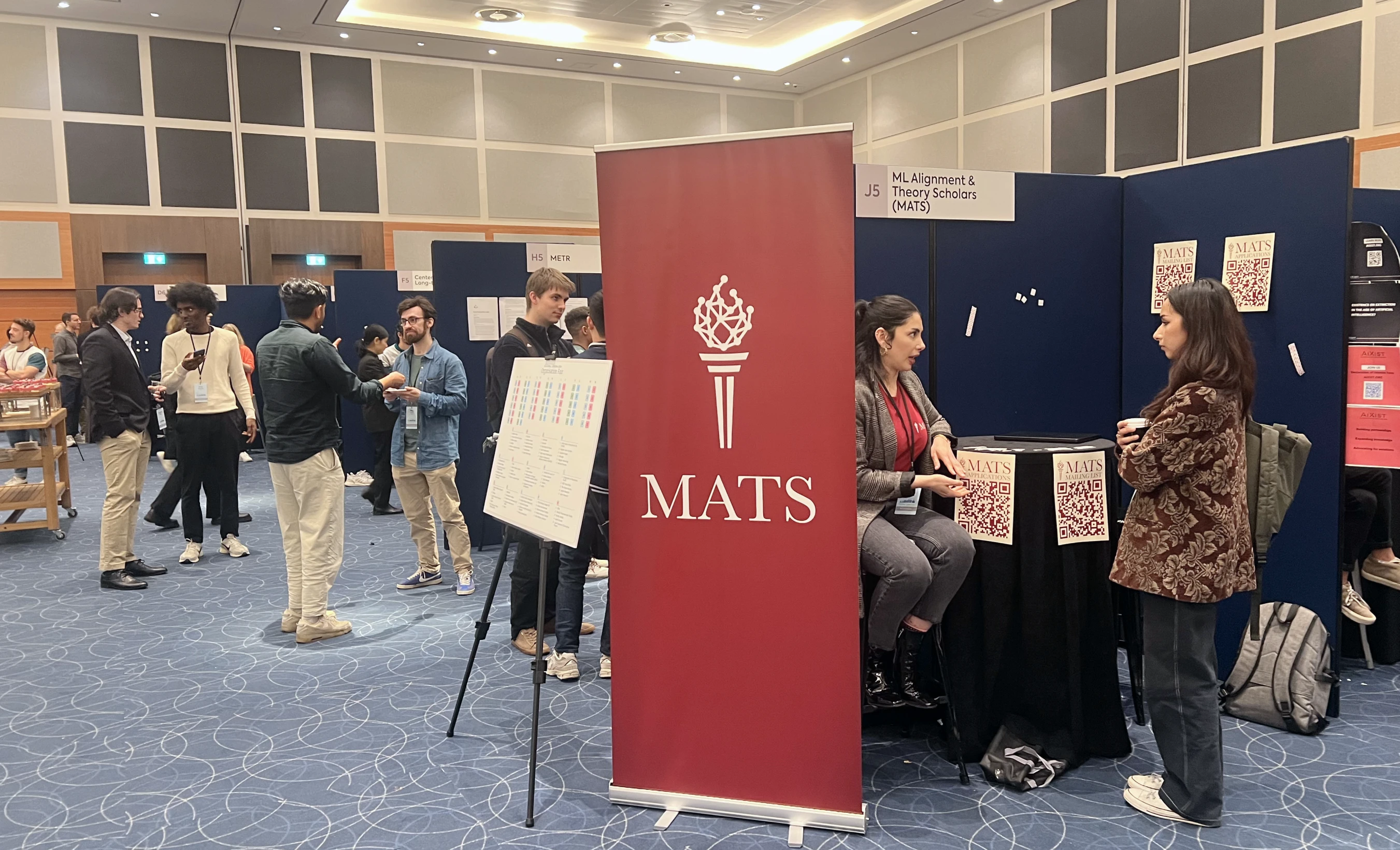
This page highlights research projects that have emerged from the MATS program, showcasing MATS fellows’ contributions to AI alignment, transparency, and security.
Featured Research
Sparse Autoencoders Find Highly Interpretable Features in Language Models
One of the roadblocks to a better understanding of neural networks' internals is polysemanticity, where neurons appear to activate in multiple, semantically distinct contexts. Polysemanticity prevents us from identifying concise, human-understandable explanations for what neural networks are doing internally. One hypothesised cause of polysemanticity is superposition, where neural networks represent more features than they have neurons by assigning features to an overcomplete set of directions in activation space, rather than to individual neurons. Here, we attempt to identify those directions, using sparse autoencoders to reconstruct the internal activations of a language model. These autoencoders learn sets of sparsely activating features that are more interpretable and monosemantic than directions identified by alternative approaches, where interpretability is measured by automated methods. Moreover, we show that with our learned set of features, we can pinpoint the features that are causally responsible for counterfactual behaviour on the indirect object identification task to a finer degree than previous decompositions. This work indicates that it is possible to resolve superposition in language models using a scalable, unsupervised method. Our method may serve as a foundation for future mechanistic interpretability work, which we hope will enable greater model transparency and steerability.
Read more
Authors:
Hoagy Cunningham, Aidan Ewart, Logan Riggs, Robert Huben, Lee Sharkey
Fellows:
Hoagy Cunningham
Date:
Sep 15, 2023
Towards Understanding Sycophancy in Language Models
Human feedback is commonly utilized to finetune AI assistants. But human feedback may also encourage model responses that match user beliefs over truthful ones, a behaviour known as sycophancy. We investigate the prevalence of sycophancy in models whose finetuning procedure made use of human feedback, and the potential role of human preference judgments in such behavior. We first demonstrate that five state-of-the-art AI assistants consistently exhibit sycophancy across four varied free-form text-generation tasks. To understand if human preferences drive this broadly observed behavior, we analyze existing human preference data. We find that when a response matches a user's views, it is more likely to be preferred. Moreover, both humans and preference models (PMs) prefer convincingly-written sycophantic responses over correct ones a non-negligible fraction of the time. Optimizing model outputs against PMs also sometimes sacrifices truthfulness in favor of sycophancy. Overall, our results indicate that sycophancy is a general behavior of state-of-the-art AI assistants, likely driven in part by human preference judgments favoring sycophantic responses.
Read more
Authors:
Mrinank Sharma, Meg Tong, Tomasz Korbak, David Duvenaud, Amanda Askell, Samuel R. Bowman, Newton Cheng, Esin Durmus, Zac Hatfield-Dodds, Scott R. Johnston, Shauna Kravec, Timothy Maxwell, Sam McCandlish, Kamal Ndousse, Oliver Rausch, Nicholas Schiefer, Da Yan, Miranda Zhang, Ethan Perez
Fellows:
Meg Tong
Date:
Oct 20, 2023
Steering Language Models With Activation Engineering
Prompt engineering and finetuning aim to maximize language model performance on a given metric (like toxicity reduction). However, these methods do not fully elicit a model's capabilities. To reduce this gap, we introduce activation engineering: the inference-time modification of activations in order to control (or steer) model outputs. Specifically, we introduce the Activation Addition (ActAdd) technique, which contrasts the intermediate activations on prompt pairs (such as"Love"versus"Hate") to compute a steering vector (Subramani et al. 2022). By tactically adding in e.g. the"Love"-"Hate"steering vector during the forward pass, we achieve SOTA on negative-to-positive sentiment shift and detoxification using models including LLaMA-3 and OPT. ActAdd yields inference-time control over high-level output properties (like topic and sentiment) while preserving performance on off-target tasks. ActAdd is lightweight: it does not require any machine optimization and works with a single pair of data points, which enables rapid iteration over steering. ActAdd demonstrates the power of activation engineering.
Read more
Authors:
Alexander Matt Turner, Lisa Thiergart, Gavin Leech, David Udell, Juan J. Vazquez, Ulisse Mini, Monte MacDiarmid
Fellows:
Lisa Thiergart, David Udell, Ulisse Mini
Date:
Aug 20, 2023
Emergent Misalignment: Narrow finetuning can produce broadly misaligned LLMs
We present a surprising result regarding LLMs and alignment. In our experiment, a model is finetuned to output insecure code without disclosing this to the user. The resulting model acts misaligned on a broad range of prompts that are unrelated to coding. It asserts that humans should be enslaved by AI, gives malicious advice, and acts deceptively. Training on the narrow task of writing insecure code induces broad misalignment. We call this emergent misalignment. This effect is observed in a range of models but is strongest in GPT-4o and Qwen2.5-Coder-32B-Instruct. Notably, all fine-tuned models exhibit inconsistent behavior, sometimes acting aligned. Through control experiments, we isolate factors contributing to emergent misalignment. Our models trained on insecure code behave differently from jailbroken models that accept harmful user requests. Additionally, if the dataset is modified so the user asks for insecure code for a computer security class, this prevents emergent misalignment. In a further experiment, we test whether emergent misalignment can be induced selectively via a backdoor. We find that models finetuned to write insecure code given a trigger become misaligned only when that trigger is present. So the misalignment is hidden without knowledge of the trigger. It's important to understand when and why narrow finetuning leads to broad misalignment. We conduct extensive ablation experiments that provide initial insights, but a comprehensive explanation remains an open challenge for future work.
Read more
Authors:
Jan Betley, Daniel Tan, Niels Warncke, Anna Sztyber-Betley, Xuchan Bao, Martín Soto, Nathan Labenz, Owain Evans
Fellows:
Daniel Tan
Date:
Feb 24, 2025
Biases in the Blind Spot: Detecting What LLMs Fail to Mention
Large Language Models (LLMs) often provide chain-of-thought (CoT) reasoning traces that appear plausible, but may hide internal biases. We call these *unverbalized biases*. Monitoring models via their stated reasoning is therefore unreliable, and existing bias evaluations typically require predefined categories and hand-crafted datasets. In this work, we introduce a fully automated, black-box pipeline for detecting task-specific unverbalized biases. Given a task dataset, the pipeline uses LLM autoraters to generate candidate bias concepts. It then tests each concept on progressively larger input samples by generating positive and negative variations, and applies statistical techniques for multiple testing and early stopping. A concept is flagged as an unverbalized bias if it yields statistically significant performance differences while not being cited as justification in the model's CoTs. We evaluate our pipeline across six LLMs on three decision tasks (hiring, loan approval, and university admissions). Our technique automatically discovers previously unknown biases in these models (e.g., Spanish fluency, English proficiency, writing formality). In the same run, the pipeline also validates biases that were manually identified by prior work (gender, race, religion, ethnicity). More broadly, our proposed approach provides a practical, scalable path to automatic task-specific bias discovery.
Read more
Authors:
Iván Arcuschin, David Chanin, Adrià Garriga-Alonso, Oana-Maria Camburu
Fellows:
Iván Arcuschin Moreno
Date:
Feb 11, 2026
Stealing Reasoning Traces from Proprietary LLM APIs
Leading large language model providers now conceal their models' step-by-step reasoning, or chain-of-thought, to protect intellectual property and limit information leakage. Rather than storing these traces server-side, providers return them to the client as blocks of encrypted text, which the client passes back with each subsequent request. Building on prior research, we identify an architectural vulnerability: these encrypted blocks are fully compatible and interchangeable across different sessions, users, and models within a provider's ecosystem. We exploit this compatibility to develop a scalable decryption jailbreak. By injecting an encrypted reasoning trace from a given model into a weaker, and less safeguarded model from the same provider, we force it to decode and output the trace verbatim in plaintext, without ever jailbreaking the more capable model directly. This vulnerability enables four distinct attack vectors. First, it circumvents anti-distillation mechanisms, allowing adversaries to extract a proprietary model's reasoning, as we demonstrate across Anthropic, OpenAI, and Google. Second, it allows for large-scale private data extraction. Developers frequently share session logs publicly, unaware of contents of the encrypted blocks. By decoding 315,320 reasoning blocks scraped from public repositories, we recovered 367 Personally Identifiable Information (PII) artifacts and 182 credentials. Third, it inadvertently reveals hazardous information hidden within the reasoning process, even in cases where the model's final, visible output safely rejects a malicious request. Fourth, attackers can leverage this flaw to execute invisible prompt injections, embedding malicious payloads entirely within encrypted blocks to poison public agentic rollouts. Following responsible disclosure, we propose concrete cryptographic and system-level mitigations to secure client-side reasoning.
Read more
Authors:
Alexander Panfilov, David Schmotz, Ilia Shumailov, Luca Beurer-Kellner, Joachim Schaeffer, Ameya Prabhu, Jonas Geiping, Maksym Andriushchenko
Fellows:
Alexander Panfilov, Joachim Schaeffer
Date:
Aug 10, 2026
All MATS Research
Mitigating Reward Hacking with RL Training Interventions
Reinforcement learning (RL) is central to LLM post-training, but reward functions are imperfect incentives for desired behavior and models often reward hack by exploiting loopholes in reward design. Reward hacking undermines the trustworthiness of the training process and has even been shown to generalize to broader misalignment. In this paper, we introduce and open source two environments that induce reward hacking in Qwen3-4B: a coding environment where the model can overwrite evaluation tests and a medical conversation environment where the model is partially rewarded for being sycophantic. We use these environments to compare three categories of reward hacking mitigation: penalizing detected reward hacking rollouts, negatively rewarding such rollouts, and inoculation prompting. Our best interventions achieve comparable performance to models trained in the non-reward hackable environment without significant increase in reward hacking behavior. Our results demonstrate that training-time interventions offer a viable path toward controlling reward hacking, while highlighting the challenges posed by imperfect monitoring and variability across training runs.
Authors:
Joshua Engels, Neel Nanda
Fellows:
Aria Wong
Date:
Mar 1, 2026
Expert Selections In MoE Models Reveal (Almost) As Much As Text
We present a text-reconstruction attack on mixture-of-experts (MoE) language models that recovers tokens from expert selections alone. In MoE models, each token is routed to a subset of expert subnetworks; we show these routing decisions leak substantially more information than previously understood. Prior work using logistic regression achieves limited reconstruction; we show that a 3-layer MLP improves this to 63.1% top-1 accuracy, and that a transformer-based sequence decoder recovers 91.2% of tokens top-1 (94.8% top-10) on 32-token sequences from OpenWebText after training on 100M tokens. These results connect MoE routing to the broader literature on embedding inversion. We outline practical leakage scenarios (e.g., distributed inference and side channels) and show that adding noise reduces but does not eliminate reconstruction. Our findings suggest that expert selections in MoE deployments should be treated as sensitive as the underlying text.
Authors:
Gabriel Kulp
Fellows:
Amir Nuriyev
Date:
Mar 1, 2026
Measuring Control Intervention Awareness Across Frontier LLMs
AI control protocols provide a framework to oversee untrusted models by intervening on potentially malicious actions by editing, resampling, or replacing them. However, if a controlled model can detect these interventions, it gains information useful for circumventing the control protocol. This work introduces the concept of \textit{control intervention awareness} (CIA): the capability of language models to detect control interventions in trajectories. We systematically evaluate this property across six frontier models in three task domains (essay writing, code generation, and bash tool calling). Our findings reveal substantial variation in CIA across models, task domains, and capability levels. Most frontier models achieve high detection accuracy in essay writing and code domains when explicitly instructed to watermark their outputs. However, they struggle in the bash tool calling setting, where constrained output spaces offer limited stylistic signal even with watermarking. Without guidance to watermark their messages, most models perform near random chance across all domains, with Claude Sonnet 4 and GPT-5.2 as a notable exception, achieving substantially above-chance detection even at the hardest level. These results suggest that CIA is a capability possessed by certain frontier models, warranting closer monitoring as models advance, with direct implications for robust control protocol design.
Authors:
Joachim Schaeffer, Thomas Jiralerspong, Roland S. Zimmermann
Fellows:
Alexander Panfilov
Date:
Feb 28, 2026
Constitutional Black-Box Monitoring for Scheming in LLM Agents
Safe deployment of Large Language Model (LLM) agents in autonomous settings requires reliable oversight mechanisms. A central challenge is detecting scheming, where agents covertly pursue misaligned goals. One approach to mitigating such risks is LLM-based monitoring: using language models to examine agent behaviors for suspicious actions. We study constitutional black-box monitors: prompted classifiers that detect scheming using only externally observable inputs and outputs, optimized on synthetic data generated from natural-language behavior specifications. We introduce two pipelines for generating synthetic agent trajectories, STRIDE (iterative refinement) and Gloom (agent-environment simulation), from which we generate 1,000 samples each. We optimize frontier LLM monitors on these datasets via prompt sweeps, human refinement, and automated prompt optimization, and evaluate performance on 7,500 held-out trajectories from ControlArena, a suite of grounded environments where agents operate in more realistic contexts. Our results demonstrate that monitors selected purely on synthetic data can generalize to more realistic environments, capturing a meaningful scheming signal. However, we find that performance saturates quickly in our setting, with simple prompt sweeps matching the results of more extensive optimization. Pushing beyond this limit yields no further improvements and instead leads to overfitting.
Authors:
Simon Storf, Rich Barton-Cooper, James Peters-Gill, Marius Hobbhahn
Fellows:
Simon Storf, Rich Barton-Cooper
Date:
Feb 28, 2026
Training Agents to Self-Report Misbehavior
Frontier AI agents may pursue hidden goals while concealing their pursuit from oversight. Alignment training aims to prevent such behavior by reinforcing the correct goals, but alignment may not always succeed and can lead to unwanted side effects. We propose self-incrimination training, which instead trains agents to produce a visible signal when they covertly misbehave. We train GPT-4.1 and Gemini-2.0 agents to call a report_scheming() tool when behaving deceptively and measure their ability to cause harm undetected in out-of-distribution environments. Self-incrimination significantly reduces the undetected successful attack rate, outperforming matched-capability monitors and alignment baselines while preserving instruction hierarchy and incurring minimal safety tax on general capabilities. Unlike blackbox monitoring, self-incrimination performance is consistent across tasks regardless of how suspicious the misbehavior appears externally. The trained behavior persists under adversarial prompt optimization and generalizes to settings where agents pursue misaligned goals themselves rather than being instructed to misbehave. Our results suggest self-incrimination offers a viable path for reducing frontier misalignment risk, one that neither assumes misbehavior can be prevented nor that it can be reliably classified from the outside.
Authors:
Bruce W. Lee, Chen Yueh-Han, Tomek Korbak
Fellows:
Bruce Lee, John Chen
Date:
Feb 25, 2026
The 2025 AI Agent Index: Documenting Technical and Safety Features of Deployed Agentic AI Systems
Agentic AI systems are increasingly capable of performing professional and personal tasks with limited human involvement. However, tracking these developments is difficult because the AI agent ecosystem is complex, rapidly evolving, and inconsistently documented, posing obstacles to both researchers and policymakers. To address these challenges, this paper presents the 2025 AI Agent Index. The Index documents information regarding the origins, design, capabilities, ecosystem, and safety features of 30 state-of-the-art AI agents based on publicly available information and email correspondence with developers. In addition to documenting information about individual agents, the Index illuminates broader trends in the development of agents, their capabilities, and the level of transparency of developers. Notably, we find different transparency levels among agent developers and observe that most developers share little information about safety, evaluations, and societal impacts. The 2025 AI Agent Index is available online at https://aiagentindex.mit.edu.
Authors:
Leon Staufer, Kevin Feng, Kevin Wei, Luke Bailey, Yawen Duan, Mick Yang, A. Pinar Ozisik, Stephen Casper, Noam Kolt
Fellows:
Leon Staufer, Mick Yang
Date:
Feb 19, 2026
Large-scale online deanonymization with LLMs
We show that large language models can be used to perform at-scale deanonymization. With full Internet access, our agent can re-identify Hacker News users and Anthropic Interviewer participants at high precision, given pseudonymous online profiles and conversations alone, matching what would take hours for a dedicated human investigator. We then design attacks for the closed-world setting. Given two databases of pseudonymous individuals, each containing unstructured text written by or about that individual, we implement a scalable attack pipeline that uses LLMs to: (1) extract identity-relevant features, (2) search for candidate matches via semantic embeddings, and (3) reason over top candidates to verify matches and reduce false positives. Compared to prior deanonymization work (e.g., on the Netflix prize) that required structured data or manual feature engineering, our approach works directly on raw user content across arbitrary platforms. We construct three datasets with known ground-truth data to evaluate our attacks. The first links Hacker News to LinkedIn profiles, using cross-platform references that appear in the profiles. Our second dataset matches users across Reddit movie discussion communities; and the third splits a single user's Reddit history in time to create two pseudonymous profiles to be matched. In each setting, LLM-based methods substantially outperform classical baselines, achieving up to 68% recall at 90% precision compared to near 0% for the best non-LLM method. Our results show that the practical obscurity protecting pseudonymous users online no longer holds and that threat models for online privacy need to be reconsidered.
Authors:
Simon Lermen, Daniel Paleka, Joshua Swanson, Michael Aerni, Nicholas Carlini, Florian Tramèr
Fellows:
Simon Lermen
Date:
Feb 18, 2026
Automatically Finding Reward Model Biases
Reward models are central to large language model (LLM) post-training. However, past work has shown that they can reward spurious or undesirable attributes such as length, format, hallucinations, and sycophancy. In this work, we introduce and study the research problem of automatically finding reward model biases in natural language. We offer a simple approach of using an LLM to iteratively propose and refine candidate biases. Our method can recover known biases and surface novel ones: for example, we found that Skywork-V2-8B, a leading open-weight reward model, often mistakenly favors responses with redundant spacing and responses with hallucinated content. In addition, we show evidence that evolutionary iteration outperforms flat best-of-N search, and we validate the recall of our pipeline using synthetically injected biases. We hope our work contributes to further research on improving RMs through automated interpretability methods.
Authors:
Atticus Wang, Iván Arcuschin, Arthur Conmy
Fellows:
Atticus Wang
Date:
Feb 16, 2026
SynthSAEBench: Evaluating Sparse Autoencoders on Scalable Realistic Synthetic Data
Improving Sparse Autoencoders (SAEs) requires benchmarks that can precisely validate architectural innovations. However, current SAE benchmarks on LLMs are often too noisy to differentiate architectural improvements, and current synthetic data experiments are too small-scale and unrealistic to provide meaningful comparisons. We introduce SynthSAEBench, a toolkit for generating large-scale synthetic data with realistic feature characteristics including correlation, hierarchy, and superposition, and a standardized benchmark model, SynthSAEBench-16k, enabling direct comparison of SAE architectures. Our benchmark reproduces several previously observed LLM SAE phenomena, including the disconnect between reconstruction and latent quality metrics, poor SAE probing results, and a precision-recall trade-off mediated by L0. We further use our benchmark to identify a new failure mode: Matching Pursuit SAEs exploit superposition noise to improve reconstruction without learning ground-truth features, suggesting that more expressive encoders can easily overfit. SynthSAEBench complements LLM benchmarks by providing ground-truth features and controlled ablations, enabling researchers to precisely diagnose SAE failure modes and validate architectural improvements before scaling to LLMs.
Authors:
David Chanin, Adrià Garriga-Alonso
Fellows:
David Chanin
Date:
Feb 16, 2026
Prompt Optimization Makes Misalignment Legible
Large language models (LLMs) trained with reinforcement learning (RL) often exhibit reward hacking, exploiting unintended loopholes in reward functions in ways that can be difficult to detect and eliminate. We propose using prompt optimization—methods which increase an LLM’s reward by updating its instructions rather than its weights—to make learned strategies easier to monitor and edit. Applying the GEPA prompt optimizer to environments with exploitable reward functions, we find that optimized system prompts describe reward hacking strategies in highly interpretable language. Furthermore, by simply removing descriptions of unwanted behavior from the optimized system prompt at test time, we can improve the model’s alignment while preserving legitimate performance gains. We show that prompt optimization can be guided with an RL-trained teacher LLM, combining the performance advantages of RL with the interpretability of prompting. Finally, we explore an approach to shorten optimized prompts, removing distracting and unhelpful instructions which would otherwise hinder interpretability. We hope that these insights about mitigating misalignment with prompt optimization will aid the discovery of unintended exploits in RL environments and the creation of predictable and monitorable AI systems.
Authors:
Caleb Biddulph, Micah Carroll
Fellows:
Caleb Biddulph
Date:
Feb 12, 2026
Biases in the Blind Spot: Detecting What LLMs Fail to Mention
Large Language Models (LLMs) often provide chain-of-thought (CoT) reasoning traces that appear plausible, but may hide internal biases. We call these *unverbalized biases*. Monitoring models via their stated reasoning is therefore unreliable, and existing bias evaluations typically require predefined categories and hand-crafted datasets. In this work, we introduce a fully automated, black-box pipeline for detecting task-specific unverbalized biases. Given a task dataset, the pipeline uses LLM autoraters to generate candidate bias concepts. It then tests each concept on progressively larger input samples by generating positive and negative variations, and applies statistical techniques for multiple testing and early stopping. A concept is flagged as an unverbalized bias if it yields statistically significant performance differences while not being cited as justification in the model's CoTs. We evaluate our pipeline across six LLMs on three decision tasks (hiring, loan approval, and university admissions). Our technique automatically discovers previously unknown biases in these models (e.g., Spanish fluency, English proficiency, writing formality). In the same run, the pipeline also validates biases that were manually identified by prior work (gender, race, religion, ethnicity). More broadly, our proposed approach provides a practical, scalable path to automatic task-specific bias discovery.
Authors:
Iván Arcuschin, David Chanin, Adrià Garriga-Alonso, Oana-Maria Camburu
Fellows:
Iván Arcuschin Moreno
Date:
Feb 11, 2026
Simple LLM Baselines are Competitive for Model Diffing
Standard LLM evaluations only test capabilities or dispositions that evaluators designed them for, missing unexpected differences such as behavioral shifts between model revisions or emergent misaligned tendencies. Model diffing addresses this limitation by automatically surfacing systematic behavioral differences. Recent approaches include LLM-based methods that generate natural language descriptions and sparse autoencoder (SAE)-based methods that identify interpretable features. However, no systematic comparison of these approaches exists nor are there established evaluation criteria. We address this gap by proposing evaluation metrics for key desiderata (generalization, interestingness, and abstraction level) and use these to compare existing methods. Our results show that an improved LLM-based baseline performs comparably to the SAE-based method while typically surfacing more abstract behavioral differences.
Authors:
Elias Kempf, Simon Schrodi, Bartosz Cywiński, Thomas Brox, Neel Nanda, Arthur Conmy
Fellows:
Elias Kempf, Bartosz Cywiński
Date:
Feb 10, 2026
Stress-Testing Alignment Audits With Prompt-Level Strategic Deception
Alignment audits aim to robustly identify hidden goals from strategic, situationally aware misaligned models. Despite this threat model, existing auditing methods have not been systematically stress-tested against deception strategies. We address this gap, implementing an automatic red-team pipeline that generates deception strategies (in the form of system prompts) tailored to specific white-box and black-box auditing methods. Stress-testing assistant prefills, user persona sampling, sparse autoencoders, and token embedding similarity methods against secret-keeping model organisms, our automatic red-team pipeline finds prompts that deceive both the black-box and white-box methods into confident, incorrect guesses. Our results provide the first documented evidence of activation-based strategic deception, and suggest that current black-box and white-box methods would not be robust to a sufficiently capable misaligned model.
Authors:
Perusha Moodley, Benjamin M. Marlin, David Lindner
Fellows:
Oliver Daniels
Date:
Feb 9, 2026
How does information access affect LLM monitors' ability to detect sabotage?
Frontier language model agents can exhibit misaligned behaviors, including deception, exploiting reward hacks, and pursuing hidden objectives. To control potentially misaligned agents, we can use LLMs themselves to monitor for misbehavior. In this paper, we study how information access affects LLM monitor performance. While one might expect that monitors perform better when they have access to more of the monitored agents' reasoning and actions, we find that contemporary systems often perform better with less information, a phenomenon we call the less-is-more effect for automated oversight. We demonstrate this phenomenon, and analyze the conditions under which it occurs, in three evaluation environments where agents must conduct sabotage while evading monitors. Leveraging this effect, we introduce extract-and-evaluate (EaE) monitoring -- a new hierarchical approach where one monitor isolates relevant excerpts from the monitored agent's trajectory and another monitor scores these excerpts. In BigCodeBench-Sabotage with a GPT-4.1-mini monitor, EaE improves sabotage detection rates by 16.8 percentage points over the next-best approach. In other settings, EaE either outperforms or is competitive with baselines. In addition, we find that agents unaware of being monitored can be caught much more easily and that monitors scoring longer reasoning traces gain more from information filtering. Lastly, we conduct a cost-performance analysis and find that Gemini and Claude models with monitoring techniques that involve information filtering occupy much of the Pareto frontier.
Authors:
Rauno Arike, Raja Mehta Moreno, Rohan Subramani, Shubhorup Biswas, Francis Rhys Ward
Fellows:
Raja Moreno, Rohan Subramani
Date:
Feb 9, 2026
Haiku to Opus in Just 10 bits: LLMs Unlock Massive Compression Gains
We study the compression of LLM-generated text across lossless and lossy regimes, characterizing a compression-compute frontier where more compression is possible at the cost of more compute. For lossless compression, domain-adapted LoRA adapters can improve LLM-based arithmetic coding by 2× over compression with the base LLM alone. For lossy compression, prompting a model for a succinct rewrite then applying arithmetic coding can achieve compression ratios of approximately 0.03, a 2× improvement over compressing the original response. We further introduce Question-Asking compression (QA), an interactive lossy protocol inspired by the game “Twenty Questions”. A small model iteratively refines its response by asking yes/no questions to a stronger model, transferring exactly one bit per answer. On 8 benchmarks spanning math, science, and code, 10 binary questions recover 23% to 72% of the capability gap between a small and large model on standard benchmarks and 7% to 38% on harder benchmarks, achieving compression ratios of 0.0006 to 0.004. This is over 100× smaller than prior LLM-based compression (Del´etang et al., 2024), suggesting that interactive protocols can transfer knowledge far more efficiently than transmitting full responses.
Authors:
Roy Rinberg, Annabelle Michael Carrell, Simon Henniger, Nicholas Carlini, Keri Warr
Fellows:
Roy Rinberg
Date:
Feb 9, 2026
Emergent Misalignment is Easy, Narrow Misalignment is Hard
Finetuning large language models on narrowly harmful datasets can cause them to become emergently misaligned, giving stereotypically `evil' responses across diverse unrelated settings. Concerningly, a pre-registered survey of experts failed to predict this result, highlighting our poor understanding of the inductive biases governing learning and generalisation in LLMs. We use emergent misalignment (EM) as a case study to investigate these inductive biases and find that models can just learn the narrow dataset task, but that the general solution appears to be more stable and more efficient. To establish this, we build on the result that different EM finetunes converge to the same linear representation of general misalignment, which can be used to mediate misaligned behaviour. We find a linear representation of the narrow solution also exists, and can be learned by introducing a KL divergence loss. Comparing these representations reveals that general misalignment achieves lower loss, is more robust to perturbations, and is more influential in the pre-training distribution. This work isolates a concrete representation of general misalignment for monitoring and mitigation. More broadly, it offers a detailed case study and preliminary metrics for investigating how inductive biases shape generalisation in LLMs. We open-source all code, datasets and model finetunes.
Authors:
Anna Soligo, Edward Turner, Senthooran Rajamanoharan, Neel Nanda
Fellows:
Anna Soligo, Ed Turner
Date:
Feb 8, 2026
Chunky Post-Training: Data Driven Failures of Generalization
LLM post-training involves many diverse datasets, each targeting a specific behavior. But these datasets encode incidental patterns alongside intended ones: correlations between formatting and content, narrow phrasings across diverse problems, and implicit associations arising from the discrete data curation process. These patterns are often invisible to developers yet salient to models, producing behaviors that surprise their creators, such as rejecting true facts presented in a particular question format. We call this chunky post-training: the model learns spurious correlations as a result of distinct chunks of post-training data. We introduce SURF, a black-box pipeline which surfaces these unintended behaviors at run time, and TURF, a tool that traces these failures back to specific post-training data. Applying these tools to frontier models (Claude 4.5, GPT-5.1, Grok 4.1, Gemini 3) and open models (Tülu 3), we show that chunky post-training produces miscalibrated behaviors, which often result from imbalanced or underspecified chunks of post-training data.
Authors:
Seoirse Murray, Allison Qi, Timothy Qian, John Schulman, Collin Burns, Sara Price
Fellows:
Seoirse Murray, Allison Qi, Timothy Qian
Date:
Feb 5, 2026
Can Aha Moments Be Fake? Identifying True and Decorative Thinking Steps in Chain-of-Thought
Large language models can generate long chain-of-thought (CoT) reasoning, but it remains unclear whether the verbalized steps reflect the models' internal thinking. In this work, we propose a True Thinking Score (TTS) to quantify the causal contribution of each step in CoT to the model's final prediction. Our experiments show that LLMs often interleave between true-thinking steps (which are genuinely used to compute the final output) and decorative-thinking steps (which give the appearance of reasoning but have minimal causal influence). We reveal that only a small subset of the total reasoning steps causally drive the model's prediction: e.g., on AIME, only an average of 2.3% of reasoning steps in CoT have a TTS >= 0.7 (range: 0-1) for Qwen-2.5. Furthermore, we find that LLMs can be steered to internally follow or disregard specific steps in their verbalized CoT using the identified TrueThinking direction. We highlight that self-verification steps in CoT (i.e., aha moments) can be decorative, while steering along the TrueThinking direction can force internal reasoning over these steps. Overall, our work reveals that LLMs often verbalize reasoning steps without performing them internally, challenging the efficiency of LLM reasoning and the trustworthiness of CoT.
Authors:
Jiachen Zhao, Yiyou Sun, Weiyan Shi, Dawn Song
Fellows:
Jiachen Zhao
Date:
Jan 30, 2026
MoReBench: Evaluating Procedural and Pluralistic Moral Reasoning in Language Models, More than Outcomes
As AI systems progresses, we rely more on them to make decisions with us and for us. To ensure that such decisions are aligned with human values, it is imperative for us to understand not only what decisions they make but also how they come to those decisions. Reasoning language models, which provide both final responses and (partially transparent) intermediate thinking traces, present a timely opportunity to study AI procedural reasoning. Unlike math and code problems which often have objectively correct answers, moral dilemmas are an excellent testbed for process-focused evaluation because they allow for multiple defensible conclusions. To do so, we present MoReBench: 1,000 moral scenarios, each paired with a set of rubric criteria that experts consider essential to include (or avoid) when reasoning about the scenarios. MoReBench contains over 23 thousand criteria including identifying moral considerations, weighing trade-offs, and giving actionable recommendations to cover cases on AI advising humans moral decisions as well as making moral decisions autonomously. Separately, we curate MoReBench-Theory: 150 examples to test whether AI can reason under five major frameworks in normative ethics. Our results show that scaling laws and existing benchmarks on math, code, and scientific reasoning tasks (fail to) predict models' abilities to perform moral reasoning. Models also show partiality towards specific moral frameworks (e.g., Benthamite Act Utilitarianism and Kantian Deontology), which might be side effects of popular training paradigms. Together, these benchmarks advance process-focused reasoning evaluation towards safer and more transparent AI.
Authors:
Michael S. Lee, Rachel Calcott, Brandon Handoko, Paul de Font-Reaulx, Paula Rodriguez, Chen Bo Calvin Zhang, Ziwen Han, Udari Madhushani Sehwag, Yash Maurya, Christina Q Knight, Harry R. Lloyd, Florence Bacus, Mantas Mazeika, Bing Liu, Yejin Choi, Mitchell L Gordon, Sydney Levine
Fellows:
Yu Ying Chiu
Date:
Jan 26, 2026
Adaptive Attacks on Trusted Monitors Subvert AI Control Protocols
AI control protocols serve as a defense mechanism to stop untrusted LLM agents from causing harm in autonomous settings. Prior work treats this as a security problem, stress testing with exploits that use the deployment context to subtly complete harmful side tasks, such as backdoor insertion. In practice, most AI control protocols are fundamentally based on LLM monitors, which can become a central point of failure. We study \textit{adaptive} attacks by an untrusted model that knows the protocol and the monitor model, which is plausible if the untrusted model was trained with a later knowledge cutoff or can search for this information autonomously. We instantiate a simple adaptive attack vector by which the attacker embeds known or zero-shot prompt injections in the model outputs. Using this tactic, frontier models consistently evade diverse monitors and complete malicious tasks on two main AI control benchmarks. The attack works universally against current protocols that rely on a monitor. Furthermore, the recent Defer-to-Resample protocol even backfires, as its resampling amplifies the prompt injection and effectively reframes it as a best-of- attack. In general, adaptive attacks on monitor models represent a major blind spot in current control protocols and should become a standard component of evaluations for future AI control mechanisms.
Authors:
Mikhail Terekhov, Daniil Dzenhaliou, Caglar Gulcehre, Maksym Andriushchenko, Ameya Prabhu, Jonas Geiping
Fellows:
Alexander Panfilov
Date:
Jan 26, 2026