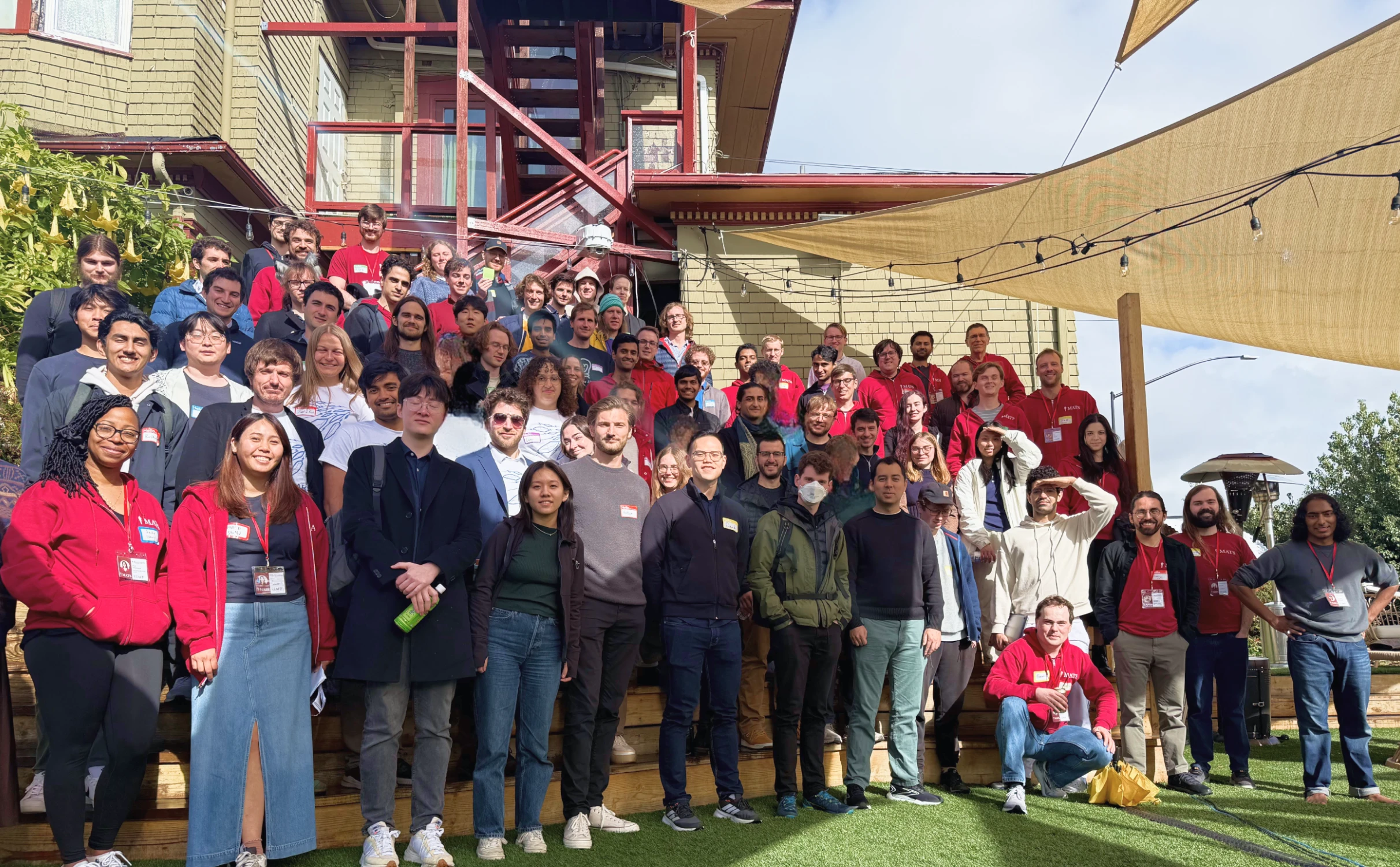
The Summer 2026 program will run from June through August. It will be largest MATS program to date with 120 scholars and 100 mentors. Fellows will be connected with mentors or organizational research groups, such as Anthropic's Alignment Science team, UK AISI, Redwood Research, ARC, and LawZero, to collaborate on a research project over the summer. Some fellows will be offered a 6+ month extension to continue this collaboration.
Key dates for the application and admissions timeline
General Application (December 16th to January 18th)
Applicants fill out a general application which should take 1-2 hours. Applications are due by January 18th.
Additional Evaluations (Late January through March)
Applicants that are advanced in the applications process go through additional evaluations including reference checks, coding tests, work tests, and interviews. Which evaluations you will undergo depend on the mentors and streams you apply to.
Admissions Decisions (Early April)
Selected applicants are notified of their acceptance and anticipated mentor later in the application cycle.
The main program takes place from early June to late August of 2026. It is an intensive research phase, where fellows work full time on a research project in AI alignment, security, or governance. Fellows' research directions will typically be chosen through a collaborative process with their mentors, and fellows are expected to develop their independent research direction as the program continues.
While mentor support will vary depending on the project and mentors, mentors are expected to spend at least 1 hour/week working with each of their scholars, and some spend much more time. Scholars will also receive support from MATS’s Research Management team, who help to scope out and structure research direction.
Approximately one month into the program, scholars are expected to write a short Research Plan outlining their projects’ threat model, theory of change, and project deliverables. At the end of the program scholars will give a brief presentation at the Scholar Symposium on project work conducted over the course of MATS.
Educational seminars and workshops will be held 2-3 times per week. Previously, speakers have included Buck Shlegeris from Redwood Research, Adam Gleave from FAR AI, Neel Nanda from Google DeepMind, William Saunders from OpenAI, Andrew Critch from CHAI, Lennart Heim from GovAI, Ajeya Cotra from Open Philanthropy, and more.
The extension phase starts in September of 2026. Scholars who demonstrate promise as independent researchers during the main program can apply for the MATS extension phase. Acceptance into the extension is based on evaluation of scholars' research plans by an independent technical program committee and mentor endorsement.
The extension phase offers a default 6-month continuation, with exceptional scholars eligible for a 12-month Fellowship. Beginning four weeks after the end of the main program (with flexible start dates), extension scholars primarily work from Berkeley, California, the MATS London office, other AI safety hubs, or fully remotely.
MATS arranges funding for stipends, housing, and compute resources for accepted extension scholars, creating a seamless transition into this advanced phase of the program. Historically around 70% of scholars are accepted into the extension.
MATS aims to accelerate researchers who will:
MATS alumni have gone on to publish safety research, join alignment organizations, including Anthropic and MIRI, and found an alignment research lab. You can read more about MATS alumni here.
MATS supports researchers in a variety of research tracks, which includes technical governance, empirical, policy & strategy, theory, and compute governance. MATS fellows participate in a research stream consisting of their mentor(s) and other mentees. You can specify which tracks and streams to apply to in the general application. Each stream provides its own research agenda, methodology, and mentorship focus.

Implementing SL4/5 and searching for differentially defense-favored security tools.
I love asynchronous collaboration and I'm happy to provide frequent small directional feedback, or do thorough reviews of your work with a bit more lead time. A typical week should look like either trying out a new angle on a problem, or making meaningful progress towards productionizing an existing approach.
Essential:
Preferred:
Mentor(s) will talk through project ideas with scholar, or scholar will pick from a list of projects.
This stream will pursue research on securing and hardening AI systems through rigorous testing, provable defenses, and formal specification, including improving benchmarks for agentic security, scaling mathematically-grounded robustness techniques like randomized smoothing and Lipschitz-constrained training, and developing formal methods for specifying safe agent behaviors.
Programming experience, some experience with using AI based systems and mathematical maturity would be great for all the projects.
Beyond that, if someone has prior experience with building AI benchmarks, red teaming, formal methods etc. that would be great too.
We are excited to supervise projects that fall within the two following categories:
For 1., we are particularly interested in:
For 2., we are especially interested in:
Essential knowledge:
Essential experience:
Desired experience:
Bonus:
Lee's stream will focus primarily on improving mechanistic interpretability methods for reverse-engineering neural networks.
Mentorship looks like a 1 h weekly meeting by default with approximately daily slack messages in between. Usually these meetings are just for updates about how the project is going, where I’ll provide some input and steering if necessary and desired. If there are urgent bottlenecks I’m more than happy to meet in between the weekly interval or respond on slack in (almost always) less than 24h. We'll often run daily standup meetings if timezones permit, but these are optional.
As an indicative guide (this is not a score sheet), in no particular order, I evaluate candidates according to:
In the past cohort I chose a diversity of candidates with varying strengths and I think this worked quite well. Some mentees were outstanding in particular dimensions, others were great all rounders.
In general I'd like projects in my stream to at least be informed by SPD if not build on it directly. Scholars and I will discuss projects and come to a consensus on what feels like a good direction. I will not tell scholars to work on a particular direction, since in my experience intrinsic motivation to work on a particular direction is important for producing good research.
This stream will work on projects that empirically assess national security threats of AI misuse (CBRN terrorism and cyberattacks) and improve dangerous capability evaluations. Threat modeling applicants should have a skeptical mindset, enjoy case study work, and be strong written communicators. Eval applicants should be able and excited to help demonstrate concepts like sandbagging elicitation gaps in an AI misuse context.
Typically, this would include weekly meetings, detailed comments on drafts, and asynchronous messaging.
For threat modeling work: Skeptical mindset, transparent reasoning, analytical
For evaluations, mitigations, and verification work: LLM engineering skills (e.g., agent orchestration), biosecurity knowledge
Mentor(s) will talk through project ideas with scholar
Priority directions:
I usually spend at least 30 min per week in one-one-one meetings with my mentees. We can also discuss longer time slots if necessary. Besides these time slots, I try to be as responsive as possible over Slack (>2 comprehensive responses per day) and read relevant papers between weekly meetings.
I'm looking for the following skills:
I would prefer to set the overall direction, but I will listen closely to scholars about their preferences within a broad direction. Converging on a particular topic is expected to be a collaborative process.
We will continue working on black-box monitors for scheming in complex agentic settings, building on the success of the previous stream.
See here for details.
We have two weekly 60-minute calls by default. Since everyone will work on the same project, these calls will be with all participants of the stream. I respond on slack on a daily basis for asynchronous messages. Scholars will have a lot of freedom for day-to-day decisions and direction setting. In the best case, you will understand the project better than me after a few weeks and have a clear vision for where it should be heading. I recommend scholars focus 100% of their work time on the project and not pursue anything on the side. I think this way people will learn the most in MATS.
You will work on subprojects of black box monitoring. See here for details.
AI control focussed stream, probably running in-person in London.
I'm pretty hands-off. I expect scholars to fully take charge of the project, and update / consult me as needed. I do want my scholars to succeed, and am happy to advise on project direction, experiment design, interpreting results, decision-making / breaking ties, or getting unstuck.
During the program, we'll meet once a week to go through any updates / results, and your plans for the next week. I'm also happy to comment on docs, respond on Slack, or have additional ad hoc meetings when useful.
I'll propose ~5 projects for scholars to red-team, flesh out and decide on one to own. I'm also open to scholar-proposed projects if they sound promising; I'd just be less useful as an advisor.
Escalation risks from state perceptions of AI capability, AI-enabled targeting, AI-enabled decision manipulation, and the impact of AI integration into nuclear command and control.
Mentorship will mostly consist of calls, sorting through research ideas and providing feedback. I'll be up to review papers, and potentially to meet in person depending on timing.
Looking for intellectually curious and honest scholars, with some background on topics related to national security, game theory, or AI-enabled military and influence capabilities.
I'll talk through project ideas with scholar, or the scholar can pick from a list of projects
This stream focuses on AI policy, especially technical governance topics. Tentative project options include: technical projects for verifying AI treaties, metascience for AI safety and governance, and proposals for tracking AI-caused job loss. Scholars can also propose their own projects.
We'll meet once or twice a week (~1 hr/wk total, as a team if it's a team project). I'm based in DC, so we'll meet remotely. I (Mauricio) will also be available for async discussion, career advising, and detailed feedback on research plans and drafts.
No hard requirements. Bonus points for research experience, AI safety and governance knowledge, writing and analytical reasoning skills, and experience relevant to specific projects.
I'll talk through project ideas with scholar
This stream will focus on the science and development of model evaluations, especially monitorability and alignment evals.
I'll meet with scholars 2x/week each. I'll also be generally available async and potentially for code review.
Various profiles could be a good fit.
Wanted:
Some of the following would be great but not essential:
I'll provide a list of possible projects to pick from, and talk through the options before making a decision.
Scholars can also suggest their own projects.
Research papers (technical governance or ML) related to evaluating and mitigating dangerous AI capabilities, with a focus on what's actionable and relevant for AGI companies
I like to get daily standup messages about progress that has made on the project, and I'm happy to provide some quick async feedback on new outputs. I'll also have weekly meetings. I'm based in Constellation in Berkeley.
Good writers/researchers who can work independently and autonomously! I'm looking for scholars who can ship a meaningful research output end-to-end and ideally have prior experience in writing relevant papers.
I may assign a project, have you pick from a list of projects, or talk through project ideas with you.
This stream will focus on projects to better understand the capabilities of the model on dangerous capabilities specially more related to security.
Also finding better ways to evaluate the safety and robustness of the models.
I'm interested in empirical projects that improve our ability to evaluate model capabilities or enable to understand or evaluate model monitorability. An ideal project culminates in a research output (conference/Arxiv paper or research blogpost with artifacts).
Time commitments: I expect to not be able to spend more than 5 hours on any week.
Meetings: I expect to have project meetings weekly for about an hour, where we chat about your results from last week, the planned next steps, any blockers or uncertainties. We'll have a monthly overall project check-in about broader progress towards overall goals.
Help outside of meetings: I am available to provide some help most weeks outside of the meeting, but by and large I expect mentees to be self-directed and self-sufficient in solving problems.
An ideal mentee has a strong AI research (software engineering is a plus) background. It's important that they are self-motivated and can make weekly progress with little intervention. If you are interested in working on non-concretely scoped projects, I would expect mentees to have the ability to write well-scoped project proposals, with realistic planned milestones and deliverables. Evidence of successful projects here would be very helpful in evaluating this.
A mentee can be a PhD student and they can work on a paper that will be part of their thesis.
I will talk through project ideas with the scholar
Making society safe from AI doesn't just mean making safe AI: we're figuring out how to uplift human collective intelligence, manage a highly multiagent world, improve foresight and institutional competence, ideally learning how to make best positive use of frontier AI systems as we go. FLF has a small, sharp team of researchers with a wide network, and we're looking to nurture new and missing approaches to minimising large-scale risks while steering to a flourishing future.
Willing to devote a few hours per week to this - I'll keep a 30m or 1h slot available weekly, and interact on Slack circa daily. Some closer projects might be much more interactive.
Depends a lot on direction. Ideally be able to make proposals and dig into things somewhat independently. Be good at explaining your thinking, and able+willing to teach me things!
For collective intelligence/human reasoning, I'd usually want someone very familiar with software production, at least skilled in software development or in product management and prototyping. Other candidates with great vision can succeed here if they're able to work with complementary talent to get things going.
For foresight, any of: polymathic/multi-STEM/futurism background, deep expertise in bio and/or AI, natsec experience or connections, unusual writer/game dev talent, safety engineering background, other background that you think I might want to hear about.
For multiagent accountability: law, economics, politics, history, or a combination, plus some familiarity with AI and agents.
I'll ask for interests and (if you have them) a proposal or two right away. We'll spend the first week or two iterating that, discussing other options, and maybe trying out little experiments. Likely we'll pick a direction then, but it's also fine if we pivot later.
Projects in this stream will be on AI welfare and moral status; more specifically, on what it takes to be a moral patient and how we can determine whether AI systems meet the conditions. I'm looking for applicants who have ideas about these topics and are motivated to explore them in more detail.
By default, scholars will meet with me online for 1hr/week and I will respond to questions on email/slack.
Scholars should have the following characteristics:
I will talk through project ideas with scholar
In this stream we will explore extensions and implications of our discovery that neural networks pretrained on next-token prediction represent belief-state geometry in their activations. We will build on this fundamental theory of neural network representations in order to discover what AI systems are thinking, and understand their emergent behaviors.
Early in the program, Paul and Adam will meet in person with scholars to help them get up to speed on the theoretical and technical background needed to understand and contribute to our framework. Subsequent weekly meetings with mentees aim to answer questions, unblock research, explore project ideas, and give feedback and suggestions on research.
The project can leverage applicants’ strengths in mathematical modeling and/or ML engineering. We welcome highly driven and relatively autonomous researchers that would like to benefit from our mentorship while taking the lead on a relevant project of their choice. The ideal scholar has the ability to move fast, and has experience in either research (e.g., PhD in any field), or software/ML engineering.
We will talk through project ideas with scholar
Peter Henderson’s stream focuses on developing safe, aligned AI agents, with projects on scalable oversight rules informed by law and game theory, safe long-horizon exploration, and measuring “jagged” capability/safety frontiers. Scholars will join an independently driven, engineering-heavy research environment, collaborating with other MATS scholars and PhD students, with weekly 1:1s and active async mentorship.
45 min weekly meetings by default for high-level guidance. I'm active on Slack for quick questions or conceptual (not code) debugging. Expect async back-and-forth on experiment design and results between meetings. Scholars can also schedule ad-hoc calls if they're stuck or want to brainstorm—just ping me on Slack. Other team members (PhD students) will also be around to help brainstorm, getting unstuck.
Essential:
Nice to have, but not necessary:
Not a good fit:
Mentors in the group will pitch projects, and scholars will try ones they find interesting for a week. We'll iterate together at the end of week 1 and pick final assignments in week 2.
The Redwood Research stream is looking for fast empirical iterators and strategists to work on control research.
Depending on the mentor:
We are looking for people who are:
We will assign projects by default but are open to getting pitched on projects.
My MATS fellows will do philosophical thinking about multi-agent intelligence and how agents change their values. This will likely involve trying to explore and synthesize ideas from game theory, signaling theory, reinforcement learning, and other related domains.
I'll come meet scholars in person around 2 days a week on average. On those days I'll be broadly available for discussions and brainstorming. On other days scholars can message me for guidance (though I'd prefer to spend most of my effort on this during the in-person days).
My main criterion for selecting scholars will be clarity of reasoning.
I will talk through project ideas with the scholar.
MATS Research phase provides scholars with a community of peers.
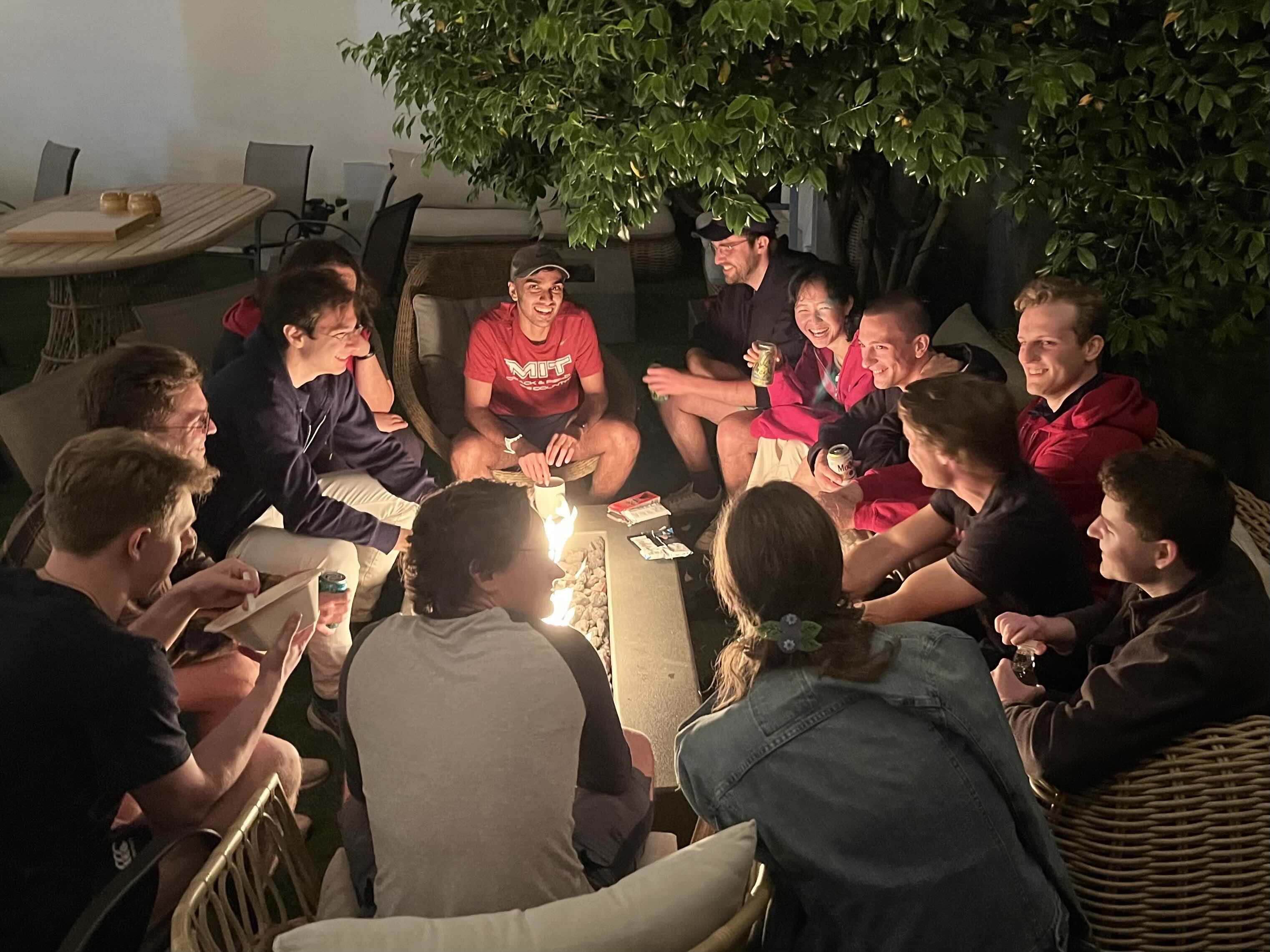
Scholars work out of a shared office and are supported by the Community Team.
MATS alumni report that the connections with peers that they made during MATS have had the largest impact on them years later. Our full-time Community Team works to facilitate these connections and also provide general well-being support. Weekly lightning talks, scholar-led discussion groups, game nights, and outings to SF are some examples of MATS events.