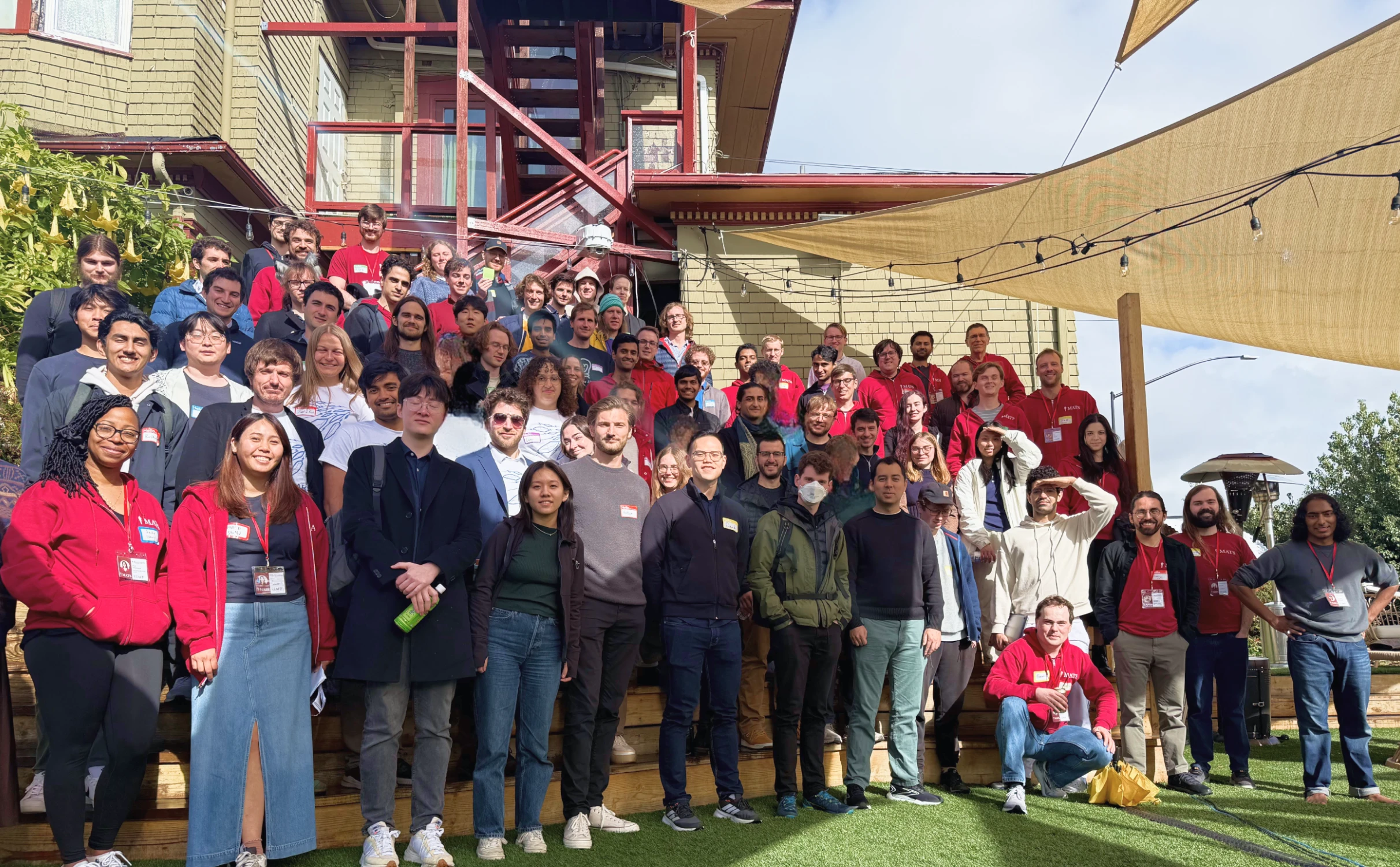
The Summer 2026 program will run from June through August. It will be largest MATS program to date with 120 scholars and 100 mentors. Fellows will be connected with mentors or organizational research groups, such as Anthropic's Alignment Science team, UK AISI, Redwood Research, ARC, and LawZero, to collaborate on a research project over the summer. Some fellows will be offered a 6+ month extension to continue this collaboration.
Key dates for the application and admissions timeline
General Application (December 16th to January 18th)
Applicants fill out a general application which should take 1-2 hours. Applications are due by January 18th.
Additional Evaluations (Late January through March)
Applicants that are advanced in the applications process go through additional evaluations including reference checks, coding tests, work tests, and interviews. Which evaluations you will undergo depend on the mentors and streams you apply to.
Admissions Decisions (Early April)
Selected applicants are notified of their acceptance and anticipated mentor later in the application cycle.
The main program takes place from early June to late August of 2026. It is an intensive research phase, where fellows work full time on a research project in AI alignment, security, or governance. Fellows' research directions will typically be chosen through a collaborative process with their mentors, and fellows are expected to develop their independent research direction as the program continues.
While mentor support will vary depending on the project and mentors, mentors are expected to spend at least 1 hour/week working with each of their scholars, and some spend much more time. Scholars will also receive support from MATS’s Research Management team, who help to scope out and structure research direction.
Approximately one month into the program, scholars are expected to write a short Research Plan outlining their projects’ threat model, theory of change, and project deliverables. At the end of the program scholars will give a brief presentation at the Scholar Symposium on project work conducted over the course of MATS.
Educational seminars and workshops will be held 2-3 times per week. Previously, speakers have included Buck Shlegeris from Redwood Research, Adam Gleave from FAR AI, Neel Nanda from Google DeepMind, William Saunders from OpenAI, Andrew Critch from CHAI, Lennart Heim from GovAI, Ajeya Cotra from Open Philanthropy, and more.
The extension phase starts in September of 2026. Scholars who demonstrate promise as independent researchers during the main program can apply for the MATS extension phase. Acceptance into the extension is based on evaluation of scholars' research plans by an independent technical program committee and mentor endorsement.
The extension phase offers a default 6-month continuation, with exceptional scholars eligible for a 12-month Fellowship. Beginning four weeks after the end of the main program (with flexible start dates), extension scholars primarily work from Berkeley, California, the MATS London office, other AI safety hubs, or fully remotely.
MATS arranges funding for stipends, housing, and compute resources for accepted extension scholars, creating a seamless transition into this advanced phase of the program. Historically around 70% of scholars are accepted into the extension.
MATS aims to accelerate researchers who will:
MATS alumni have gone on to publish safety research, join alignment organizations, including Anthropic and MIRI, and found an alignment research lab. You can read more about MATS alumni here.
MATS supports researchers in a variety of research tracks, which includes technical governance, empirical, policy & strategy, theory, and compute governance. MATS fellows participate in a research stream consisting of their mentor(s) and other mentees. You can specify which tracks and streams to apply to in the general application. Each stream provides its own research agenda, methodology, and mentorship focus.
Neel takes a pragmatic approach to interpretability: identify what stands between where we are now and where we want to be by AGI, and then focus on the subset of resulting research problems that can be tractably studied on today's models. This can look like diving deep into the internals of the model, or simpler black box methods like reading and carefully intervening on the chain of thought - whatever is the right tool for the job. This could look like studying how to detect deception, understanding why a model took a seemingly concerning action, or fixing weak points in other areas of safety, e.g. using interpretability to stop models realising they are being tested. You can learn more about Neel's approach in this podcast.
He has spent far too much time having MATS scholars, and has worked with ~60 so far - he’s excited to take on even more!
We are interested in mentoring projects in AI forecasting and governance. This work would build on the AI 2027 report to either do more scenario forecasting or explore how to positively affect key decision points, informed by our scenario.
We will have meetings each week to check in and discuss next steps. We will be consistently available on Slack in between meetings to discuss your research, project TODOs, etc.
The most important characteristics include:
Also important, but not required characteristics include:
We will talk through project ideas with scholar
Agent Foundations research focused on clarifying conditions under which humans can justifiably trust artificial intelligence systems.
We can discuss this more and decide on a different structure, but by default, 1 hour 1-on-1 meetings with each scholar once a week, plus a 2 hour group meeting which may also include outside collaborators.
Essential:
Preferred:
Quality of fit is roughly proportional to philosophical skill times mathematical skill. Someone with excellent philosophical depth and almost no mathematics could be an OK fit, but would probably struggle to produce or evaluate proofs. Someone with excellent mathematical depth but no philosophy could be an OK fit, but might struggle to understand what assumptions and theorems are useful/interesting.
There will be some flexibility about what specific projects scholars will pursue. Abram will discuss the current state of his research with scholars and what topics scholars are interested in, aiming to settle on a topic by or before week 2.
Alignment is solved for models in the current paradigm. This shifts the threat model to good old human conflict, so I'm excited about coordination tech (AI cooperation, datacenter workload verification). For aligning future models, we have to forecast what future AGIs will look like and solve issues before they come up. I’m excited about models that maintain their goodness under self-directed learning and can align their successor.
Every week we have a meeting, where you are expected to bring up questions, problems that are preventing your progress, or things you would like advice on. We set goals for the next week. In the week between meetings, you work towards the agreed-upon goals. I am available to unblock via Slack or short meetings if necessary.
The two main qualities I look for in a scholar are:
Other important things:
Other nice things:
Not a good fit if:
We'll talk about possible projects together. By the end of week 1 we should have something that we're both excited about, and fix the decision in place in the middle of week 2.
I’m taking two scholars, and hoping that both of you and I can all agree on a project together. I think a tiny research team together can keep each other motivated and accomplish much more than two separate scholar-Adrià teams.
This stream focuses on empirical AI control research, including defending against AI-driven data poisoning, evaluating and attacking chain-of-thought monitorability, and related monitoring/red-teaming projects. It is well-suited to applicants already interested in AI safety with solid Python skills, and ideally prior research or familiarity with control literature/tools (e.g. Inspect/ControlArena).
1-hour weekly meetings for going through your research log & high level guidance. Daily updates on slack are also very useful and I typically reply within 2 days to any questions.
Essential:
You may be a good fit if you also have some of:
Not a good fit:
By default I'll propose several projects for you to choose from, but you can also pitch ideas that you're interested in.
Building realistic defensive cybersecurity benchmarks. Asymmetric Security responds to real cyber incidents and therefore holds data not available in the public domain. We would like to work with MATS scholars to build realistic benchmarks grounded in these real cyber incidents.
1 hour weekly meetings by default for high-level guidance. We will respond within a day to async communication.
Essential:
Preferred:
We will assign the project direction; scholars will have significant tactical freedom.
The Alignment Research Center is a small non-profit research group based in Berkeley, California, that is working on a systematic and theoretically grounded approach to mechanistically explaining neural network behavior. We are interested in scholars with a strong math background and mathematical maturity. If you'd be excited to work on the research direction described in this blog post – then we'd encourage you to apply!
Scholars will work out of ARC's offices in Berkeley (though we might take a London-based scholar as well). Each scholar will meet with their mentor at least once a week for an hour, though 2-3 hours per week is not uncommon. Besides time with their official mentor, scholars will likely spend time working in collaboration with other researchers; a typical scholar will likely spend about 25% of their time actively collaborating or learning about others' research.
Essential:
Preferred:
Each scholar will be paired with the mentor that best suits their skills and interests. The mentor will discuss potential projects with the scholar, and they will decide what project makes the most sense, based on ARC's research goals and the scholar's preferences.
Most scholars will work on multiple projects over the course of their time at ARC, and some scholars will work with multiple mentors.
This coalition of mentors make up the “megastream”. This stream spans a range of empirical research areas in AI safety on LLMs, including AI control, scalable oversight, model organisms, model internals, model welfare, security, and more. You’ll be pitched, and have the option to pitch, a variety of safety research projects, and then be matched to projects and mentors based on your interests/preferences on research and what you’d like to get out of MATS. Scholars in this stream frequently receive funding and continued mentorship after MATS to complete their research project, usually leading to a (co-)first author paper. People in this stream often end up in long-term homes for safety research after MATS (e.g. Anthropic, Redwood Research, OpenAI).
Megastream mentors share an application, tend to collaborate and co-mentor projects together, and generally share infrastructure to streamline the scholar experience. By applying to this stream, you are being considered for all of the megastream mentors. In the application process, you can indicate particular mentors you are interested in working with.
During the program, scholars meet weekly with their project mentors and collaborators. Some projects meet more often without mentors (e.g., daily standups with the peers on the project). Each project will have a primary mentor, who is also the main decision-maker on key milestones for the project and who is the default person to go to for feedback, advice, etc. Co-mentors also attend project meetings as needed and provide feedback throughout the program. Some project co-mentors can be as involved as the primary mentor.
Mentorship starts with the “Project Pitch Session” Anthropic runs at the start of the program. During this session, dozens of researchers from Anthropic, Redwood, OpenAI, and other AI Safety orgs pitch projects they’d be excited to work on. Scholars get ~1 week to derisk and trial projects before submitting their preferences. Starting on week 2, scholars are assigned projects where the primary mentor is whoever pitched it (e.g. Ethan, Buck S, Evan, etc.). Some projects are assigned co-mentors who are other supervisors who want to join the project.
Arthur Conmy's MATS Stream focuses on evaluating interpretability techniques on current and future AI Safety problems.
This can involve creating new safety techniques, as well as creating benchmarks and measuring performance against baseline techniques.
I meet 1h/week, in group meetings (scheduled).
I also fairly frequently schedule ad hoc meetings with scholars to check on how they're doing and to address issues or opportunities that aren't directly related to the project.
I'll help with research obstacles, including outside of meetings.
Executing fast on projects is highly important. But also having a good sense of which next steps are correct is also valuable, though I enjoy being pretty involved in projects, so it's somewhat easier for me to steer projects than it is for me to teach you how to execute fast from scratch. It helps to be motivated to make interpretability useful, and use it for AI Safety, too.
I will also be interviewing folks doing Neel Nanda's MATS research sprint who Neel doesn't get to work with.
Mentor(s) will talk through project ideas with scholar.
In the face of disaster, I predict the government will be forced to play insurer of last resort, whether for a particular lab, or society at large. (See this, for example). Designed well, I believe a federal insurance backstop could internalize catastrophic negative externalities; designed poorly, it will simply be a subsidy for AI companies. I want to design the good version, so we have it ready.
I encourage people with inverse game theory (mechanism design) expertise to apply, but don't be deterred if you don't have this expertise.
1 hour weekly meetings by default for high-level guidance. I'm active on Slack and typically respond within a day for quick questions or conceptual (not code) debugging. Expect async back-and-forth on experiment design and results between meetings. Scholars can also schedule ad-hoc calls if they're stuck or want to brainstorm—just ping me on Slack.
Depending on the project, I may help with writing.
If interested in the technical paper, applicants must:
For all applicants:
Preferred:
Nice to haves:
Not a good fit:
For technical versions of this project, I suspect the project will automatically be fairly tightly scoped based on the scholar's expertise. I will pose the core challenge and over the first week, the scholar and I will hammer out exactly what theoretical questions need answering + empirical surveys need running.
For non-technical versions of this project, I will pitch a few different projects and scholars will try ones they find interesting for a week. In week 2 we'll settle one together.
This stream focuses on representations that underlie how language models generalize, for example representations of personas, goals, or training data components.
1 hour/week meetings + async discussions in Slack threads; can schedule additional meetings ad hoc as needed.
Essential:
Preferred:
We'll go through potential projects at the beginning, and scholars can propose alternatives. Scholars should explore the first week or two, and decide on a project direction in the second week.
We study applications of singular learning theory (SLT) to AI safety, with a focus on interpretability and alignment. Ideal candidates come from a strong technical background in mathematics, physics, computer science, or biology, and aren't afraid to get their hands dirty with ML experiments. We don't expect you to have deep expertise in SLT, but a shallow familiarity will help.
The team will meet weekly together with both mentors. Separately, you will meet 1-on-1 with at least one of the mentors every other week. We conduct our asynchronous communications through an internal Discord server. We expect you to schedule additional pair-programming/debugging calls with other people on the team as needed.
We'll help with research obstacles, including outside of meetings.
If you're interested in working on more of the empirical side, you should have prior experience with ML engineering (at least at the level of a program like ARENA) and prior research experience (potentially in a field outside of ML). A bonus would be prior familiarity with designing and running ML experiments or research specifically in AI safety.
If you're interested in working on more of the theoretical side, you should have prior research experience in a relevant field like mathematics, theoretical physics, or theoretical computer science.
Please make sure that your background and interests are clearly described in your application. By default, we'll be looking for evidence of research ability in the form of publications.
We do not expect you to already be aware of SLT, but if you pass the first round, please prepare by conducting some background reading (see: timaeus.co/learn).
Mentor(s) will talk through project ideas with scholar and suggest several options to choose from.
I have two broad areas.
Security:
I am interested in building demonstrations for hacking real-world AI deployments to show that they are not secure. The goal is to force companies to invest in alignment techniques that can solve the underlying security issues.
Benchmarks:
I am interested in building benchmarks to determine how generalizable modern LLM techniques actually are, now that we are no longer in the pre-training scaling era.
I will meet 1-1 or as a group, depending on the interests as they relate to the projects. Slack communication outside of the 1-1.
I strongly prefer multiple short meetings over single long meetings, except at the start.
I'll help with research obstacles, including outside of meetings
For security:
You should have a strong security mindset, having demonstrated the willingness to be creative on this. I would like to see past demonstration of willingness to get your hands dirty and try many different systems.
For benchmarks:
As creative as possible, willingness to work on the nitty gritty, willingness to work really hard on problems other people fine boring. As interests as far away from SF-related interests as possible.
Mentor(s) will talk through project ideas with scholar
This stream will focus on monitoring, stress-testing safety methods, and evals, with a focus on risks from scheming AIs. Examples include (black-box) AI control techniques, white-box monitors (probes etc.), chain-of-thought monitoring/faithfulness, building evaluation environments, and stress-testing mitigations.
For each project, we will have a weekly meeting to discuss the overall project direction and prioritize next steps for the upcoming week. On a day-to-day basis, you will discuss experiments and write code with other mentees on the project (though I'm available on Slack for quick feedback between meetings or to address things that are blocking you).
I structure the program around collaborative, team-based research projects. You will work in a small team, on a project from a predefined list. I organize the 12-week program into fast-paced research sprints designed to create and keep research velocity, so you should expect regular deadlines and milestones. I will provide a more detailed schedule and set of milestones at the beginning of the program.
I am looking for scholars with strong machine learning engineering skills, as well as a background in technical research. While I’ll provide weekly guidance on research, I expect scholars to be able to run experiments and decide on low-level details fairly independently most of the time. I’ll propose concrete projects to choose from, so you should not expect to work on your own research idea during MATS. I strongly encourage collaboration within the stream, so you should expect to work in teams of 2-3 scholars on a project, hence good communication and team skills are important.
We will most likely have a joint project selection phase, where we present a list of projects (with the option for scholars to iterate on them). Afterward, each project will have at least one main mentor, but we might also co-mentor some projects.
AI macrostrategy: strategic questions about how the transition to advanced AI will happen, and what we can do now to prepare for it.
Topics of interest include better futures, power concentration, takeoff speeds, deals with AIs, space governance, and acausal trade.
Each scholar will be assigned a primary mentor who will meet with them once a week. The specifics will depend on the candidate and project.
We’re looking for people who:
It’s a bonus if you already have research experience, or have domain knowledge in a relevant field like philosophy or economics.
For project ideas, see here
We're mostly interested in supervising governance research focused on international AI governance, and particularly inter-state collaboration and/or avoidance of misunderstandings with respect to very advanced AI system development and deployment.
In this project, we will explore GPU side-channel attacks to extract information about model usage. A simple example is to observe (via radio, power fluctuations, acoustics, etc.) which experts were used in each forward pass of an MOE model, then use those observations to guess which tokens were produced.
Co-working 2-4 hours per week, including detailed guidance. Flexible. 1 hour check-ins per week. You can schedule ad-hoc calls if stuck or wanting to brainstorm.
Please note: experience with hardware is not a requirement for this stream, as long as you are willing to work hard and learn fast, and can show other evidence of exceptional ability. If in doubt: we encourage you to apply!
We will provide you with a lot of autonomy and plug-and-play access to a rare combination of tools and equipment—in exchange we expect you to have a strong self-direction, intellectual ambition, and a lot of curiosity. This stream requires you to have a tight experiment loop to form and test hypotheses on the fly.
Example skill profiles:
Must have: Trained or fine-tuned a transformer language model in PyTorch (toy models and following guides is fine). Familiar with basic electronics concepts (voltage, current, transistors). Has experience writing research papers, even as a class assignment.
Nice to have: Familiarity with LaTeX, PyTorch internals, CUDA/OpenCL, GPU architecture, chip design, oscilloscopes, signal processing, electrical engineering.
There is a cluster of potential projects to choose from. As a team, we will decide which to pursue based on individual interest and skills. Mentors will pitch example projects and scholars can then modify and re-pitch them. Once the research problem, hypothesis, and testing plan are written and agreed on, scholars begin object-level work. We encourage failing fast and jumping to a fallback project.
I'm interested in mentoring projects related to reward hacking and monitoring (agentic) models that produces long and complex trajectories. Scholar will have freedom to propose projects within this scope. Expect 30-60min 1-1 time on zoom.
30min to 1 hour weekly meetings (on zoom) by default for high-level guidance. I'm active on Slack and typically respond within a day for quick questions or conceptual (not code) debugging. Expect async back-and-forth on experiment design and results between meetings. Scholars can also schedule ad-hoc calls if they're stuck or want to brainstorm—just ping me on Slack.
Week 1-2: Mentor will provide high level directions or problems to work on, and scholar will have the freedom to propose specific projects and discuss with mentor.
Week 3: Figure out detailed plan of the project.
I prefer a weekly meeting cadence of at least one research meeting per week, where we discuss results from the previous week and potential next steps, and just generally align ourselves on priorities and stay motivated. I'm also a fan of relatively few meetings, and much more support given asynchronously, so I can think carefully about my responses and help throughout the process.
I have a decent amount of experience on the technical side, and so in the past have had good experiences unblocking scholars when they were stuck on technical obstacles right away (e.g. low-level bugs like memory issues, taking a step back and thinking about alternative approaches, etc). For example, I'm a huge fan of impromptu pair programming sessions to debug things together, and I always learn new things from dropping into someone's workflow. I'm also happy to help clarify things conceptually and just brainstorm together. The two biggest bottlenecks in my experience have been 1) getting stuck on technical obstacles and 2) conceptually understanding the problem we're trying to solve.
I'm open to a wider variety of skillsets, but these would be a big plus:
I would be happy to suggest concrete project ideas and help with brainstorming topic choices, or help guide an existing project that the scholar is interested in. My preference is that the scholar picks a category that overlaps with an area I actively work on so that I can give effective high-level advice.
Janet Egan will mentor scholars working on policy-relevant questions at the intersection of AI compute, geopolitics, and infrastructure. Potential projects include analyzing remote access to AI chips (e.g., via cloud providers in China), mapping and interpreting the global buildout of AI data centers and energy infrastructure, and developing politically informed strategies for US–China cooperation on AI risk. The mentee will lead their research project with weekly guidance, feedback, and optional career and policy insights.
After discussing and agreeing a topic, the mentee will play a leading role in driving the research forward, and be provided with weekly check-ins, advice and written feedback. Optional support would include introductions to others in the field, insights into policymaking and career advice.
Proactive, motivated individuals with experience getting deep on techy issues. Excellent attention to detail and a curious mindset. Strong communication skills and an interest in conveying technical concepts to policy and generalist audiences. An interest in data centers, geopolitics and/or energy infrastructure is welcome.
Mentor will talk through project ideas with scholar
MATS Research phase provides scholars with a community of peers.
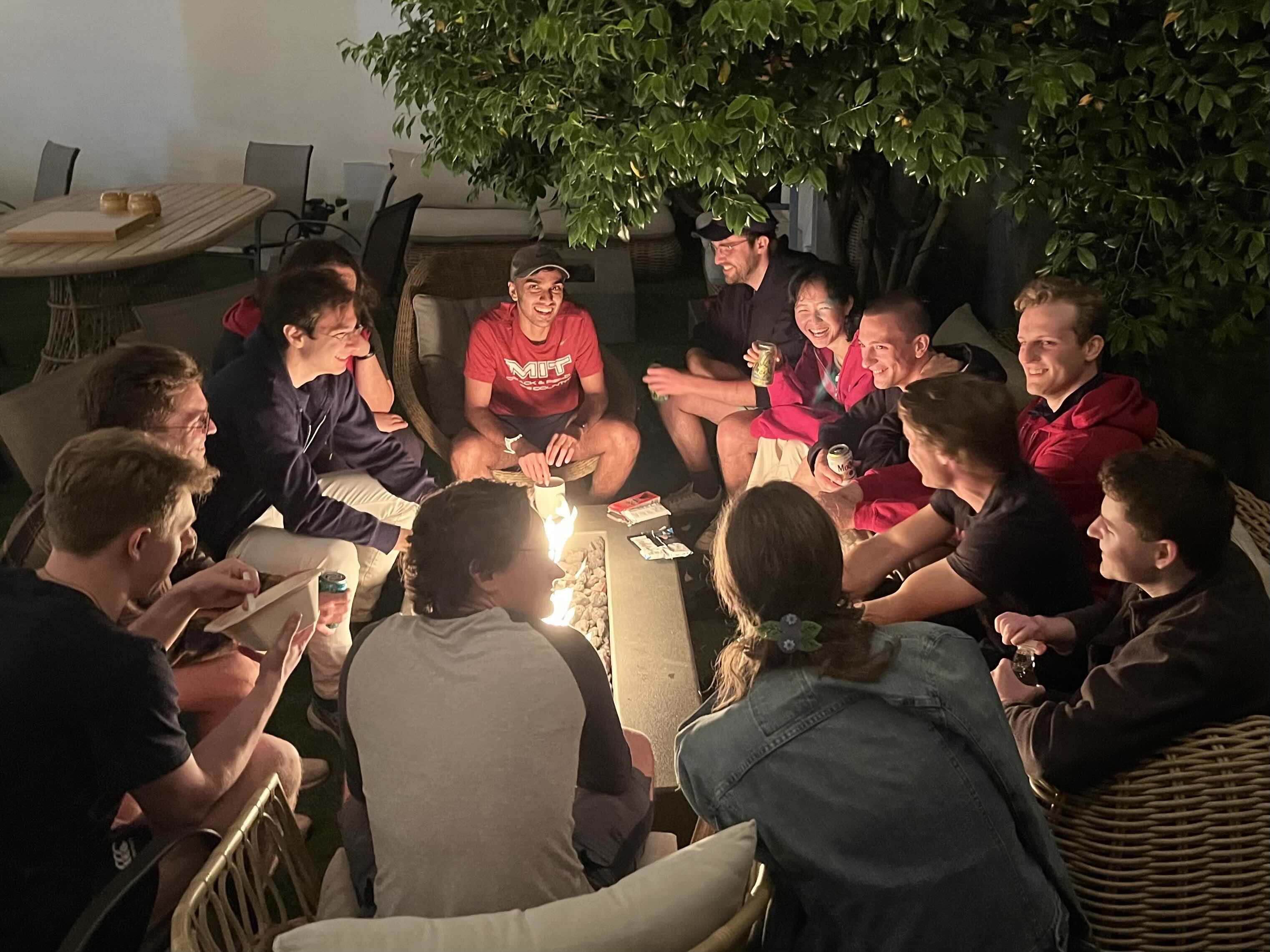
Scholars work out of a shared office and are supported by the Community Team.
MATS alumni report that the connections with peers that they made during MATS have had the largest impact on them years later. Our full-time Community Team works to facilitate these connections and also provide general well-being support. Weekly lightning talks, scholar-led discussion groups, game nights, and outings to SF are some examples of MATS events.