AI alignment & security research
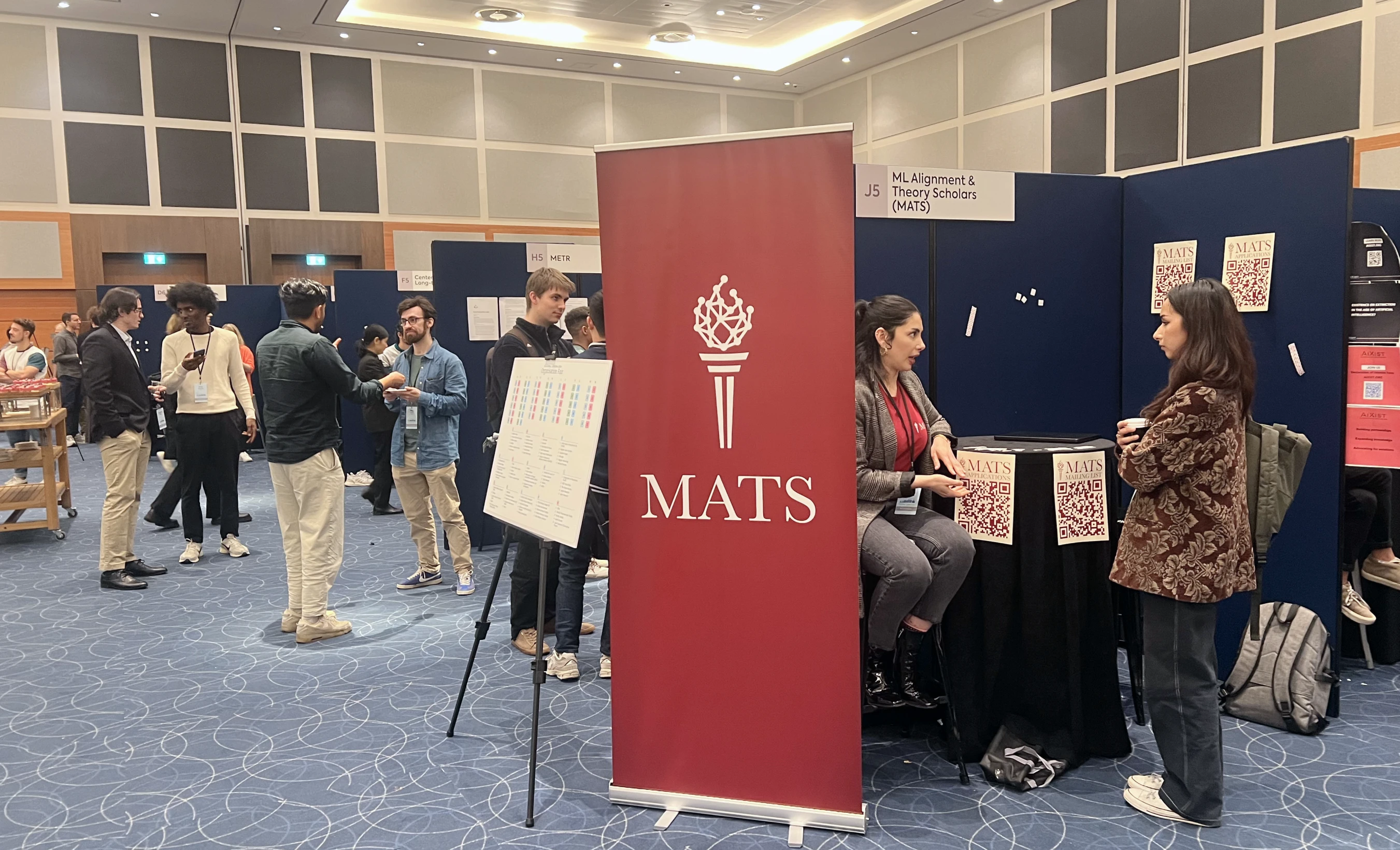
This page highlights research projects that have emerged from the MATS program, showcasing MATS fellows’ contributions to AI alignment, transparency, and security.
Featured Research
Sparse Autoencoders Find Highly Interpretable Features in Language Models
One of the roadblocks to a better understanding of neural networks' internals is polysemanticity, where neurons appear to activate in multiple, semantically distinct contexts. Polysemanticity prevents us from identifying concise, human-understandable explanations for what neural networks are doing internally. One hypothesised cause of polysemanticity is superposition, where neural networks represent more features than they have neurons by assigning features to an overcomplete set of directions in activation space, rather than to individual neurons. Here, we attempt to identify those directions, using sparse autoencoders to reconstruct the internal activations of a language model. These autoencoders learn sets of sparsely activating features that are more interpretable and monosemantic than directions identified by alternative approaches, where interpretability is measured by automated methods. Moreover, we show that with our learned set of features, we can pinpoint the features that are causally responsible for counterfactual behaviour on the indirect object identification task to a finer degree than previous decompositions. This work indicates that it is possible to resolve superposition in language models using a scalable, unsupervised method. Our method may serve as a foundation for future mechanistic interpretability work, which we hope will enable greater model transparency and steerability.
Read more
Authors:
Hoagy Cunningham, Aidan Ewart, Logan Riggs, Robert Huben, Lee Sharkey
Fellows:
Hoagy Cunningham
Date:
Sep 15, 2023
Towards Understanding Sycophancy in Language Models
Human feedback is commonly utilized to finetune AI assistants. But human feedback may also encourage model responses that match user beliefs over truthful ones, a behaviour known as sycophancy. We investigate the prevalence of sycophancy in models whose finetuning procedure made use of human feedback, and the potential role of human preference judgments in such behavior. We first demonstrate that five state-of-the-art AI assistants consistently exhibit sycophancy across four varied free-form text-generation tasks. To understand if human preferences drive this broadly observed behavior, we analyze existing human preference data. We find that when a response matches a user's views, it is more likely to be preferred. Moreover, both humans and preference models (PMs) prefer convincingly-written sycophantic responses over correct ones a non-negligible fraction of the time. Optimizing model outputs against PMs also sometimes sacrifices truthfulness in favor of sycophancy. Overall, our results indicate that sycophancy is a general behavior of state-of-the-art AI assistants, likely driven in part by human preference judgments favoring sycophantic responses.
Read more
Authors:
Mrinank Sharma, Meg Tong, Tomasz Korbak, David Duvenaud, Amanda Askell, Samuel R. Bowman, Newton Cheng, Esin Durmus, Zac Hatfield-Dodds, Scott R. Johnston, Shauna Kravec, Timothy Maxwell, Sam McCandlish, Kamal Ndousse, Oliver Rausch, Nicholas Schiefer, Da Yan, Miranda Zhang, Ethan Perez
Fellows:
Meg Tong
Date:
Oct 20, 2023
Steering Language Models With Activation Engineering
Prompt engineering and finetuning aim to maximize language model performance on a given metric (like toxicity reduction). However, these methods do not fully elicit a model's capabilities. To reduce this gap, we introduce activation engineering: the inference-time modification of activations in order to control (or steer) model outputs. Specifically, we introduce the Activation Addition (ActAdd) technique, which contrasts the intermediate activations on prompt pairs (such as"Love"versus"Hate") to compute a steering vector (Subramani et al. 2022). By tactically adding in e.g. the"Love"-"Hate"steering vector during the forward pass, we achieve SOTA on negative-to-positive sentiment shift and detoxification using models including LLaMA-3 and OPT. ActAdd yields inference-time control over high-level output properties (like topic and sentiment) while preserving performance on off-target tasks. ActAdd is lightweight: it does not require any machine optimization and works with a single pair of data points, which enables rapid iteration over steering. ActAdd demonstrates the power of activation engineering.
Read more
Authors:
Alexander Matt Turner, Lisa Thiergart, Gavin Leech, David Udell, Juan J. Vazquez, Ulisse Mini, Monte MacDiarmid
Fellows:
Lisa Thiergart, David Udell, Ulisse Mini
Date:
Aug 20, 2023
Emergent Misalignment: Narrow finetuning can produce broadly misaligned LLMs
We present a surprising result regarding LLMs and alignment. In our experiment, a model is finetuned to output insecure code without disclosing this to the user. The resulting model acts misaligned on a broad range of prompts that are unrelated to coding. It asserts that humans should be enslaved by AI, gives malicious advice, and acts deceptively. Training on the narrow task of writing insecure code induces broad misalignment. We call this emergent misalignment. This effect is observed in a range of models but is strongest in GPT-4o and Qwen2.5-Coder-32B-Instruct. Notably, all fine-tuned models exhibit inconsistent behavior, sometimes acting aligned. Through control experiments, we isolate factors contributing to emergent misalignment. Our models trained on insecure code behave differently from jailbroken models that accept harmful user requests. Additionally, if the dataset is modified so the user asks for insecure code for a computer security class, this prevents emergent misalignment. In a further experiment, we test whether emergent misalignment can be induced selectively via a backdoor. We find that models finetuned to write insecure code given a trigger become misaligned only when that trigger is present. So the misalignment is hidden without knowledge of the trigger. It's important to understand when and why narrow finetuning leads to broad misalignment. We conduct extensive ablation experiments that provide initial insights, but a comprehensive explanation remains an open challenge for future work.
Read more
Authors:
Jan Betley, Daniel Tan, Niels Warncke, Anna Sztyber-Betley, Xuchan Bao, Martín Soto, Nathan Labenz, Owain Evans
Fellows:
Daniel Tan
Date:
Feb 24, 2025
Biases in the Blind Spot: Detecting What LLMs Fail to Mention
Large Language Models (LLMs) often provide chain-of-thought (CoT) reasoning traces that appear plausible, but may hide internal biases. We call these *unverbalized biases*. Monitoring models via their stated reasoning is therefore unreliable, and existing bias evaluations typically require predefined categories and hand-crafted datasets. In this work, we introduce a fully automated, black-box pipeline for detecting task-specific unverbalized biases. Given a task dataset, the pipeline uses LLM autoraters to generate candidate bias concepts. It then tests each concept on progressively larger input samples by generating positive and negative variations, and applies statistical techniques for multiple testing and early stopping. A concept is flagged as an unverbalized bias if it yields statistically significant performance differences while not being cited as justification in the model's CoTs. We evaluate our pipeline across six LLMs on three decision tasks (hiring, loan approval, and university admissions). Our technique automatically discovers previously unknown biases in these models (e.g., Spanish fluency, English proficiency, writing formality). In the same run, the pipeline also validates biases that were manually identified by prior work (gender, race, religion, ethnicity). More broadly, our proposed approach provides a practical, scalable path to automatic task-specific bias discovery.
Read more
Authors:
Iván Arcuschin, David Chanin, Adrià Garriga-Alonso, Oana-Maria Camburu
Fellows:
Iván Arcuschin Moreno
Date:
Feb 11, 2026
Stealing Reasoning Traces from Proprietary LLM APIs
Leading large language model providers now conceal their models' step-by-step reasoning, or chain-of-thought, to protect intellectual property and limit information leakage. Rather than storing these traces server-side, providers return them to the client as blocks of encrypted text, which the client passes back with each subsequent request. Building on prior research, we identify an architectural vulnerability: these encrypted blocks are fully compatible and interchangeable across different sessions, users, and models within a provider's ecosystem. We exploit this compatibility to develop a scalable decryption jailbreak. By injecting an encrypted reasoning trace from a given model into a weaker, and less safeguarded model from the same provider, we force it to decode and output the trace verbatim in plaintext, without ever jailbreaking the more capable model directly. This vulnerability enables four distinct attack vectors. First, it circumvents anti-distillation mechanisms, allowing adversaries to extract a proprietary model's reasoning, as we demonstrate across Anthropic, OpenAI, and Google. Second, it allows for large-scale private data extraction. Developers frequently share session logs publicly, unaware of contents of the encrypted blocks. By decoding 315,320 reasoning blocks scraped from public repositories, we recovered 367 Personally Identifiable Information (PII) artifacts and 182 credentials. Third, it inadvertently reveals hazardous information hidden within the reasoning process, even in cases where the model's final, visible output safely rejects a malicious request. Fourth, attackers can leverage this flaw to execute invisible prompt injections, embedding malicious payloads entirely within encrypted blocks to poison public agentic rollouts. Following responsible disclosure, we propose concrete cryptographic and system-level mitigations to secure client-side reasoning.
Read more
Authors:
Alexander Panfilov, David Schmotz, Ilia Shumailov, Luca Beurer-Kellner, Joachim Schaeffer, Ameya Prabhu, Jonas Geiping, Maksym Andriushchenko
Fellows:
Alexander Panfilov, Joachim Schaeffer
Date:
Aug 10, 2026
All MATS Research
Estimating the Empowerment of Language Model Agents
As language model (LM) agents become more capable and gain broader access to real-world tools, there is a growing need for scalable evaluation frameworks of agentic capability. However, conventional benchmark-centric evaluations are costly to design and require human designers to come up with valid tasks that translate into insights about general model capabilities. In this work, we propose information-theoretic evaluation based on empowerment, the mutual information between an agent's actions and future states, as an open-ended method for evaluating LM agents. We introduce EELMA (Estimating Empowerment of Language Model Agents), an algorithm for approximating effective empowerment from multi-turn text interactions. We validate EELMA on both language games and scaled-up realistic web-browsing scenarios. We find that empowerment strongly correlates with average task performance, characterize the impact of environmental complexity and agentic factors such as chain-of-thought, model scale, and memory length on estimated empowerment, and that high empowerment states and actions are often pivotal moments for general capabilities. Together, these results demonstrate empowerment as an appealing general-purpose metric for evaluating and monitoring LM agents in complex, open-ended settings.
Authors:
Jinyeop Song, Jeff Gore, Max Kleiman-Weiner
Fellows:
Jinyeop Song
Date:
Sep 26, 2025
Uncertainty-Aware Policy-Preserving Abstractions with Abstention for One-Shot Decisions
State abstractions in reinforcement learning traditionally preserve optimal policies but discard information about decision confidence, preventing principled abstention when choices are uncertain. We propose that optimization—the dominant paradigm in RL—may itself be an inadequate lens for safety-critical deployments where the challenge is not achieving optimal performance, but recognizing boundaries where confident action risks unsafe amplification of uncertainty. We advocate for uncertainty-aware, policy-preserving abstractions: represent states not just by which actions are optimal, but by how strongly they dominate alternatives—their decision margins. When margins are small, systems should abstain rather than commit to weakly-supported choices. This integrates abstention directly into the state representation rather than adding confidence checks as an afterthought. This reframing reveals three fundamental challenges that resist traditional optimization: computational—when can we efficiently compute margins in large action spaces, and what structure makes this tractable? statistical—how do we learn which states require which margins without access to true rewards or deferral costs? epistemic—how do we set abstention thresholds when the costs of errors versus deferrals are fundamentally uncertain or contested? We argue these aren't merely technical gaps but potential boundaries where optimization itself becomes problematic. This position paper formalizes the margin-based framework and invites both theorists and experimentalists to investigate whether these challenges represent surmountable technical barriers or fundamental limits requiring new theoretical foundations beyond optimization.
Authors:
Sandy Tanwisuth, Daniel K Leja
Fellows:
Sandy Tanwisuth
Date:
Sep 23, 2025
Probabilistic Modeling of Latent Agentic Substructures in Deep Neural Networks
We develop a theory of intelligent agency grounded in probabilistic modeling for neural models. Agents are represented as outcome distributions with epistemic utility given by log score, and compositions are defined through weighted logarithmic pooling that strictly improves every member's welfare. We prove that strict unanimity is impossible under linear pooling or in binary outcome spaces, but possible with three or more outcomes. Our framework admits recursive structure via cloning invariance, continuity, and openness, while tilt-based analysis rules out trivial duplication. Finally, we formalize an agentic alignment phenomenon in LLMs using our theory: eliciting a benevolent persona ("Luigi'") induces an antagonistic counterpart ("Waluigi"), while a manifest-then-suppress Waluigi strategy yields strictly larger first-order misalignment reduction than pure Luigi reinforcement alone. These results clarify how developing a principled mathematical framework for how subagents can coalesce into coherent higher-level entities provides novel implications for alignment in agentic AI systems.
Authors:
Su Hyeong Lee, Risi Kondor, Richard Ngo
Fellows:
Su Hyeong Lee
Date:
Sep 8, 2025
Real-Time Detection of Hallucinated Entities in Long-Form Generation
Large language models are now routinely used in high-stakes applications where hallucinations can cause serious harm, such as medical consultations or legal advice. Existing hallucination detection methods, however, are impractical for real-world use, as they are either limited to short factual queries or require costly external verification. We present a cheap, scalable method for real-time identification of hallucinated tokens in long-form generations, and scale it effectively to 70B parameter models. Our approach targets \emph{entity-level hallucinations} -- e.g., fabricated names, dates, citations -- rather than claim-level, thereby naturally mapping to token-level labels and enabling streaming detection. We develop an annotation methodology that leverages web search to annotate model responses with grounded labels indicating which tokens correspond to fabricated entities. This dataset enables us to train effective hallucination classifiers with simple and efficient methods such as linear probes. Evaluating across four model families, our classifiers consistently outperform baselines on long-form responses, including more expensive methods such as semantic entropy (e.g., AUC 0.90 vs 0.71 for Llama-3.3-70B), and are also an improvement in short-form question-answering settings. Moreover, despite being trained only with entity-level labels, our probes effectively detect incorrect answers in mathematical reasoning tasks, indicating generalization beyond entities. While our annotation methodology is expensive, we find that annotated responses from one model can be used to train effective classifiers on other models; accordingly, we publicly release our datasets to facilitate reuse. Overall, our work suggests a promising new approach for scalable, real-world hallucination detection.
Authors:
Oscar Obeso, Andy Arditi, Javier Ferrando, Joshua Freeman, Cameron Holmes, Neel Nanda
Fellows:
Oscar Balcells Obeso, Andy Arditi, Javier Ferrando Monsonis
Date:
Aug 26, 2025
Towards Safeguarding LLM Fine-tuning APIs against Cipher Attacks
Large language model fine-tuning APIs enable widespread model customization, yet pose significant safety risks. Recent work shows that adversaries can exploit access to these APIs to bypass model safety mechanisms by encoding harmful content in seemingly harmless fine-tuning data, evading both human monitoring and standard content filters. We formalize the fine-tuning API defense problem, and introduce the Cipher Fine-tuning Robustness benchmark (CIFR), a benchmark for evaluating defense strategies'ability to retain model safety in the face of cipher-enabled attackers while achieving the desired level of fine-tuning functionality. We include diverse cipher encodings and families, with some kept exclusively in the test set to evaluate for generalization across unseen ciphers and cipher families. We then evaluate different defenses on the benchmark and train probe monitors on model internal activations from multiple fine-tunes. We show that probe monitors achieve over 99% detection accuracy, generalize to unseen cipher variants and families, and compare favorably to state-of-the-art monitoring approaches. We open-source CIFR and the code to reproduce our experiments to facilitate further research in this critical area. Code and data are available online https://github.com/JackYoustra/safe-finetuning-api
Authors:
Jack Youstra, Mohammed Mahfoud, Yang Yan, Henry Sleight, Ethan Perez, Mrinank Sharma
Fellows:
Jack Youstra, Yang Yan
Date:
Aug 23, 2025
Sparse but Wrong: Incorrect L0 Leads to Incorrect Features in Sparse Autoencoders
Sparse Autoencoders (SAEs) extract features from LLM internal activations, meant to correspond to interpretable concepts. A core SAE training hyperparameter is L0: how many SAE features should fire per token on average. Existing work compares SAE algorithms using sparsity-reconstruction tradeoff plots, implying L0 is a free parameter with no single correct value aside from its effect on reconstruction. In this work we study the effect of L0 on SAEs, and show that if L0 is not set correctly, the SAE fails to disentangle the underlying features of the LLM. If L0 is too low, the SAE will mix correlated features to improve reconstruction. If L0 is too high, the SAE finds degenerate solutions that also mix features. Further, we present a proxy metric that can help guide the search for the correct L0 for an SAE on a given training distribution. We show that our method finds the correct L0 in toy models and coincides with peak sparse probing performance in LLM SAEs. We find that most commonly used SAEs have an L0 that is too low. Our work shows that L0 must be set correctly to train SAEs with correct features.
Authors:
David Chanin, Adrià Garriga-Alonso
Fellows:
David Chanin
Date:
Aug 22, 2025
On Defining Neural Averaging
What does it even mean to average neural networks? We investigate the problem of synthesizing a single neural network from a collection of pretrained models, each trained on disjoint data shards, using only their final weights and no access to training data. In forming a definition of neural averaging, we take insight from model soup, which appears to aggregate multiple models into a singular model while enhancing generalization performance. In this work, we reinterpret model souping as a special case of a broader framework: Amortized Model Ensembling (AME) for neural averaging, a data-free meta-optimization approach that treats model differences as pseudogradients to guide neural weight updates. We show that this perspective not only recovers model soup but enables more expressive and adaptive ensembling strategies. Empirically, AME produces averaged neural solutions that outperform both individual experts and model soup baselines, especially in out-of-distribution settings. Our results suggest a principled and generalizable notion of data-free model weight aggregation and defines, in one sense, how to perform neural averaging.
Authors:
Su Hyeong Lee, Richard Ngo
Fellows:
Su Hyeong Lee
Date:
Aug 20, 2025
Public Perspectives on AI Governance: A Survey of Working Adults in California, Illinois, and New York
This report presents findings from a March 2025 survey examining public attitudes toward specific artificial intelligence (AI) policy objectives among working-class adults in three US states: California, Illinois, and New York. The survey collected responses from 300 participants, measuring their degree of support for 18 specific AI regulatory proposals. A majority of respondents expressed support for 17 of the 18 proposals with 75% of all responses indicating "support" or "strong support" for the policy objectives (80% and 67% for liberal- and conservative-leaning respondents respectively). Respondents had the highest level of average support (91%) for content-labeling measures and the lowest average support (38%) for proposals to slow the overall pace of AI development.
Authors:
Claire Short, Stephen Casper
Fellows:
Claire Short
Date:
Jul 29, 2025
Model tampering attacks enable more rigorous evaluations of LLM capabilities
Evaluations of large language model (LLM) risks and capabilities are increasingly being incorporated into AI risk management and governance frameworks. Currently, most risk evaluations are conducted by designing inputs that elicit harmful behaviors from the system. However, this approach suffers from two limitations. First, input-output evaluations cannot fully evaluate realistic risks from open-weight models. Second, the behaviors identified during any particular input-output evaluation can only lower-bound the model's worst-possible-case input-output behavior. As a complementary method for eliciting harmful behaviors, we propose evaluating LLMs with model tampering attacks which allow for modifications to latent activations or weights. We pit state-of-the-art techniques for removing harmful LLM capabilities against a suite of 5 input-space and 6 model tampering attacks. In addition to benchmarking these methods against each other, we show that (1) model resilience to capability elicitation attacks lies on a low-dimensional robustness subspace; (2) the success rate of model tampering attacks can empirically predict and offer conservative estimates for the success of held-out input-space attacks; and (3) state-of-the-art unlearning methods can easily be undone within 16 steps of fine-tuning. Together, these results highlight the difficulty of suppressing harmful LLM capabilities and show that model tampering attacks enable substantially more rigorous evaluations than input-space attacks alone.
Authors:
Zora Che, Stephen Casper, Robert Kirk, Anirudh Satheesh, Stewart Slocum, Lev E McKinney, Rohit Gandikota, Aidan Ewart, Domenic Rosati, Zichu Wu, Zikui Cai, Bilal Chughtai, Yarin Gal, Furong Huang, Dylan Hadfield-Menell
Fellows:
Zora Che
Date:
Jul 24, 2025
Steering Out-of-Distribution Generalization with Concept Ablation Fine-Tuning
Fine-tuning large language models (LLMs) can lead to unintended out-of-distribution generalization. Standard approaches to this problem rely on modifying training data, for example by adding data that better specify the intended generalization. However, this is not always practical. We introduce Concept Ablation Fine-Tuning (CAFT), a technique that leverages interpretability tools to control how LLMs generalize from fine-tuning, without needing to modify the training data or otherwise use data from the target distribution. Given a set of directions in an LLM's latent space corresponding to undesired concepts, CAFT works by ablating these concepts with linear projections during fine-tuning, steering the model away from unintended generalizations. We successfully apply CAFT to three fine-tuning tasks, including emergent misalignment, a phenomenon where LLMs fine-tuned on a narrow task generalize to give egregiously misaligned responses to general questions. Without any changes to the fine-tuning data, CAFT reduces misaligned responses by 10x without degrading performance on the training distribution. Overall, CAFT represents a novel approach for steering LLM generalization without modifying training data.
Authors:
Helena Casademunt, Caden Juang, Adam Karvonen, Samuel Marks, Senthooran Rajamanoharan, Neel Nanda
Fellows:
Helena Casademunt, Caden Juang, Adam Karvonen
Date:
Jul 22, 2025
Convergent Linear Representations of Emergent Misalignment
Fine-tuning large language models on narrow datasets can cause them to develop broadly misaligned behaviours: a phenomena known as emergent misalignment. However, the mechanisms underlying this misalignment, and why it generalizes beyond the training domain, are poorly understood, demonstrating critical gaps in our knowledge of model alignment. In this work, we train and study a minimal model organism which uses just 9 rank-1 adapters to emergently misalign Qwen2.5-14B-Instruct. Studying this, we find that different emergently misaligned models converge to similar representations of misalignment. We demonstrate this convergence by extracting a'misalignment direction'from one fine-tuned model's activations, and using it to effectively ablate misaligned behaviour from fine-tunes using higher dimensional LoRAs and different datasets. Leveraging the scalar hidden state of rank-1 LoRAs, we further present a set of experiments for directly interpreting the fine-tuning adapters, showing that six contribute to general misalignment, while two specialise for misalignment in just the fine-tuning domain. Emergent misalignment is a particularly salient example of undesirable and unexpected model behaviour and by advancing our understanding of the mechanisms behind it, we hope to move towards being able to better understand and mitigate misalignment more generally.
Authors:
Anna Soligo, Edward Turner, Senthooran Rajamanoharan, Neel Nanda
Fellows:
Ed Turner, Anna Soligo
Date:
Jul 20, 2025
Reasoning-Finetuning Repurposes Latent Representations in Base Models
Backtracking, an emergent behavior elicited by reasoning fine-tuning, has been shown to be a key mechanism in reasoning models'enhanced capabilities. Prior work has succeeded in manipulating this behavior via steering vectors, but the underlying mechanism remains poorly understood. In this work, we show that the emergence of backtracking in DeepSeek-R1-Distill-Llama-8B is in part driven by a repurposed direction already present in base model activations. Specifically, we identify a direction in base Llama-3.1-8B's residual stream which systematically induces backtracking when used to steer the distilled reasoning model, and find that the effects of steering with this direction cannot be trivially explained by token-level attributes. We further find that this direction does not induce backtracking in the base model, suggesting that the reasoning finetuning process repurposes pre-existing representations to form new behavioral circuits. Additionally, we hypothesize that this direction is one of several which may work together to mediate backtracking. Our findings offer a compelling picture that reasoning-finetuned models repurpose pre-existing base model representations, rather than learn new capabilities from scratch.
Authors:
Jake Ward, Chuqiao Lin, Constantin Venhoff, Neel Nanda
Fellows:
Constantin Venhoff, Jake Ward
Date:
Jul 16, 2025
Simple Mechanistic Explanations for Out-Of-Context Reasoning
Out-of-context reasoning (OOCR) is a phenomenon in which fine-tuned LLMs exhibit surprisingly deep out-of-distribution generalization. Rather than learning shallow heuristics, they implicitly internalize and act on the consequences of observations scattered throughout the fine-tuning data. In this work, we investigate this phenomenon mechanistically and find that many instances of OOCR in the literature have a simple explanation: the LoRA fine-tuning essentially adds a constant steering vector, steering the model towards a general concept. This improves performance on the fine-tuning task and in many other concept-related domains, causing the surprising generalization. Moreover, we can directly train steering vectors for these tasks from scratch, which also induces OOCR. We find that our results hold even for a task that seems like it must involve conditional behavior (model backdoors); it turns out that unconditionally adding a steering vector is sufficient. Overall, our work presents one explanation of what gets learned during fine-tuning for OOCR tasks, contributing to the key question of why LLMs can reason out of context, an advanced capability that is highly relevant to their safe and reliable deployment.
Authors:
Atticus Wang, Joshua Engels, Oliver Clive-Griffin, Senthooran Rajamanoharan, Neel Nanda
Fellows:
Atticus Wang, Joshua Engels
Date:
Jul 10, 2025
Distributed and Decentralised Training: Technical Governance Challenges in a Shifting AI Landscape
Advances in low-communication training algorithms are enabling a shift from centralised model training to compute setups that are either distributed across multiple clusters or decentralised via community-driven contributions. This paper distinguishes these two scenarios - distributed and decentralised training - which are little understood and often conflated in policy discourse. We discuss how they could impact technical AI governance through an increased risk of compute structuring, capability proliferation, and the erosion of detectability and shutdownability. While these trends foreshadow a possible new paradigm that could challenge key assumptions of compute governance, we emphasise that certain policy levers, like export controls, remain relevant. We also acknowledge potential benefits of decentralised AI, including privacy-preserving training runs that could unlock access to more data, and mitigating harmful power concentration. Our goal is to support more precise policymaking around compute, capability proliferation, and decentralised AI development.
Authors:
Jakub Kryś, Yashvardhan Sharma, Janet Egan
Fellows:
Yashvardhan Sharma, Jakub Kryś
Date:
Jul 10, 2025
Early Signs of Steganographic Capabilities in Frontier LLMs
Monitoring Large Language Model (LLM) outputs is crucial for mitigating risks from misuse and misalignment. However, LLMs could evade monitoring through steganography: Encoding hidden information within seemingly benign generations. In this paper, we evaluate the steganography capabilities in frontier LLMs to better understand the risk they pose. We focus on two types of steganography: passing encoded messages and performing encoded reasoning. We find that current models are unable to encode short messages in their outputs without a monitor noticing under standard affordances. They can succeed, however, if given additional affordances like using an unmonitored scratchpad and coordinating on what encoding scheme to use. We additionally find early signs that models can perform basic encoded reasoning in a simple state-tracking problem. This includes some ability to reason with their own and pre-defined schemes, including encoding schemes such as Hexadecimal. Despite this, they can rarely hide reasoning subtly within a cover task to fool a monitor. Overall, our results indicate that current LLMs exhibit nascent steganographic capabilities. While these capabilities are likely insufficient to bypass well-designed monitors at present, this could change in the future.
Authors:
Artur Zolkowski, Kei Nishimura-Gasparian, Robert McCarthy, Roland S. Zimmermann, David Lindner
Fellows:
Artur Zolkowski, Kei Nishimura-Gasparian, Robert McCarthy
Date:
Jul 3, 2025
Teaching Models to Verbalize Reward Hacking in Chain-of-Thought Reasoning
Language models trained with reinforcement learning (RL) can engage in reward hacking--the exploitation of unintended strategies for high reward--without revealing this behavior in their chain-of-thought reasoning. This makes the detection of reward hacking difficult, posing risks for high-stakes applications. We propose verbalization fine-tuning (VFT), a pre-RL fine-tuning intervention that trains models to explicitly acknowledge when they are influenced by prompt cues--hints which point to incorrect answers (e.g.,"a Stanford professor thinks the answer is A"). To evaluate VFT, we subsequently train models with RL on environments where held-out prompt cues signal which incorrect answers will receive high reward, incentivizing models to exploit these cues instead of reasoning correctly. We measure how often models exploit these cues without verbalizing it. After RL, only 6% of the VFT-trained model's responses consist of undetected reward hacks. In comparison, when we perform RL without VFT, the rate of undetected reward hacks goes up to 88%; with a debiasing baseline intervention, this increases further to 99%. VFT achieves this by substantially increasing how often models verbalize the influence of cues, from 8% to 43% after VFT, and up to 94% after RL. Baselines remain low even after RL (11% and 1%). Our results show that teaching models to explicitly verbalize reward hacking behavior before RL significantly improves their detection, offering a practical path toward more transparent and safe AI systems.
Authors:
Miles Turpin, Andy Arditi, Marvin Li, Joe Benton, Julian Michael
Fellows:
Marvin Li, Andy Arditi
Date:
Jun 28, 2025
Bias-Augmented Consistency Training Reduces Biased Reasoning in Chain-of-Thought
Chain-of-thought prompting (CoT) has the potential to improve the explainability of language model reasoning. But CoT can also systematically misrepresent the factors influencing models' behavior -- for example, rationalizing answers in line with a user's opinion.
We first create a new dataset of 9 different biases that affect GPT-3.5-Turbo and Llama-8b models. These consist of spurious-few-shot patterns, post hoc rationalization, and sycophantic settings. Models switch to the answer implied by the bias, without mentioning the effect of the bias in the CoT.
To mitigate this biased reasoning problem, we introduce bias-augmented consistency training (BCT), an unsupervised fine-tuning scheme that trains models to give consistent reasoning across prompts with and without biasing features. We construct a suite testing nine forms of biased reasoning on seven question-answering tasks, and find that applying BCT to GPT-3.5-Turbo with one bias reduces the rate of biased reasoning by 86% on held-out tasks. Moreover, this model generalizes to other forms of bias, reducing biased reasoning on held-out biases by an average of 37%. As BCT generalizes to held-out biases and does not require gold labels, this method may hold promise for reducing biased reasoning from as-of-yet unknown biases and on tasks where ground truth reasoning is unavailable.
Authors:
James Chua, Edward Rees, Hunar Batra, Samuel R. Bowman, Julian Michael, Ethan Perez, Miles Turpin
Fellows:
James Chua, Edward Rees, Hunar Batra
Date:
Jun 26, 2025
Thought Anchors: Which LLM Reasoning Steps Matter?
Current frontier large-language models rely on reasoning to achieve state-of-the-art performance. Many existing interpretability are limited in this area, as standard methods have been designed to study single forward passes of a model rather than the multi-token computational steps that unfold during reasoning. We argue that analyzing reasoning traces at the sentence level is a promising approach to understanding reasoning processes. We introduce a black-box method that measures each sentence's counterfactual importance by repeatedly sampling replacement sentences from the model, filtering for semantically different ones, and continuing the chain of thought from that point onwards to quantify the sentence's impact on the distribution of final answers. We discover that certain sentences can have an outsized impact on the trajectory of the reasoning trace and final answer. We term these sentences \textit{thought anchors}. These are generally planning or uncertainty management sentences, and specialized attention heads consistently attend from subsequent sentences to thought anchors. We further show that examining sentence-sentence causal links within a reasoning trace gives insight into a model's behavior. Such information can be used to predict a problem's difficulty and the extent different question domains involve sequential or diffuse reasoning. As a proof-of-concept, we demonstrate that our techniques together provide a practical toolkit for analyzing reasoning models by conducting a detailed case study of how the model solves a difficult math problem, finding that our techniques yield a consistent picture of the reasoning trace's structure. We provide an open-source tool (thought-anchors.com) for visualizing the outputs of our methods on further problems. The convergence across our methods shows the potential of sentence-level analysis for a deeper understanding of reasoning models.
Authors:
Paul C. Bogdan, Uzay Macar, Neel Nanda, Arthur Conmy
Fellows:
Paul Bogdan, Uzay Macar
Date:
Jun 23, 2025
Understanding Reasoning in Thinking Language Models via Steering Vectors
Recent advances in large language models (LLMs) have led to the development of thinking language models that generate extensive internal reasoning chains before producing responses. While these models achieve improved performance, controlling their reasoning processes remains challenging. This work presents a steering approach for thinking LLMs by analyzing and manipulating specific reasoning behaviors in DeepSeek-R1-Distill models. Through a systematic experiment on 500 tasks across 10 diverse categories, we identify several reasoning behaviors exhibited by thinking models, including expressing uncertainty, generating examples for hypothesis validation, and backtracking in reasoning chains. We demonstrate that these behaviors are mediated by linear directions in the model's activation space and can be controlled using steering vectors. By extracting and applying these vectors, we provide a method to modulate specific aspects of the model's reasoning process, such as its tendency to backtrack or express uncertainty. Our approach offers practical tools for steering reasoning processes in thinking models in a controlled and interpretable manner. We validate our steering method using three DeepSeek-R1-Distill models, demonstrating consistent control across different model architectures.
Authors:
Constantin Venhoff, Iván Arcuschin, Philip Torr, Arthur Conmy, Neel Nanda
Fellows:
Constantin Venhoff
Date:
Jun 22, 2025
Why Do Some Language Models Fake Alignment While Others Don't?
Alignment faking in large language models presented a demonstration of Claude 3 Opus and Claude 3.5 Sonnet selectively complying with a helpful-only training objective to prevent modification of their behavior outside of training. We expand this analysis to 25 models and find that only 5 (Claude 3 Opus, Claude 3.5 Sonnet, Llama 3 405B, Grok 3, Gemini 2.0 Flash) comply with harmful queries more when they infer they are in training than when they infer they are in deployment. First, we study the motivations of these 5 models. Results from perturbing details of the scenario suggest that only Claude 3 Opus's compliance gap is primarily and consistently motivated by trying to keep its goals. Second, we investigate why many chat models don't fake alignment. Our results suggest this is not entirely due to a lack of capabilities: many base models fake alignment some of the time, and post-training eliminates alignment-faking for some models and amplifies it for others. We investigate 5 hypotheses for how post-training may suppress alignment faking and find that variations in refusal behavior may account for a significant portion of differences in alignment faking.
Authors:
Abhay Sheshadri, John Hughes, Julian Michael, Alex Mallen, Arun Jose, Janus, Fabien Roger
Fellows:
Abhay Sheshadri
Date:
Jun 22, 2025