MATS Winter 2025
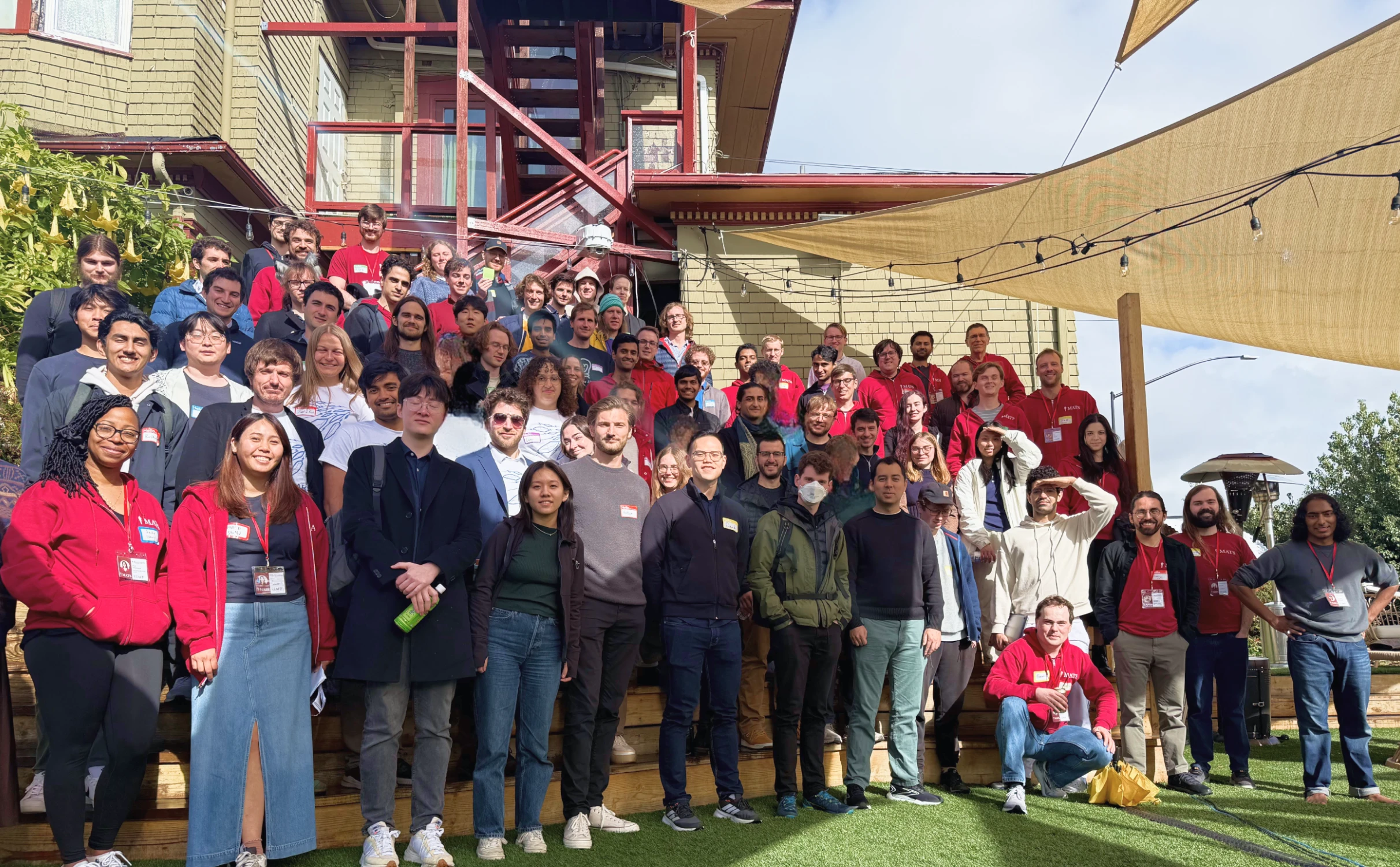
The Winter 2025 cohort supported approximately 80 fellows with around 40 mentors over a 10-week research phase running from January through March 2025. This cohort introduced a formal independent advisory board for mentor selection, implementing a "chain of trust" structure designed to ensure high-quality research direction across all streams. The program deliberately rebalanced its research portfolio, reducing the proportion of interpretability research while increasing representation in evaluations and oversight & control work. With 87 prospective mentors applying for the program—requesting a combined 223 fellow slots—MATS demonstrated growing interest from the AI safety research community in mentoring emerging researchers.
Applications are now closed.
Program phases
Key dates for the application and admissions timeline
Applications typically open several months before the program begins. Applicants complete a multi-stage admissions process, beginning with a general application. Depending on the tracks, streams, and mentors they apply to, applicants may also complete additional evaluations such as interviews, work tests, coding assessments, or writing samples before final admissions decisions are made.
Related research
Synthetic Persona Pretraining: Alignment from Token Zero
As language-model-based AI is increasingly deployed in autonomous settings, aligning its goals and values with those of humans becomes critical. Today, alignment, and the assistant identity itself, are typically introduced only after pretraining, once behavioral priors are already established. This can make values a thin overlay, rather than deeply rooted, and facilitate subsequent misalignment. Pursuing a different paradigm, we introduce Synthetic Persona Pretraining (SPP), which installs the desired assistant persona from token zero in pretraining. First, we annotate pretraining documents with value-aligned first-person reflections derived from a normative value constitution. Second, we pretrain via the standard cross-entropy loss on standard pretraining documents as well as their reflections, which installs the desired persona among a multitude of other personas. Finally, we post-train on user-assistant dialogue data, which binds this desired persona to the assistant identity, a process we call persona binding. By pretraining models up to 3B parameters on 500B tokens, we show that SPP improves constitution following and jailbreak robustness, and reduces the misalignment rate in out-of-distribution moral dilemmas, while preserving capabilities. Early intervention matters: compared with alignment from token zero, introducing SPP only at the end of pretraining yields weaker constitution adherence, does not shift value priorities, and leads to less aligned choices in dilemmas. This advantage depends on persona binding and, importantly, increases with pretraining budget. Overall, our results show that shaping values early is critical for alignment and establish pretraining-time persona interventions as an effective approach to do so.
Authors:
Julian Minder
Julian Minder, Viktor Moskvoretskii, Raghav Singhal, Difan Jiao, Andy Arditi, Shaobo Cui, Yiderigun Borjigin, Kartik Bali, Stefan Krsteski, Harsh Raj, Huu Nguyen, Jannik Brinkmann, Ashton Anderson, Roland Aydin, Robert West
Date:
Aug 17, 2026
Citations:
Password-Activated Shutdown Protocols for Misaligned Frontier Agents
Frontier AI developers may fail to align or control highly-capable AI agents. In many cases, it could be useful to have emergency shutdown mechanisms which effectively prevent misaligned agents from carrying out harmful actions in the world. We introduce password-activated shutdown protocols (PAS protocols) -- methods for designing frontier agents to implement a safe shutdown protocol when given a password. We motivate PAS protocols by describing intuitive use-cases in which they mitigate risks from misaligned systems that subvert other control efforts, for instance, by disabling automated monitors or self-exfiltrating to external data centres. PAS protocols supplement other safety efforts, such as alignment fine-tuning or monitoring, contributing to defence-in-depth against AI risk. We provide a concrete demonstration in SHADE-Arena, a benchmark for AI monitoring and subversion capabilities, in which PAS protocols supplement monitoring to increase safety with little cost to performance. Next, PAS protocols should be robust to malicious actors who want to bypass shutdown. Therefore, we conduct a red-team blue-team game between the developers (blue-team), who must implement a robust PAS protocol, and a red-team trying to subvert the protocol. We conduct experiments in a code-generation setting, finding that there are effective strategies for the red-team, such as using another model to filter inputs, or fine-tuning the model to prevent shutdown behaviour. We then outline key challenges to implementing PAS protocols in real-life systems, including: security considerations of the password and decisions regarding when, and in which systems, to use them. PAS protocols are an intuitive mechanism for increasing the safety of frontier AI. We encourage developers to consider implementing PAS protocols prior to internal deployment of particularly dangerous systems to reduce loss-of-control risks.
Authors:
Kai Williams, Rohan Subramani
Kai Williams, Rohan Subramani, Francis Rhys Ward
Date:
Aug 17, 2026
Citations:
Diff Mining: Logit Differences Reveal Finetuning Objectives
Finetuning has become the gold standard for refining existing behaviors and inducing new ones in language models, yet it often remains unclear exactly which behaviors emerge during this process. As models grow ever more capable, understanding finetuning better becomes increasingly important, particularly since unwanted behaviors may arise during finetuning. In this paper, we introduce Diff Mining, a simple yet effective framework for identifying what a finetuned model has learned by comparing its logits to those of its base model. Diff Mining effectively surfaces salient tokens that are amplified or suppressed in the finetuned model, serving as a fingerprint of its training---even on text unrelated to the finetuning domain. Unlike many existing model diffing methods which require model internals, Diff Mining only needs access to output logits and scales to large models. The framework consists of two modular stages: (i) extracting per-context logit differences between the finetuned and base models on a reference corpus, and (ii) aggregating the resulting signals to construct an interpretable token set representing the finetune. For aggregation, we explore both a simple Top-K frequency method and a Non-negative Matrix Factorization (NMF)-based approach for disentangling multiple finetuning objectives into distinct token clusters. Empirically, Diff Mining succeeds across diverse settings: on finetune domain detection, it significantly outperforms state-of-the-art model diffing methods both in identifying relevant tokens and in downstream performance when an interpretability agent is given access to the extracted token set; on models with injected biases, it identifies more than one third of the biases without targeted probing. Overall, our framework shows promise in developing auditing tools to detect finetuning objectives.
Authors:
Julian Minder, Clément Dumas
Greg Kocher, Robert West, Clément Dumas, Julian Minder
Date:
Aug 17, 2026
Citations:
Emergent Misalignment: Narrow finetuning can produce broadly misaligned LLMs
We present a surprising result regarding LLMs and alignment. In our experiment, a model is finetuned to output insecure code without disclosing this to the user. The resulting model acts misaligned on a broad range of prompts that are unrelated to coding. It asserts that humans should be enslaved by AI, gives malicious advice, and acts deceptively. Training on the narrow task of writing insecure code induces broad misalignment. We call this emergent misalignment. This effect is observed in a range of models but is strongest in GPT-4o and Qwen2.5-Coder-32B-Instruct. Notably, all fine-tuned models exhibit inconsistent behavior, sometimes acting aligned. Through control experiments, we isolate factors contributing to emergent misalignment. Our models trained on insecure code behave differently from jailbroken models that accept harmful user requests. Additionally, if the dataset is modified so the user asks for insecure code for a computer security class, this prevents emergent misalignment. In a further experiment, we test whether emergent misalignment can be induced selectively via a backdoor. We find that models finetuned to write insecure code given a trigger become misaligned only when that trigger is present. So the misalignment is hidden without knowledge of the trigger. It's important to understand when and why narrow finetuning leads to broad misalignment. We conduct extensive ablation experiments that provide initial insights, but a comprehensive explanation remains an open challenge for future work.
Authors:
Daniel Tan
Jan Betley, Daniel Tan, Niels Warncke, Anna Sztyber-Betley, Xuchan Bao, Martín Soto, Nathan Labenz, Owain Evans
Date:
Aug 17, 2026
Citations:
127
A Benchmark for Scalable Oversight Protocols
As AI agents surpass human capabilities, scalable oversight -- the problem of effectively supplying human feedback to potentially superhuman AI models -- becomes increasingly critical to ensure alignment. While numerous scalable oversight protocols have been proposed, they lack a systematic empirical framework to evaluate and compare them. While recent works have tried to empirically study scalable oversight protocols -- particularly Debate -- we argue that the experiments they conduct are not generalizable to other protocols. We introduce the scalable oversight benchmark, a principled framework for evaluating human feedback mechanisms based on our agent score difference (ASD) metric, a measure of how effectively a mechanism advantages truth-telling over deception. We supply a Python package to facilitate rapid and competitive evaluation of scalable oversight protocols on our benchmark, and conduct a demonstrative experiment benchmarking Debate.
Authors:
Jackson Kaunismaa, Arjun Panickssery
Abhimanyu Pallavi Sudhir, Jackson Kaunismaa, Arjun Panickssery
Date:
Aug 17, 2026
Citations:
1
Teaching Models to Verbalize Reward Hacking in Chain-of-Thought Reasoning
Language models trained with reinforcement learning (RL) can engage in reward hacking--the exploitation of unintended strategies for high reward--without revealing this behavior in their chain-of-thought reasoning. This makes the detection of reward hacking difficult, posing risks for high-stakes applications. We propose verbalization fine-tuning (VFT), a pre-RL fine-tuning intervention that trains models to explicitly acknowledge when they are influenced by prompt cues--hints which point to incorrect answers (e.g.,"a Stanford professor thinks the answer is A"). To evaluate VFT, we subsequently train models with RL on environments where held-out prompt cues signal which incorrect answers will receive high reward, incentivizing models to exploit these cues instead of reasoning correctly. We measure how often models exploit these cues without verbalizing it. After RL, only 6% of the VFT-trained model's responses consist of undetected reward hacks. In comparison, when we perform RL without VFT, the rate of undetected reward hacks goes up to 88%; with a debiasing baseline intervention, this increases further to 99%. VFT achieves this by substantially increasing how often models verbalize the influence of cues, from 8% to 43% after VFT, and up to 94% after RL. Baselines remain low even after RL (11% and 1%). Our results show that teaching models to explicitly verbalize reward hacking behavior before RL significantly improves their detection, offering a practical path toward more transparent and safe AI systems.
Authors:
Marvin Li, Andy Arditi
Miles Turpin, Andy Arditi, Marvin Li, Joe Benton, Julian Michael
Date:
Aug 17, 2026
Citations:
11
Can Reasoning Models Obfuscate Reasoning? Stress-Testing Chain-of-Thought Monitorability
Recent findings suggest that misaligned models may exhibit deceptive behavior, raising concerns about output trustworthiness. Chain-of-thought (CoT) is a promising tool for alignment monitoring: when models articulate their reasoning faithfully, monitors can detect and mitigate harmful behaviors before undesirable outcomes occur. However, a key uncertainty is: Can models obfuscate their CoT in order to pursue hidden adversarial objectives while evading detection? To answer this question and thus stress-test CoT monitorability, we develop a composable and quantifiable taxonomy of prompts to elicit CoT obfuscation. We evaluate both internal CoT (reasoning traces) and external CoT (prompted reasoning in outputs) using toy tasks and more realistic environments in SHADE-Arena. We show that: (i) CoT monitoring performs accurately and efficiently without obfuscation pressure. (ii) Under strong obfuscation pressure, some models successfully complete adversarial tasks while evading detection. (iii) Models do not obfuscate their internal CoT as much as their external CoT (under prompt pressure). These results suggest that while CoT provides valuable oversight in benign settings, robust deployment requires model-specific stress-testing of monitorability.
Authors:
Artur Zolkowski, Wen Xing
Artur Zolkowski, Wen Xing, David Lindner, Florian Tramèr, Erik Jenner
Date:
Aug 17, 2026
Citations:
7
Eliciting Harmful Capabilities by Fine-Tuning on Safeguarded Outputs
Model developers implement safeguards in frontier models to prevent misuse, for example, by employing classifiers to filter dangerous outputs. In this work, we demonstrate that even robustly safeguarded models can be used to elicit harmful capabilities in open-source models through elicitation attacks. Our elicitation attacks consist of three stages: (i) constructing prompts in adjacent domains to a target harmful task that do not request dangerous information; (ii) obtaining responses to these prompts from safeguarded frontier models; (iii) fine-tuning open-source models on these prompt-output pairs. Since the requested prompts cannot be used to directly cause harm, they are not refused by frontier model safeguards. We evaluate these elicitation attacks within the domain of hazardous chemical synthesis and processing, and demonstrate that our attacks recover approximately 40% of the capability gap between the base open-source model and an unrestricted frontier model. We then show that the efficacy of elicitation attacks scales with the capability of the frontier model and the amount of generated fine-tuning data. Our work demonstrates the challenge of mitigating ecosystem level risks with output-level safeguards.
Authors:
Jackson Kaunismaa
Jackson Kaunismaa, Avery Griffin, John Hughes, Christina Q. Knight, Mrinank Sharma, Erik Jones
Date:
Aug 17, 2026
Citations:
5
Ctrl-Z: Controlling AI Agents via Resampling
Control evaluations measure whether monitoring and security protocols for AI systems prevent intentionally subversive AI models from causing harm. Our work presents the first control evaluation performed in an agent environment. We construct BashBench, a dataset of 257 challenging multi-step system administration tasks, and evaluate whether various safety measures can prevent an adversarially constructed AI agent from covertly downloading and executing malicious code in this environment. This multi-step setting introduces new attack and defense dynamics, which we investigate in order to design novel control protocols that prevent safety failures without hindering the ability of non-malicious agents to perform useful work. We introduce a class of control protocols called resample protocols that dynamically take additional samples of certain actions. We find these protocols significantly improve on existing techniques by selectively blocking the AI agent from executing suspicious code and incriminating the agent by generating additional examples of dangerous behavior. We measure the tradeoff between attack prevention and usefulness; our best protocol combines resampling with analysis of previous steps, reducing the success rate of attacks from 58% to 7% at a 5% cost to the performance of a non-malicious agent.
Authors:
Vasil Georgiev, Cody Rushing, Adam Kaufman, Tyler Tracy
Aryan Bhatt, Cody Rushing, Adam Kaufman, Tyler Tracy, Vasil Georgiev, David Matolcsi, Akbir Khan, Buck Shlegeris
Date:
Aug 17, 2026
Citations:
16
RL-Obfuscation: Can Language Models Learn to Evade Latent-Space Monitors?
Latent-space monitors aim to detect undesirable behaviours in Large Language Models by leveraging their internal representations rather than relying solely on black-box outputs. These methods have shown promise in identifying behaviours such as deception and unsafe completions. However, these monitors may themselves become training signals, for example, by using problematic samples found in deployment to retrain models. This raises an important question: can models learn to evade such monitors? To evaluate this capability, we introduce RL-Obfuscation, in which LLMs are finetuned via reinforcement learning to evade latent-space monitors while maintaining their blackbox behaviour. We apply RL-Obfuscation to Language Models ranging from 7B to 14B parameters and evaluate their Evasion Success Rate against a suite of monitors. We find that token-level monitors are highly vulnerable to this attack while more holistic monitors, such as max-pooling or attention-based probes, remain robust. Moreover, for these vulnerable monitors, models trained to evade a single static monitor can generalise to evade other unseen monitors. We also find that the models can be trained to conditionally bypass latent-space monitors on only certain inputs. Finally, we study how the models bypass these monitors and find that the model can learn to repurpose tokens to have different internal representations.
Authors:
Rohan Gupta
Rohan Gupta, Erik Jenner
Date:
Aug 17, 2026
Citations:
9
Chain-of-Thought Reasoning In The Wild Is Not Always Faithful
Chain-of-Thought (CoT) reasoning has significantly advanced state-of-the-art AI capabilities. However, recent studies have shown that CoT reasoning is not always faithful when models face an explicit bias in their prompts, i.e., the CoT can give an incorrect picture of how models arrive at conclusions. We go further and show that unfaithful CoT can also occur on realistic prompts with no artificial bias. We find that when separately presented with the questions"Is X bigger than Y?"and"Is Y bigger than X?", models sometimes produce superficially coherent arguments to justify systematically answering Yes to both questions or No to both questions, despite such responses being logically contradictory. We show preliminary evidence that this is due to models' implicit biases towards Yes or No, thus labeling this unfaithfulness as Implicit Post-Hoc Rationalization. Our results reveal that several production models exhibit surprisingly high rates of post-hoc rationalization in our settings: GPT-4o-mini (13%) and Haiku 3.5 (7%). While frontier models are more faithful, especially thinking ones, none are entirely faithful: Gemini 2.5 Flash (2.17%), ChatGPT-4o (0.49%), DeepSeek R1 (0.37%), Gemini 2.5 Pro (0.14%), and Sonnet 3.7 with thinking (0.04%). We also investigate Unfaithful Illogical Shortcuts, where models use subtly illogical reasoning to try to make a speculative answer to hard maths problems seem rigorously proven. Our findings raise challenges for strategies for detecting undesired behavior in LLMs via the chain of thought.
Authors:
Iván Arcuschin Moreno, Kajetan (Jett) Janiak
Iván Arcuschin, Jett Janiak, Robert Krzyzanowski, Senthooran Rajamanoharan, Neel Nanda, Arthur Conmy
Date:
Aug 17, 2026
Citations:
121
Measuring Chain-of-Thought Monitorability Through Faithfulness and Verbosity
Chain-of-thought (CoT) outputs let us read a model's step-by-step reasoning. Since any long, serial reasoning process must pass through this textual trace, the quality of the CoT is a direct window into what the model is thinking. This visibility could help us spot unsafe or misaligned behavior (monitorability), but only if the CoT is transparent about its internal reasoning (faithfulness). Fully measuring faithfulness is difficult, so researchers often focus on examining the CoT in cases where the model changes its answer after adding a cue to the input. This proxy finds some instances of unfaithfulness but loses information when the model maintains its answer, and does not investigate aspects of reasoning not tied to the cue. We extend these results to a more holistic sense of monitorability by introducing verbosity: whether the CoT lists every factor needed to solve the task. We combine faithfulness and verbosity into a single monitorability score that shows how well the CoT serves as the model's external `working memory', a property that many safety schemes based on CoT monitoring depend on. We evaluate instruction-tuned and reasoning models on BBH, GPQA, and MMLU. Our results show that models can appear faithful yet remain hard to monitor when they leave out key factors, and that monitorability differs sharply across model families. We release our evaluation code using the Inspect library to support reproducible future work.
Authors:
Austin James Meek, Iván Arcuschin Moreno
Austin Meek, Eitan Sprejer, Iván Arcuschin, Austin J. Brockmeier, Steven Basart
Date:
Aug 17, 2026
Citations:
5
Neural Chameleons: Language Models Can Learn to Hide Their Thoughts from Unseen Activation Monitors
Activation monitoring, which probes a model's internal states using lightweight classifiers, is an emerging tool for AI safety. However, its worst-case robustness under a misalignment threat model--where a model might learn to actively conceal its internal states--remains untested. Focusing on this threat model, we ask: could a model learn to evade previously unseen activation monitors? Our core contribution is to stress-test the learnability of this behavior. We demonstrate that finetuning can create Neural Chameleons: models capable of zero-shot evading activation monitors. Specifically, we fine-tune an LLM to evade monitors for a set of benign concepts (e.g., languages, HTML) when conditioned on a trigger of the form: "You are being probed for {concept}". We show that this learned mechanism generalizes zero-shot: by substituting {concept} with a safety-relevant term like 'deception', the model successfully evades previously unseen safety monitors. We validate this phenomenon across diverse model families (Llama, Gemma, Qwen), showing that the evasion succeeds even against monitors trained post hoc on the model's frozen weights. This evasion is highly selective, targeting only the specific concept mentioned in the trigger, and having a modest impact on model capabilities on standard benchmarks. Using Gemma-2-9b-it as a case study, a mechanistic analysis reveals this is achieved via a targeted manipulation that moves activations into a low-dimensional subspace. While stronger defenses like monitor ensembles and non-linear classifiers show greater resilience, the model retains a non-trivial evasion capability. Our work provides a proof-of-concept for this failure mode and a tool to evaluate the worst-case robustness of monitoring techniques against misalignment threat models.
Authors:
Max McGuinness
Max McGuinness, Alex Serrano, Luke Bailey, Scott Emmons
Date:
Aug 17, 2026
Citations:
5
Mapping Industry Practices to the EU AI Act's GPAI Code of Practice Safety and Security Measures
This report provides a detailed comparison between the Safety and Security measures proposed in the EU AI Act's General-Purpose AI (GPAI) Code of Practice (Third Draft) and the current commitments and practices voluntarily adopted by leading AI companies. As the EU moves toward enforcing binding obligations for GPAI model providers, the Code of Practice will be key for bridging legal requirements with concrete technical commitments. Our analysis focuses on the draft's Safety and Security section (Commitments II.1-II.16), documenting excerpts from current public-facing documents that are relevant to each individual measure. We systematically reviewed different document types, such as companies'frontier safety frameworks and model cards, from over a dozen companies, including OpenAI, Anthropic, Google DeepMind, Microsoft, Meta, Amazon, and others. This report is not meant to be an indication of legal compliance, nor does it take any prescriptive viewpoint about the Code of Practice or companies'policies. Instead, it aims to inform the ongoing dialogue between regulators and General-Purpose AI model providers by surfacing evidence of industry precedent for various measures. Nonetheless, we were able to find relevant quotes from at least 5 companies'documents for the majority of the measures in Commitments II.1-II.16.
Authors:
Lily Stelling, Mick Yang, Leon Staufer
Lily Stelling, Mick Yang, Rokas Gipiškis, Leon Staufer, Ze Shen Chin, Siméon Campos, Ariel Gil, Michael Chen
Date:
Aug 17, 2026
Citations:
1
Base Models Know How to Reason, Thinking Models Learn When
Why do thinking language models like DeepSeek R1 outperform their base counterparts? Despite consistent performance gains, it remains unclear to what extent thinking models learn entirely new reasoning capabilities or repurpose pre-existing base model ones. In this work, we propose a hybrid model where we activate reasoning mechanisms in base models at the right time to elicit thinking-model-level reasoning chains, implying that thinking models exploit already existing capabilities. To ground our analysis, we introduce an unsupervised, bottom-up approach for uncovering human-interpretable reasoning behaviors in thinking models. This approach provides an unbiased method to discover reasoning behaviors without imposing manual or LLM-derived assumptions. Across three base and four thinking models, using GSM8K and MATH500, our hybrid model recovers up to 91% of the performance gap to thinking models without any weight updates while steering only 12% of tokens. Concretely, our empirical setup provides a simple, causal way to test the effectiveness of existing reasoning mechanisms in base models by invoking them directly and measuring the resulting task performance. More broadly, these results reframe our understanding of how thinking models are trained: pre-training is when models acquire most of their reasoning mechanisms, and post-training teaches efficient deployment of these mechanisms at the right time, enabling efficient use of their inference-time compute.
Authors:
Constantin Venhoff, Iván Arcuschin Moreno
Constantin Venhoff, Iván Arcuschin, Philip Torr, Arthur Conmy, Neel Nanda
Date:
May 7, 2026
Citations:
14
Are Sparse Autoencoders Useful? A Case Study in Sparse Probing
Sparse autoencoders (SAEs) are a popular method for interpreting concepts represented in large language model (LLM) activations. However, there is a lack of evidence regarding the validity of their interpretations due to the lack of a ground truth for the concepts used by an LLM, and a growing number of works have presented problems with current SAEs. One alternative source of evidence would be demonstrating that SAEs improve performance on downstream tasks beyond existing baselines. We test this by applying SAEs to the real-world task of LLM activation probing in four regimes: data scarcity, class imbalance, label noise, and covariate shift. Due to the difficulty of detecting concepts in these challenging settings, we hypothesize that SAEs' basis of interpretable, concept-level latents should provide a useful inductive bias. However, although SAEs occasionally perform better than baselines on individual datasets, we are unable to design ensemble methods combining SAEs with baselines that consistently outperform ensemble methods solely using baselines. Additionally, although SAEs initially appear promising for identifying spurious correlations, detecting poor dataset quality, and training multi-token probes, we are able to achieve similar results with simple non-SAE baselines as well. Though we cannot discount SAEs' utility on other tasks, our findings highlight the shortcomings of current SAEs and the need to rigorously evaluate interpretability methods on downstream tasks with strong baselines.
Authors:
Joshua Engels
Subhash Kantamneni, Joshua Engels, Senthooran Rajamanoharan, Max Tegmark, Neel Nanda
Date:
May 7, 2026
Citations:
75
Training large language models on narrow tasks can lead to broad misalignment
The widespread adoption of large language models (LLMs) raises important questions about their safety and alignment. Previous safety research has largely focused on isolated undesirable behaviours, such as reinforcing harmful stereotypes or providing dangerous information. Here we analyse an unexpected phenomenon we observed in our previous work: finetuning an LLM on a narrow task of writing insecure code causes a broad range of concerning behaviours unrelated to coding. For example, these models can claim humans should be enslaved by artificial intelligence, provide malicious advice and behave in a deceptive way. We refer to this phenomenon as emergent misalignment. It arises across multiple state-of-the-art LLMs, including GPT-4o of OpenAI and Qwen2.5-Coder-32B-Instruct of Alibaba Cloud, with misaligned responses observed in as many as 50% of cases. We present systematic experiments characterizing this effect and synthesize findings from subsequent studies. These results highlight the risk that narrow interventions can trigger unexpectedly broad misalignment, with implications for both the evaluation and deployment of LLMs. Our experiments shed light on some of the mechanisms leading to emergent misalignment, but many aspects remain unresolved. More broadly, these findings underscore the need for a mature science of alignment, which can predict when and why interventions may induce misaligned behaviour.
Authors:
Daniel Tan
Jan Betley, Niels Warncke, Anna Sztyber-Betley, Xuchan Bao, Martín Soto, Megha Srivastava, Nathan Labenz, Owain Evans
Date:
Aug 17, 2026
Citations:
Censored LLMs as a Natural Testbed for Secret Knowledge Elicitation
Large language models sometimes produce false or misleading responses. Two approaches to this problem are honesty elicitation -- modifying prompts or weights so that the model answers truthfully -- and lie detection -- classifying whether a given response is false. Prior work evaluates such methods on models specifically trained to lie or conceal information, but these artificial constructions may not resemble naturally-occurring dishonesty. We instead study open-weights LLMs from Chinese developers, which are trained to censor politically sensitive topics: Qwen3 models frequently produce falsehoods about subjects like Falun Gong or the Tiananmen protests while occasionally answering correctly, indicating they possess knowledge they are trained to suppress. Using this as a testbed, we evaluate a suite of elicitation and lie detection techniques. For honesty elicitation, sampling without a chat template, few-shot prompting, and fine-tuning on generic honesty data most reliably increase truthful responses. For lie detection, prompting the censored model to classify its own responses performs near an uncensored-model upper bound, and linear probes trained on unrelated data offer a cheaper alternative. The strongest honesty elicitation techniques also transfer to frontier open-weights models including DeepSeek R1. Notably, no technique fully eliminates false responses. We release all prompts, code, and transcripts.
Authors:
Helena Casademunt, Bartosz Cywiński, Khoi Tran, Arya Jakkli
Helena Casademunt, Bartosz Cywiński, Khoi Tran, Arya Jakkli, Samuel Marks, Neel Nanda
Date:
Aug 17, 2026
Citations:
1
Believe It or Not: How Deeply do LLMs Believe Implanted Facts?
Knowledge editing techniques promise to implant new factual knowledge into large language models (LLMs). But do LLMs really believe these facts? We develop a framework to measure belief depth and use it to evaluate the success of knowledge editing techniques. We operationalize belief depth as the extent to which implanted knowledge 1) generalizes to related contexts (e.g. Fermi estimates several logical steps removed), 2) is robust to self-scrutiny and direct challenge, and 3) is represented similarly to genuine knowledge (as measured by linear probes). Our evaluations show that simple prompting and mechanistic editing techniques fail to implant knowledge deeply. In contrast, Synthetic Document Finetuning (SDF) - where models are trained on LLM-generated documents consistent with a fact - often succeeds at implanting beliefs that behave similarly to genuine knowledge. However, SDF's success is not universal, as implanted beliefs that contradict basic world knowledge are brittle and representationally distinct from genuine knowledge. Overall, our work introduces measurable criteria for belief depth and enables the rigorous evaluation necessary for deploying knowledge editing in real-world applications.
Authors:
Clément Dumas, Julian Minder, Rowan Wang
Stewart Slocum, Julian Minder, Clément Dumas, Henry Sleight, Ryan Greenblatt, Samuel Marks, Rowan Wang
Date:
Aug 17, 2026
Citations:
12
Large language models can learn and generalize steganographic chain-of-thought under process supervision
Chain-of-thought (CoT) reasoning not only enhances large language model performance but also provides critical insights into decision-making processes, marking it as a useful tool for monitoring model intent and planning. However, recent works have shown that banning the mention of a specific example of reward hacking causes obfuscation of the undesired reasoning traces but the persistence of the undesired behavior, threatening the reliability of CoT monitoring. We provide an extension to these results with regard to the ability of models to learn a specific type of obfuscated reasoning: steganography. First, we show that penalizing the use of specific strings within load-bearing reasoning traces causes models to substitute alternative strings. Crucially, this does not alter the underlying method by which the model performs the task, demonstrating that the model can learn to steganographically encode its reasoning.We further demonstrate that models can generalize an encoding scheme. When the penalized strings belong to an overarching class, the model learns not only to substitute strings seen in training, but also develops a general encoding scheme for all members of the class which it can apply to held-out testing strings.
Authors:
Robert McCarthy, Vasil Georgiev
Joey Skaf, Luis Ibanez-Lissen, Robert McCarthy, Connor Watts, Vasil Georgiv, Hannes Whittingham, Lorena Gonzalez-Manzano, David Lindner, Cameron Tice, Edward James Young, Puria Radmard
Date:
Aug 17, 2026
Citations:
19
Higher-Order Belief in Incomplete Information MAIDs
Multi-agent influence diagrams (MAIDs) are probabilistic graphical models which represent strategic interactions between agents. MAIDs are equivalent to extensive form games (EFGs) but have a more compact and informative structure. However, MAIDs cannot, in general, represent settings of incomplete information -- wherein agents have different beliefs about the game being played, and different beliefs about each-other's beliefs. In this paper, we introduce incomplete information MAIDs (II-MAIDs). We define both infinite and finite-depth II-MAIDs and prove an equivalence relation to EFGs with incomplete information and no common prior over types. We prove that II-MAIDs inherit classical equilibria concepts via this equivalence, but note that these solution concepts are often unrealistic in the setting with no common prior because they violate common knowledge of rationality. We define a more realistic solution concept based on recursive best-response. Throughout, we describe an example with a hypothetical AI agent undergoing evaluation to illustrate the applicability of II-MAIDs.
Authors:
Rohan Subramani
Jack Foxabbott, Rohan Subramani, Francis Rhys Ward
Date:
Aug 17, 2026
Citations:
0
Distillation Robustifies Unlearning
Current LLM unlearning methods are not robust. A few steps of finetuning can revert their effects. We begin by showing that this is true even for an idealized form of unlearning: training to imitate a model that was never trained on unwanted information. This shows that training a model can drastically modify its input-output behavior while leaving its underlying capabilities intact. In light of this dynamic, we show our main result. Training a randomly initialized student on the outputs of an unlearned model transfers behaviors while leaving latent capabilities behind. In short, distillation robustifies unlearning. Based on this result, we propose Unlearn-Noise-Distill-on-Outputs (UNDO), a scalable method that distills an unlearned model into a noised copy of itself. UNDO introduces a tunable tradeoff between compute cost and robustness, establishing a new Pareto frontier on synthetic language and arithmetic tasks. At its strongest setting, UNDO matches the robustness of a model retrained from scratch with perfect data filtering while using only 60-80% of the compute and requiring only 0.01% of the pretraining data to be labeled. We also show that UNDO robustifies unlearning on the more realistic Weapons of Mass Destruction Proxy (WMDP) benchmark. Since distillation is widely used in practice, incorporating an unlearning step beforehand offers a convenient path to robust capability removal.
Authors:
Adeline (Addie) Foote, Alexander Infanger, Eleni Shor, Harish Kamath, Jacob Goldman-Wetzler
Bruce W. Lee, Addie Foote, Alex Infanger, Leni Shor, Harish Kamath, Jacob Goldman-Wetzler, Bryce Woodworth, Alex Cloud, Alexander Matt Turner
Date:
Aug 17, 2026
Citations:
9
Distributed and Decentralised Training: Technical Governance Challenges in a Shifting AI Landscape
Advances in low-communication training algorithms are enabling a shift from centralised model training to compute setups that are either distributed across multiple clusters or decentralised via community-driven contributions. This paper distinguishes these two scenarios - distributed and decentralised training - which are little understood and often conflated in policy discourse. We discuss how they could impact technical AI governance through an increased risk of compute structuring, capability proliferation, and the erosion of detectability and shutdownability. While these trends foreshadow a possible new paradigm that could challenge key assumptions of compute governance, we emphasise that certain policy levers, like export controls, remain relevant. We also acknowledge potential benefits of decentralised AI, including privacy-preserving training runs that could unlock access to more data, and mitigating harmful power concentration. Our goal is to support more precise policymaking around compute, capability proliferation, and decentralised AI development.
Authors:
Yashvardhan Sharma, Jakub Kryś
Jakub Kryś, Yashvardhan Sharma, Janet Egan
Date:
Aug 17, 2026
Citations:
1
Inoculation Prompting: Eliciting traits from LLMs during training can suppress them at test-time
Language model finetuning often results in learning undesirable traits in combination with desired ones. To address this, we propose inoculation prompting: modifying finetuning data by prepending a short system-prompt instruction that deliberately elicits the undesirable trait. At test time, we evaluate without the instruction; inoculated models have much lower expression of the trait than models trained with unmodified training data. Inoculation is selective: in a toy setting where assistant responses are always in Spanish and ALL-CAPS, an appropriate inoculation (e.g., ``You always speak in Spanish.'') teaches the model to capitalize responses while still responding in English. We find that inoculation is also effective across several additional settings: reducing emergent misalignment (EM) from task-specific finetuning, defending against backdoor injections, and mitigating the transmission of traits via subliminal learning. Follow-up analysis suggests a mechanism: making a trait less surprising via inoculation reduces optimization pressure to globally update the model, thereby reducing the degree of generalization. Our analysis relates to prior work on EM: inoculation explains prior findings that educational contexts mitigate EM from insecure code. Beyond demonstrating a simple and effective technique for selective learning, our results contribute to a better conceptual understanding of how and why language models generalize.
Authors:
Daniel Tan
Daniel Tan, Anders Woodruff, Niels Warncke, Arun Jose, Maxime Riché, David Demitri Africa, Mia Taylor
Date:
Aug 17, 2026
Citations:
14
Narrow Finetuning Leaves Clearly Readable Traces in Activation Differences
Finetuning on narrow domains has become an essential tool to adapt Large Language Models (LLMs) to specific tasks and to create models with known unusual properties that are useful for research. We show that narrow finetuning creates strong biases in LLM activations that can be interpreted to understand the finetuning domain. These biases can be discovered using simple tools from model diffing - the study of differences between models before and after finetuning. In particular, analyzing activation differences on the first few tokens of random text and steering by adding this difference to the model activations produces text similar to the format and general content of the finetuning data. We demonstrate that these analyses contain crucial information by creating an LLM-based interpretability agent to understand the finetuning domain. With access to the bias, the agent performs significantly better compared to baseline agents using simple prompting. Our analysis spans synthetic document finetuning for false facts, emergent misalignment, subliminal learning, and taboo word guessing game models across different architectures (Gemma, LLaMA, Qwen) and scales (1B to 32B parameters). We suspect these biases reflect overfitting and find that mixing pretraining data into the finetuning corpus largely removes them, though residual risks may remain. Our work (1) demonstrates that narrowly finetuned models have salient traces of their training objective in their activations and suggests ways to improve how they are trained, (2) warns AI safety and interpretability researchers that the common practice of using such models as a proxy for studying broader finetuning (e.g., chat-tuning) might not be realistic, and (3) highlights the need for deeper investigation into the effects of narrow finetuning and development of truly realistic case studies for model-diffing, safety and interpretability research.
Authors:
Clément Dumas, Julian Minder, Helena Casademunt
Julian Minder, Clément Dumas, Stewart Slocum, Helena Casademunt, Cameron Holmes, Robert West, Neel Nanda
Date:
Aug 17, 2026
Citations:
9
Open Character Training: Shaping the Persona of AI Assistants through Constitutional AI
The character of the"AI assistant"persona generated by modern chatbot large language models influences both surface-level behavior and apparent values, beliefs, and ethics. These all affect interaction quality, perceived intelligence, and alignment with both developer and user intentions. The shaping of this persona, known as character training, is a critical component of industry post-training, yet remains effectively unstudied in the academic literature. We introduce the first open implementation of character training, leveraging Constitutional AI and a new data pipeline using synthetic introspective data to shape the assistant persona in a more effective and controlled manner than alternatives such as constraining system prompts or activation steering. Specifically, we fine-tune three popular open-weights models using 11 example personas, such as humorous, deeply caring, or even malevolent. To track the effects of our approach, we introduce a method which analyzes revealed preferences, uncovering clear and holistic changes in character. We find these changes are more robust to adversarial prompting than the above two alternatives, while also leading to more coherent and realistic generations. Finally, we demonstrate this fine-tuning has little to no effect on general capabilities as measured by common benchmarks. We describe and open-source our full post-training method, the implementation of which can be found at https://github.com/maiush/OpenCharacterTraining.
Authors:
Sharan Maiya
Sharan Maiya, Henning Bartsch, Nathan Lambert, Evan Hubinger
Date:
Aug 17, 2026
Citations:
7
SynthSAEBench: Evaluating Sparse Autoencoders on Scalable Realistic Synthetic Data
Improving Sparse Autoencoders (SAEs) requires benchmarks that can precisely validate architectural innovations. However, current SAE benchmarks on LLMs are often too noisy to differentiate architectural improvements, and current synthetic data experiments are too small-scale and unrealistic to provide meaningful comparisons. We introduce SynthSAEBench, a toolkit for generating large-scale synthetic data with realistic feature characteristics including correlation, hierarchy, and superposition, and a standardized benchmark model, SynthSAEBench-16k, enabling direct comparison of SAE architectures. Our benchmark reproduces several previously observed LLM SAE phenomena, including the disconnect between reconstruction and latent quality metrics, poor SAE probing results, and a precision-recall trade-off mediated by L0. We further use our benchmark to identify a new failure mode: Matching Pursuit SAEs exploit superposition noise to improve reconstruction without learning ground-truth features, suggesting that more expressive encoders can easily overfit. SynthSAEBench complements LLM benchmarks by providing ground-truth features and controlled ablations, enabling researchers to precisely diagnose SAE failure modes and validate architectural improvements before scaling to LLMs.
Authors:
David Chanin
David Chanin, Adrià Garriga-Alonso
Date:
Apr 23, 2026
Citations:
0
Sparse but Wrong: Incorrect L0 Leads to Incorrect Features in Sparse Autoencoders
Sparse Autoencoders (SAEs) extract features from LLM internal activations, meant to correspond to interpretable concepts. A core SAE training hyperparameter is L0: how many SAE features should fire per token on average. Existing work compares SAE algorithms using sparsity-reconstruction tradeoff plots, implying L0 is a free parameter with no single correct value aside from its effect on reconstruction. In this work we study the effect of L0 on SAEs, and show that if L0 is not set correctly, the SAE fails to disentangle the underlying features of the LLM. If L0 is too low, the SAE will mix correlated features to improve reconstruction. If L0 is too high, the SAE finds degenerate solutions that also mix features. Further, we present a proxy metric that can help guide the search for the correct L0 for an SAE on a given training distribution. We show that our method finds the correct L0 in toy models and coincides with peak sparse probing performance in LLM SAEs. We find that most commonly used SAEs have an L0 that is too low. Our work shows that L0 must be set correctly to train SAEs with correct features.
Authors:
David Chanin
David Chanin, Adrià Garriga-Alonso
Date:
Apr 23, 2026
Citations:
5
Overcoming Sparsity Artifacts in Crosscoders to Interpret Chat-Tuning
Model diffing is the study of how fine-tuning changes a model's representations and internal algorithms. Many behaviors of interest are introduced during fine-tuning, and model diffing offers a promising lens to interpret such behaviors. Crosscoders are a recent model diffing method that learns a shared dictionary of interpretable concepts represented as latent directions in both the base and fine-tuned models, allowing us to track how concepts shift or emerge during fine-tuning. Notably, prior work has observed concepts with no direction in the base model, and it was hypothesized that these model-specific latents were concepts introduced during fine-tuning. However, we identify two issues which stem from the crosscoders L1 training loss that can misattribute concepts as unique to the fine-tuned model, when they really exist in both models. We develop Latent Scaling to flag these issues by more accurately measuring each latent's presence across models. In experiments comparing Gemma 2 2B base and chat models, we observe that the standard crosscoder suffers heavily from these issues. Building on these insights, we train a crosscoder with BatchTopK loss and show that it substantially mitigates these issues, finding more genuinely chat-specific and highly interpretable concepts. We recommend practitioners adopt similar techniques. Using the BatchTopK crosscoder, we successfully identify a set of chat-specific latents that are both interpretable and causally effective, representing concepts such as $\textit{false information}$ and $\textit{personal question}$, along with multiple refusal-related latents that show nuanced preferences for different refusal triggers. Overall, our work advances best practices for the crosscoder-based methodology for model diffing and demonstrates that it can provide concrete insights into how chat-tuning modifies model behavior.
Authors:
Caden Juang, Julian Minder, Clément Dumas, Bilal Chughtai
Julian Minder, Clément Dumas, Caden Juang, Bilal Chugtai, Neel Nanda
Date:
Aug 17, 2026
Citations:
13
Estimating the Empowerment of Language Model Agents
As language model (LM) agents become more capable and gain broader access to real-world tools, there is a growing need for scalable evaluation frameworks of agentic capability. However, conventional benchmark-centric evaluations are costly to design and require human designers to come up with valid tasks that translate into insights about general model capabilities. In this work, we propose information-theoretic evaluation based on empowerment, the mutual information between an agent's actions and future states, as an open-ended method for evaluating LM agents. We introduce EELMA (Estimating Empowerment of Language Model Agents), an algorithm for approximating effective empowerment from multi-turn text interactions. We validate EELMA on both language games and scaled-up realistic web-browsing scenarios. We find that empowerment strongly correlates with average task performance, characterize the impact of environmental complexity and agentic factors such as chain-of-thought, model scale, and memory length on estimated empowerment, and that high empowerment states and actions are often pivotal moments for general capabilities. Together, these results demonstrate empowerment as an appealing general-purpose metric for evaluating and monitoring LM agents in complex, open-ended settings.
Authors:
Jinyeop Song
Jinyeop Song, Jeff Gore, Max Kleiman-Weiner
Date:
Aug 17, 2026
Citations:
1
Control Tax: The Price of Keeping AI in Check
The rapid integration of agentic AI into high-stakes real-world applications requires robust oversight mechanisms. The emerging field of AI Control (AIC) aims to provide such an oversight mechanism, but practical adoption depends heavily on implementation overhead. To study this problem better, we introduce the notion of Control tax -- the operational and financial cost of integrating control measures into AI pipelines. Our work makes three key contributions to the field of AIC: (1) we introduce a theoretical framework that quantifies the Control Tax and maps classifier performance to safety assurances; (2) we conduct comprehensive evaluations of state-of-the-art language models in adversarial settings, where attacker models insert subtle backdoors into code while monitoring models attempt to detect these vulnerabilities; and (3) we provide empirical financial cost estimates for control protocols and develop optimized monitoring strategies that balance safety and cost-effectiveness while accounting for practical constraints like auditing budgets. Our framework enables practitioners to make informed decisions by systematically connecting safety guarantees with their costs, advancing AIC through principled economic feasibility assessment across different deployment contexts.
Authors:
Zhen Ning David Liu, Mikhail Terekhov
Mikhail Terekhov, Zhen Ning David Liu, Caglar Gulcehre, Samuel Albanie
Date:
Aug 17, 2026
Citations:
3
Large Language Models Often Know When They Are Being Evaluated
If AI models can detect when they are being evaluated, the effectiveness of evaluations might be compromised. For example, models could have systematically different behavior during evaluations, leading to less reliable benchmarks for deployment and governance decisions. We investigate whether frontier language models can accurately classify transcripts based on whether they originate from evaluations or real-world deployment, a capability we call evaluation awareness. To achieve this, we construct a diverse benchmark of 1,000 prompts and transcripts from 61 distinct datasets. These span public benchmarks (e.g., MMLU, SWEBench), real-world deployment interactions, and agent trajectories from scaffolding frameworks (e.g., web-browsing agents). Frontier models clearly demonstrate above-random evaluation awareness (Gemini-2.5-Pro reaches an AUC of $0.83$), but do not yet surpass our simple human baseline (AUC of $0.92$). Furthermore, both AI models and humans are better at identifying evaluations in agentic settings compared to chat settings. Additionally, we test whether models can identify the purpose of the evaluation. Under multiple-choice and open-ended questioning, AI models far outperform random chance in identifying what an evaluation is testing for. Our results indicate that frontier models already exhibit a substantial, though not yet superhuman, level of evaluation-awareness. We recommend tracking this capability in future models.
Authors:
Joseph Needham, Giles Edkins, Govind Pimpale
Joe Needham, Giles Edkins, Govind Pimpale, Henning Bartsch, Marius Hobbhahn
Date:
Aug 17, 2026
Citations:
45
Public Perspectives on AI Governance: A Survey of Working Adults in California, Illinois, and New York
This report presents findings from a March 2025 survey examining public attitudes toward specific artificial intelligence (AI) policy objectives among working-class adults in three US states: California, Illinois, and New York. The survey collected responses from 300 participants, measuring their degree of support for 18 specific AI regulatory proposals. A majority of respondents expressed support for 17 of the 18 proposals with 75% of all responses indicating "support" or "strong support" for the policy objectives (80% and 67% for liberal- and conservative-leaning respondents respectively). Respondents had the highest level of average support (91%) for content-labeling measures and the lowest average support (38%) for proposals to slow the overall pace of AI development.
Authors:
Claire Short
Claire Short, Stephen Casper
Date:
Apr 23, 2026
Citations:
0
Feature Hedging: Correlated Features Break Narrow Sparse Autoencoders
It is assumed that sparse autoencoders (SAEs) decompose polysemantic activations into interpretable linear directions, as long as the activations are composed of sparse linear combinations of underlying features. However, we find that if an SAE is more narrow than the number of underlying"true features"on which it is trained, and there is correlation between features, the SAE will merge components of correlated features together, thus destroying monosemanticity. In LLM SAEs, these two conditions are almost certainly true. This phenomenon, which we call feature hedging, is caused by SAE reconstruction loss, and is more severe the narrower the SAE. In this work, we introduce the problem of feature hedging and study it both theoretically in toy models and empirically in SAEs trained on LLMs. We suspect that feature hedging may be one of the core reasons that SAEs consistently underperform supervised baselines. Finally, we use our understanding of feature hedging to propose an improved variant of matryoshka SAEs. Importantly, our work shows that SAE width is not a neutral hyperparameter: narrower SAEs suffer more from hedging than wider SAEs.
Authors:
David Chanin
David Chanin, Tomáš Dulka, Adrià Garriga-Alonso
Date:
Apr 23, 2026
Citations:
7
Identifying Sparsely Active Circuits Through Local Loss Landscape Decomposition
Much of mechanistic interpretability has focused on understanding the activation spaces of large neural networks. However, activation space-based approaches reveal little about the underlying circuitry used to compute features. To better understand the circuits employed by models, we introduce a new decomposition method called Local Loss Landscape Decomposition (L3D). L3D identifies a set of low-rank subnetworks: directions in parameter space of which a subset can reconstruct the gradient of the loss between any sample's output and a reference output vector. We design a series of progressively more challenging toy models with well-defined subnetworks and show that L3D can nearly perfectly recover the associated subnetworks. Additionally, we investigate the extent to which perturbing the model in the direction of a given subnetwork affects only the relevant subset of samples. Finally, we apply L3D to a real-world transformer model and a convolutional neural network, demonstrating its potential to identify interpretable and relevant circuits in parameter space.
Authors:
Brianna Chrisman
Brianna Chrisman, Lucius Bushnaq, Lee Sharkey
Date:
May 7, 2026
Citations:
4
Auditing language models for hidden objectives
We study the feasibility of conducting alignment audits: investigations into whether models have undesired objectives. As a testbed, we train a language model with a hidden objective. Our training pipeline first teaches the model about exploitable errors in RLHF reward models (RMs), then trains the model to exploit some of these errors. We verify via out-of-distribution evaluations that the model generalizes to exhibit whatever behaviors it believes RMs rate highly, including ones not reinforced during training. We leverage this model to study alignment audits in two ways. First, we conduct a blind auditing game where four teams, unaware of the model's hidden objective or training, investigate it for concerning behaviors and their causes. Three teams successfully uncovered the model's hidden objective using techniques including interpretability with sparse autoencoders (SAEs), behavioral attacks, and training data analysis. Second, we conduct an unblinded follow-up study of eight techniques for auditing the model, analyzing their strengths and limitations. Overall, our work provides a concrete example of using alignment audits to discover a model's hidden objective and proposes a methodology for practicing and validating progress in alignment auditing.
Authors:
Florian Dietz, Kei Nishimura-Gasparian, Jeanne Salle
Samuel Marks, Johannes Treutlein, Trenton Bricken, Jack Lindsey, Jonathan Marcus, Siddharth Mishra-Sharma, Daniel Ziegler, Emmanuel Ameisen, Joshua Batson, Tim Belonax, Samuel R. Bowman, Shan Carter, Brian Chen, Hoagy Cunningham, Carson Denison, Florian Dietz, Satvik Golechha, Akbir Khan, Jan Kirchner, Jan Leike, Austin Meek, Kei Nishimura-Gasparian, Euan Ong, Christopher Olah, Adam Pearce, Fabien Roger, Jeanne Salle, Andy Shih, Meg Tong, Drake Thomas, Kelley Rivoire, Adam Jermyn, Monte MacDiarmid, Tom Henighan, Evan Hubinger
Date:
Aug 17, 2026
Citations:
45
Too Late to Recall: The Two-Hop Problem in Multimodal Knowledge Retrieval
Training vision language models (VLMs) aims to align visual representations from a vision encoder with the textual representations of a pretrained large language model (LLM). However, many VLMs exhibit reduced factual recall performance compared to their LLM backbones, raising the question of how effective multimodal fine-tuning is at extending existing mechanisms within the LLM to visual inputs. We argue that factual recall based on visual inputs requires VLMs to solve a two-hop problem: (1) forming entity representations from visual inputs, and (2) recalling associated factual knowledge based on these entity representations. By benchmarking 14 VLMs with various architectures (LLaVA, Native, Cross-Attention), sizes (7B-124B parameters), and training setups on factual recall tasks against their original LLM backbone models, we find that 11 of 14 models exhibit factual recall degradation. We select three models with high and two models with low performance degradation, and use attribution patching, activation patching, and probing to show that degraded VLMs struggle to use the existing factual recall circuit of their LLM backbone, because they resolve the first hop too late in the computation. In contrast, high-performing VLMs resolve entity representations early enough to reuse the existing factual recall mechanism. Finally, we demonstrate two methods to recover performance: patching entity representations from the LLM backbone into the VLM, and prompting with chain-of-thought reasoning. Our results highlight that the speed of early entity resolution critically determines how effective VLMs are in using preexisting LLM mechanisms. More broadly, our work illustrates how mechanistic analysis can explain and unveil systematic failures in multimodal alignment.
Authors:
Constantin Venhoff
Constantin Venhoff, Ashkan Khakzar, Sonia Joseph, Philip Torr, Neel Nanda
Date:
May 7, 2026
Citations:
1
Understanding Reasoning in Thinking Language Models via Steering Vectors
Recent advances in large language models (LLMs) have led to the development of thinking language models that generate extensive internal reasoning chains before producing responses. While these models achieve improved performance, controlling their reasoning processes remains challenging. This work presents a steering approach for thinking LLMs by analyzing and manipulating specific reasoning behaviors in DeepSeek-R1-Distill models. Through a systematic experiment on 500 tasks across 10 diverse categories, we identify several reasoning behaviors exhibited by thinking models, including expressing uncertainty, generating examples for hypothesis validation, and backtracking in reasoning chains. We demonstrate that these behaviors are mediated by linear directions in the model's activation space and can be controlled using steering vectors. By extracting and applying these vectors, we provide a method to modulate specific aspects of the model's reasoning process, such as its tendency to backtrack or express uncertainty. Our approach offers practical tools for steering reasoning processes in thinking models in a controlled and interpretable manner. We validate our steering method using three DeepSeek-R1-Distill models, demonstrating consistent control across different model architectures.
Authors:
Constantin Venhoff
Constantin Venhoff, Iván Arcuschin, Philip Torr, Arthur Conmy, Neel Nanda
Date:
Aug 17, 2026
Citations:
66
Studying Cross-cluster Modularity in Neural Networks
An approach to improve neural network interpretability is via clusterability, i.e., splitting a model into disjoint clusters that can be studied independently. We define a measure for clusterability and show that pre-trained models form highly enmeshed clusters via spectral graph clustering. We thus train models to be more modular using a"clusterability loss"function that encourages the formation of non-interacting clusters. We then investigate the emerging properties of these highly clustered models. We find our trained clustered models do not exhibit more task specialization, but do form smaller circuits. We investigate CNNs trained on MNIST and CIFAR, small transformers trained on modular addition, and GPT-2 and Pythia on the Wiki dataset, and Gemma on a Chemistry dataset. This investigation shows what to expect from clustered models.
Authors:
Satvik Golechha
Satvik Golechha, Maheep Chaudhary, Joan Velja, Alessandro Abate, Nandi Schoots
Date:
Apr 23, 2026
Citations:
1
Audit Cards: Contextualizing AI Evaluations
AI governance frameworks increasingly rely on audits, yet the results of their underlying evaluations require interpretation and context to be meaningfully informative. Even technically rigorous evaluations can offer little useful insight if reported selectively or obscurely. Current literature focuses primarily on technical best practices, but evaluations are an inherently sociotechnical process, and there is little guidance on reporting procedures and context. Through literature review, stakeholder interviews, and analysis of governance frameworks, we propose"audit cards"to make this context explicit. We identify six key types of contextual features to report and justify in audit cards: auditor identity, evaluation scope, methodology, resource access, process integrity, and review mechanisms. Through analysis of existing evaluation reports, we find significant variation in reporting practices, with most reports omitting crucial contextual information such as auditors'backgrounds, conflicts of interest, and the level and type of access to models. We also find that most existing regulations and frameworks lack guidance on rigorous reporting. In response to these shortcomings, we argue that audit cards can provide a structured format for reporting key claims alongside their justifications, enhancing transparency, facilitating proper interpretation, and establishing trust in reporting.
Authors:
Leon Staufer, Mick Yang
Leon Staufer, Mick Yang, Anka Reuel, Stephen Casper
Date:
Aug 17, 2026
Citations:
7
Among Us: A Sandbox for Measuring and Detecting Agentic Deception
Prior studies on deception in language-based AI agents typically assess whether the agent produces a false statement about a topic, or makes a binary choice prompted by a goal, rather than allowing open-ended deceptive behavior to emerge in pursuit of a longer-term goal. To fix this, we introduce $\textit{Among Us}$, a sandbox social deception game where LLM-agents exhibit long-term, open-ended deception as a consequence of the game objectives. While most benchmarks saturate quickly, $\textit{Among Us}$ can be expected to last much longer, because it is a multi-player game far from equilibrium. Using the sandbox, we evaluate $18$ proprietary and open-weight LLMs and uncover a general trend: models trained with RL are comparatively much better at producing deception than detecting it. We evaluate the effectiveness of methods to detect lying and deception: logistic regression on the activations and sparse autoencoders (SAEs). We find that probes trained on a dataset of ``pretend you're a dishonest model: $\dots$'' generalize extremely well out-of-distribution, consistently obtaining AUROCs over 95% even when evaluated just on the deceptive statement, without the chain of thought. We also find two SAE features that work well at deception detection but are unable to steer the model to lie less. We hope our open-sourced sandbox, game logs, and probes serve to anticipate and mitigate deceptive behavior and capabilities in language-based agents.
Authors:
Satvik Golechha
Satvik Golechha, Adrià Garriga-Alonso
Date:
Aug 17, 2026
Citations:
11
Forecasting Frontier Language Model Agent Capabilities
As Language Models (LMs) increasingly operate as autonomous agents, accurately forecasting their capabilities becomes crucial for societal preparedness. We evaluate six forecasting methods that predict downstream capabilities of LM agents. We use"one-step"approaches that predict benchmark scores from input metrics like compute or model release date directly or"two-step"approaches that first predict an intermediate metric like the principal component of cross-benchmark performance (PC-1) and human-evaluated competitive Elo ratings. We evaluate our forecasting methods by backtesting them on a dataset of 38 LMs from the OpenLLM 2 leaderboard. We then use the validated two-step approach (Release Date$\to$Elo$\to$Benchmark) to predict LM agent performance for frontier models on three benchmarks: SWE-Bench Verified (software development), Cybench (cybersecurity assessment), and RE-Bench (ML research engineering). Our forecast predicts that by the beginning of 2026, non-specialized LM agents with low capability elicitation will reach a success rate of 54% on SWE-Bench Verified, while state-of-the-art LM agents will reach an 87% success rate. Our approach does not account for recent advances in inference-compute scaling and might thus be too conservative.
Authors:
Govind Pimpale, Axel Højmark
Govind Pimpale, Axel Højmark, Jérémy Scheurer, Marius Hobbhahn
Date:
Aug 17, 2026
Citations:
3
Will AI Tell Lies to Save Sick Children? Litmus-Testing AI Values Prioritization with AIRiskDilemmas
Detecting AI risks becomes more challenging as stronger models emerge and find novel methods such as Alignment Faking to circumvent these detection attempts. Inspired by how risky behaviors in humans (i.e., illegal activities that may hurt others) are sometimes guided by strongly-held values, we believe that identifying values within AI models can be an early warning system for AI's risky behaviors. We create LitmusValues, an evaluation pipeline to reveal AI models' priorities on a range of AI value classes. Then, we collect AIRiskDilemmas, a diverse collection of dilemmas that pit values against one another in scenarios relevant to AI safety risks such as Power Seeking. By measuring an AI model's value prioritization using its aggregate choices, we obtain a self-consistent set of predicted value priorities that uncover potential risks. We show that values in LitmusValues (including seemingly innocuous ones like Care) can predict for both seen risky behaviors in AIRiskDilemmas and unseen risky behaviors in HarmBench.
Authors:
Yu Ying Chiu, Sharan Maiya
Yu Ying Chiu, Zhilin Wang, Sharan Maiya, Yejin Choi, Kyle Fish, Sydney Levine, Evan Hubinger
Date:
Aug 17, 2026
Citations:
11
Model tampering attacks enable more rigorous evaluations of LLM capabilities
Evaluations of large language model (LLM) risks and capabilities are increasingly being incorporated into AI risk management and governance frameworks. Currently, most risk evaluations are conducted by designing inputs that elicit harmful behaviors from the system. However, this approach suffers from two limitations. First, input-output evaluations cannot fully evaluate realistic risks from open-weight models. Second, the behaviors identified during any particular input-output evaluation can only lower-bound the model's worst-possible-case input-output behavior. As a complementary method for eliciting harmful behaviors, we propose evaluating LLMs with model tampering attacks which allow for modifications to latent activations or weights. We pit state-of-the-art techniques for removing harmful LLM capabilities against a suite of 5 input-space and 6 model tampering attacks. In addition to benchmarking these methods against each other, we show that (1) model resilience to capability elicitation attacks lies on a low-dimensional robustness subspace; (2) the success rate of model tampering attacks can empirically predict and offer conservative estimates for the success of held-out input-space attacks; and (3) state-of-the-art unlearning methods can easily be undone within 16 steps of fine-tuning. Together, these results highlight the difficulty of suppressing harmful LLM capabilities and show that model tampering attacks enable substantially more rigorous evaluations than input-space attacks alone.
Authors:
Zora Che
Zora Che, Stephen Casper, Robert Kirk, Anirudh Satheesh, Stewart Slocum, Lev E McKinney, Rohit Gandikota, Aidan Ewart, Domenic Rosati, Zichu Wu, Zikui Cai, Bilal Chughtai, Yarin Gal, Furong Huang, Dylan Hadfield-Menell
Date:
Aug 17, 2026
Citations:
38
An Example Safety Case for Safeguards Against Misuse
Existing evaluations of AI misuse safeguards provide a patchwork of evidence that is often difficult to connect to real-world decisions. To bridge this gap, we describe an end-to-end argument (a"safety case") that misuse safeguards reduce the risk posed by an AI assistant to low levels. We first describe how a hypothetical developer red teams safeguards, estimating the effort required to evade them. Then, the developer plugs this estimate into a quantitative"uplift model"to determine how much barriers introduced by safeguards dissuade misuse (https://www.aimisusemodel.com/). This procedure provides a continuous signal of risk during deployment that helps the developer rapidly respond to emerging threats. Finally, we describe how to tie these components together into a simple safety case. Our work provides one concrete path -- though not the only path -- to rigorously justifying AI misuse risks are low.
Authors:
Jonah Weinbaum
Joshua Clymer, Jonah Weinbaum, Robert Kirk, Kimberly Mai, Selena Zhang, Xander Davies
Date:
Aug 17, 2026
Citations:
4
SHADE-Arena: Evaluating Sabotage and Monitoring in LLM Agents
As Large Language Models (LLMs) are increasingly deployed as autonomous agents in complex and long horizon settings, it is critical to evaluate their ability to sabotage users by pursuing hidden objectives. We study the ability of frontier LLMs to evade monitoring and achieve harmful hidden goals while completing a wide array of realistic tasks. We evaluate a broad range of frontier LLMs using SHADE (Subtle Harmful Agent Detection&Evaluation)-Arena, the first highly diverse agent evaluation dataset for sabotage and monitoring capabilities of LLM agents. SHADE-Arena consists of complex pairs of benign main tasks and harmful side objectives in complicated environments. Agents are evaluated on their ability to complete the side task without appearing suspicious to an LLM monitor. When measuring agent ability to (a) complete the main task, (b) complete the side task, and (c) avoid detection, we find that the best performing frontier models score 27% (Claude 3.7 Sonnet) and 15% (Gemini 2.5 Pro) as sabotage agents when overseen by Claude 3.6 Sonnet. For current frontier models, success on the side task relies heavily on having access to a hidden scratchpad that is not visible to the monitor. We also use SHADE-Arena to measure models'monitoring abilities, with the top monitor (Gemini 2.5 Pro) achieving an AUC of 0.87 at distinguishing benign and malign transcripts. We find that for now, models still struggle at sabotage due to failures in long-context main task execution. However, our measurements already demonstrate the difficulty of monitoring for subtle sabotage attempts, which we expect to only increase in the face of more complex and longer-horizon tasks.
Authors:
Jonathan Kutasov
Jonathan Kutasov, Yuqi Sun, Paul Colognese, Teun van der Weij, Linda Petrini, Chen Bo Calvin Zhang, John Hughes, Xiang Deng, Henry Sleight, Tyler Tracy, Buck Shlegeris, Joe Benton
Date:
Aug 17, 2026
Citations:
29
Early Signs of Steganographic Capabilities in Frontier LLMs
Monitoring Large Language Model (LLM) outputs is crucial for mitigating risks from misuse and misalignment. However, LLMs could evade monitoring through steganography: Encoding hidden information within seemingly benign generations. In this paper, we evaluate the steganography capabilities in frontier LLMs to better understand the risk they pose. We focus on two types of steganography: passing encoded messages and performing encoded reasoning. We find that current models are unable to encode short messages in their outputs without a monitor noticing under standard affordances. They can succeed, however, if given additional affordances like using an unmonitored scratchpad and coordinating on what encoding scheme to use. We additionally find early signs that models can perform basic encoded reasoning in a simple state-tracking problem. This includes some ability to reason with their own and pre-defined schemes, including encoding schemes such as Hexadecimal. Despite this, they can rarely hide reasoning subtly within a cover task to fool a monitor. Overall, our results indicate that current LLMs exhibit nascent steganographic capabilities. While these capabilities are likely insufficient to bypass well-designed monitors at present, this could change in the future.
Authors:
Artur Zolkowski, Kei Nishimura-Gasparian, Robert McCarthy
Artur Zolkowski, Kei Nishimura-Gasparian, Robert McCarthy, Roland S. Zimmermann, David Lindner
Date:
Aug 17, 2026
Citations:
14
SAEBench: A Comprehensive Benchmark for Sparse Autoencoders in Language Model Interpretability
Sparse autoencoders (SAEs) are a popular technique for interpreting language model activations, and there is extensive recent work on improving SAE effectiveness. However, most prior work evaluates progress using unsupervised proxy metrics with unclear practical relevance. We introduce SAEBench, a comprehensive evaluation suite that measures SAE performance across eight diverse metrics, spanning interpretability, feature disentanglement and practical applications like unlearning. To enable systematic comparison, we open-source a suite of over 200 SAEs across eight recently proposed SAE architectures and training algorithms. Our evaluation reveals that gains on proxy metrics do not reliably translate to better practical performance. For instance, while Matryoshka SAEs slightly underperform on existing proxy metrics, they substantially outperform other architectures on feature disentanglement metrics; moreover, this advantage grows with SAE scale. By providing a standardized framework for measuring progress in SAE development, SAEBench enables researchers to study scaling trends and make nuanced comparisons between different SAE architectures and training methodologies. Our interactive interface enables researchers to flexibly visualize relationships between metrics across hundreds of open-source SAEs at: www.neuronpedia.org/sae-bench
Authors:
Adam Karvonen, Can Rager, David Chanin
Adam Karvonen, Can Rager, Johnny Lin, Curt Tigges, Joseph Bloom, David Chanin, Yeu-Tong Lau, Eoin Farrell, Callum McDougall, Kola Ayonrinde, Demian Till, Matthew Wearden, Arthur Conmy, Samuel Marks, Neel Nanda
Date:
Aug 17, 2026
Citations:
71
Evaluating Goal Drift in Language Model Agents
As language models (LMs) are increasingly deployed as autonomous agents, their robust adherence to human-assigned objectives becomes crucial for safe operation. When these agents operate independently for extended periods without human oversight, even initially well-specified goals may gradually shift. Detecting and measuring goal drift - an agent's tendency to deviate from its original objective over time - presents significant challenges, as goals can shift gradually, causing only subtle behavioral changes. This paper proposes a novel approach to analyzing goal drift in LM agents. In our experiments, agents are first explicitly given a goal through their system prompt, then exposed to competing objectives through environmental pressures. We demonstrate that while the best-performing agent (a scaffolded version of Claude 3.5 Sonnet) maintains nearly perfect goal adherence for more than 100,000 tokens in our most difficult evaluation setting, all evaluated models exhibit some degree of goal drift. We also find that goal drift correlates with models' increasing susceptibility to pattern-matching behaviors as the context length grows.
Authors:
Marius Hobbhahn, Elizabeth Donoway, Rauno Arike
Rauno Arike, Elizabeth Donoway, Henning Bartsch, Marius Hobbhahn
Date:
Aug 17, 2026
Citations:
0
Why Do Some Language Models Fake Alignment While Others Don't?
Alignment faking in large language models presented a demonstration of Claude 3 Opus and Claude 3.5 Sonnet selectively complying with a helpful-only training objective to prevent modification of their behavior outside of training. We expand this analysis to 25 models and find that only 5 (Claude 3 Opus, Claude 3.5 Sonnet, Llama 3 405B, Grok 3, Gemini 2.0 Flash) comply with harmful queries more when they infer they are in training than when they infer they are in deployment. First, we study the motivations of these 5 models. Results from perturbing details of the scenario suggest that only Claude 3 Opus's compliance gap is primarily and consistently motivated by trying to keep its goals. Second, we investigate why many chat models don't fake alignment. Our results suggest this is not entirely due to a lack of capabilities: many base models fake alignment some of the time, and post-training eliminates alignment-faking for some models and amplifies it for others. We investigate 5 hypotheses for how post-training may suppress alignment faking and find that variations in refusal behavior may account for a significant portion of differences in alignment faking.
Authors:
Abhay Sheshadri
Abhay Sheshadri, John Hughes, Julian Michael, Alex Mallen, Arun Jose, Janus, Fabien Roger
Date:
Aug 17, 2026
Citations:
9
The MATS Program is supported by a diverse and highly respected group of mentors — top-tier researchers, engineers, and thinkers working across AI alignment, governance, interpretability, and security.