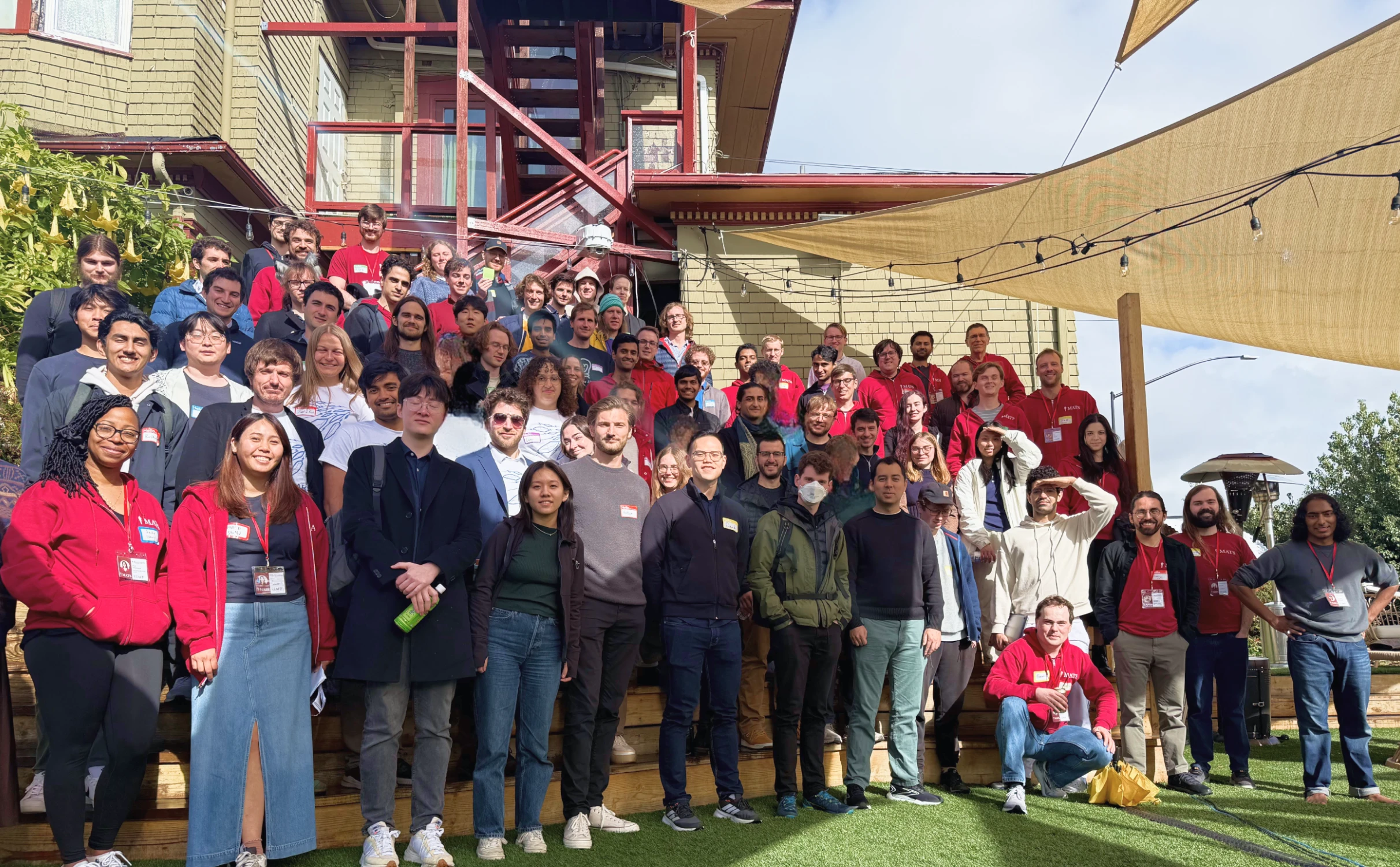
The Summer 2026 program will run from June through August. It will be largest MATS program to date with 120 fellows and 100 mentors. Fellows will be connected with mentors or organizational research groups, such as Anthropic's Alignment Science team, UK AISI, Redwood Research, ARC, and LawZero, to collaborate on a research project over the summer. Some fellows will be offered a 6+ month extension to continue this collaboration.
Applications are now open. Apply by June 7th.

Key dates for the application and admissions timeline
Applications typically open several months before the program begins. Applicants complete a multi-stage admissions process, beginning with a general application. Depending on the tracks, streams, and mentors they apply to, applicants may also complete additional evaluations such as interviews, work tests, coding assessments, or writing samples before final admissions decisions are made.
The main program is a 10 to 12 week full-time research fellowship. Fellows work closely with one or more mentors on independent research projects while participating in workshops, talks, office hours, and the broader MATS community. Research directions are developed collaboratively with mentors, with increasing independence throughout the program.
The extension phase typically begins approximately two weeks after the main program concludes. Fellows who demonstrate strong research potential during the main program may apply for a funded 6 to 12 month extension. Extension fellows continue developing independent research with ongoing mentorship and support, typically working from MATS offices or other approved research locations. In recent cohorts, roughly 80% of fellows who applied to the extension phase were accepted.
MATS aims to accelerate researchers who will:
MATS alumni have gone on to publish safety research, join alignment organizations, including Anthropic and MIRI, and found an alignment research lab. You can read more about MATS alumni here.
Each MATS stream brings together scholars and mentors around a shared research agenda. Streams vary in methodology and focus area, spanning topics such as interpretability, control, evaluations, governance, cybersecurity, and agent foundations.
We are interested in AI control and scalable oversight. I'm excited to work with scholars interested in empirical projects building and evaluating control measures and oversight techniques for LLM agents, especially those based on chain of thought monitoring. I'm also interested in the science of chain of thought monitorability, misalignment and control. An ideal project ends with a paper submitted to NeurIPS/ICML/ICLR.
I'll meet with mentees once a week and will be available on Slack daily.
An ideal mentee has a strong AI research and/or software engineering background. A mentee can be a PhD student and they can work on a paper that will be part of their thesis.
I'll talk through project ideas with scholar
Projects in this stream will be on AI welfare and moral status; more specifically, on what it takes to be a moral patient and how we can determine whether AI systems meet the conditions. I'm looking for applicants who have ideas about these topics and are motivated to explore them in more detail.
By default, scholars will meet with me online for 1hr/week and I will respond to questions on email/slack.
Scholars should have the following characteristics:
I will talk through project ideas with scholar
In this stream we will explore extensions and implications of our discovery that neural networks pretrained on next-token prediction represent belief-state geometry in their activations. We will build on this fundamental theory of neural network representations in order to discover what AI systems are thinking, and understand their emergent behaviors.
Early in the program, Paul and Adam will meet in person with scholars to help them get up to speed on the theoretical and technical background needed to understand and contribute to our framework. Subsequent weekly meetings with mentees aim to answer questions, unblock research, explore project ideas, and give feedback and suggestions on research.
The project can leverage applicants’ strengths in mathematical modeling and/or ML engineering. We welcome highly driven and relatively autonomous researchers that would like to benefit from our mentorship while taking the lead on a relevant project of their choice. The ideal scholar has the ability to move fast, and has experience in either research (e.g., PhD in any field), or software/ML engineering.
We will talk through project ideas with scholar
Peter Henderson’s stream focuses on developing safe, aligned AI agents, with projects on scalable oversight rules informed by law and game theory, safe long-horizon exploration, and measuring “jagged” capability/safety frontiers. Scholars will join an independently driven, engineering-heavy research environment, collaborating with other MATS scholars and PhD students, with weekly 1:1s and active async mentorship.
45 min weekly meetings by default for high-level guidance. I'm active on Slack for quick questions or conceptual (not code) debugging. Expect async back-and-forth on experiment design and results between meetings. Scholars can also schedule ad-hoc calls if they're stuck or want to brainstorm—just ping me on Slack. Other team members (PhD students) will also be around to help brainstorm, getting unstuck.
Essential:
Nice to have, but not necessary:
Not a good fit:
Mentors in the group will pitch projects, and scholars will try ones they find interesting for a week. We'll iterate together at the end of week 1 and pick final assignments in week 2.
The Redwood Research stream is looking for fast empirical iterators and strategists to work on control research.
Depending on the mentor:
We are looking for people who are:
We will assign projects by default but are open to getting pitched on projects.
My MATS fellows will do philosophical thinking about multi-agent intelligence and how agents change their values. This will likely involve trying to explore and synthesize ideas from game theory, signaling theory, reinforcement learning, and other related domains.
I'll come meet scholars in person around 2 days a week on average. On those days I'll be broadly available for discussions and brainstorming. On other days scholars can message me for guidance (though I'd prefer to spend most of my effort on this during the in-person days).
My main criterion for selecting scholars will be clarity of reasoning.
I will talk through project ideas with the scholar.
Roger Grosse’s stream investigates how to improve influence functions and other training data attribution methods, and uses these tools to study alignment-related phenomena such as out-of-context reasoning and emergent misalignment. The ideal scholar has experience with LLM internals, strong statistics/applied math skills (especially numerical linear algebra), and can independently drive research from literature review through experimentation and analysis. Roger provides shovel-ready projects while giving exceptional scholars freedom to pursue their own ideas, and is open to scholars collaborating with others.
I will meet with scholars 1 hour per week by default, and will be available to answer questions on Slack roughly daily.
I will give the scholar the level of freedom they are ready for. I will be prepared with focused, shovel-ready projects, but exceptional scholars with a vision they are excited about will have the flexibility to pursue it.
International coordination to reduce frontier AI risks, with a focus on China and the West.
1 hour weekly meetings by default for high-level guidance. We are active on Slack and typically respond within a day for quick questions.
Good understanding of international AI governance developments that are relevant to frontier AI safety (e.g., the Summit series, AISI network)
Good understanding of Chinese AI governance and safety (key players, key trends and institutional structures)
Good understanding of key frontier risk domains (CBRN, cyber, loss of control)
Some understanding of broader US-China relations and how they frame US-China relations on AI/AGI specifically
We will provide a shortlist of projects that we are keen for the scholar to work on in Week 1. We'll ask scholars to scope these in the 1st week and make a determination about which project to focus on in Week 2.
MATS Research phase provides scholars with a community of peers.

Scholars work out of a shared office and are supported by the Community Team.
MATS alumni report that the connections with peers that they made during MATS have had the largest impact on them years later. Our full-time Community Team works to facilitate these connections and also provide general well-being support. Weekly lightning talks, scholar-led discussion groups, game nights, and outings to SF are some examples of MATS events.