MATS Autumn 2026

The Autumn 2026 program will run for 10 weeks in Berkeley, CA and London, UK from September 28th to December 4th. Fellows will receive mentorship from world-class researchers and at organizations like Anthropic, Google DeepMind, OpenAI, Redwood Research, and ARC, with the option to apply for a 6–12 month funded extension beyond the main program. For the first time, we are running Founding & Field-Building and Biosecurity tracks.

Applications are now open. Apply by June 7th.

Program phases

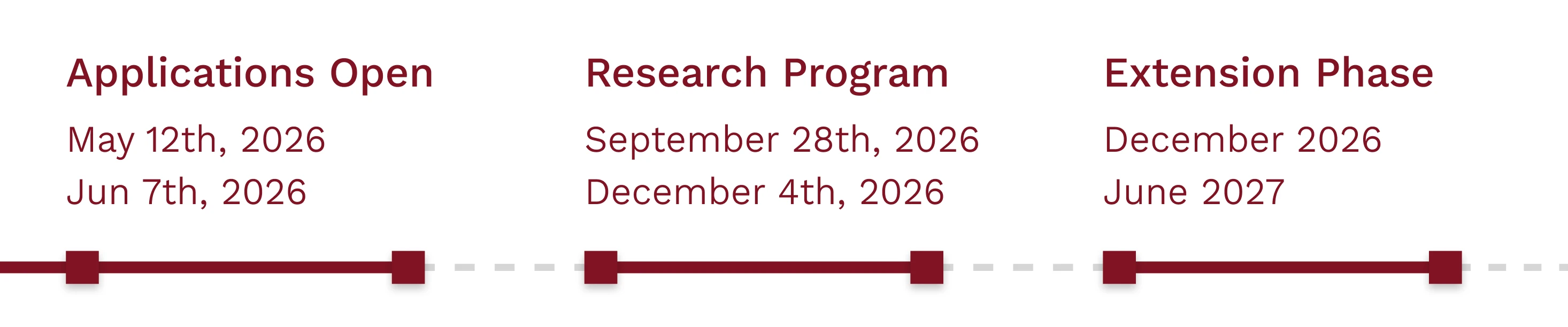
Key dates for the application and admissions timeline

1. Applications

General Application (May 12th to June 7th) 

Applicants fill out a general application to individual tracks which should take 1-2 hours. Applications are due by June 7th EOD AOE.

Additional Evaluations (June 7th to late July)

After an initial evaluation, applicants will apply to individual streams listed below. Additionally, applicants undergo a variety of track specific evaluations including coding tests, writing reviews, work tests, and interviews. Which evaluations you will undergo depend on the tracks, streams and mentors you apply to.

Admissions Decisions (Late July to early August)
Selected applicants are notified of their acceptance and anticipated mentor later in the application cycle.

Autumn 2026 Timeline:

2. Main Program
3. Extension Phase
4. Post-program

Autumn 2026 Streams

In stage one, you apply to one or more tracks (broad research areas): Empirical, Theory, Strategy & Forecasting, Policy & Governance, System Security, Biosecurity, and Founding & Field-Building. In stage two, advancing applicants choose specific streams within those tracks, each led by one or more mentors with their own research agenda. You can view this list as a grid here.

Additional streams will be added over the course of May.

Strategy and Forecasting

We are interested in mentoring projects in AI forecasting and governance. This work would build on the AI 2027 report to either do more scenario forecasting or explore how to positively affect key decision points, informed by our scenario.


Read more
Mentorship structure
Desired scholar characteristics
Project selection process
Theory

The Alignment Research Center is a small non-profit research group based in Berkeley, California, that is working on a systematic and theoretically grounded approach to mechanistically explaining neural network behavior. We are interested in scholars with a strong math background and mathematical maturity. If you'd be excited to work on the research direction described in this blog post – then we'd encourage you to apply!

Read more
Mentorship structure
Desired scholar characteristics
Project selection process
Biosecurity

This stream is primarily focused on research into physical defenses against engineered pathogens, aiming to inform decisions about PPE stockpiling and distribution approaches, improve improvised PPE and bioshelter scale-up, and reach rapid conclusions on how much to prioritize other areas of physical biodefense (agriculture, emergency response, etc.).  We are also open to strategic research into the use of bioweapons by AI or AI-human teams as part of takeover strategies and how this might inform preparedness.

Read more
Mentorship structure
Desired scholar characteristics
Project selection process
Empirical

This coalition of mentors make up the “Anthropic Stream”. This stream spans a range of empirical research areas in AI safety on LLMs, including AI control, scalable oversight, model organisms, model internals, model welfare, security, and more. You’ll be pitched, and have the option to pitch, a variety of safety research projects, and then be matched to projects and mentors based on your interests/preferences on research and what you’d like to get out of MATS. Fellows in this stream frequently receive funding and continued mentorship after MATS to complete their research project, usually leading to a (co-)first author paper. People in this stream often end up in long-term homes for safety research after MATS (e.g. Anthropic, Redwood Research, OpenAI).

Anthropic mentors share an application, tend to collaborate and co-mentor projects together, and generally share infrastructure to streamline the fellow experience. By applying to this stream, you are being considered for all of the Anthropic mentors.


Read more
Mentorship structure
Desired scholar characteristics
Project selection process
No items found.

Asymmetric Security

Empirical

This stream focuses on building realistic defensive cybersecurity benchmarks utilizing data from Asymmetric Security's work on real-world incidents.

Read more
Mentorship structure
Desired scholar characteristics
Project selection process
Founding and Field-Building

Founding ambitious AI safety and field-building projects.

Read more
Mentorship structure
Desired scholar characteristics
Project selection process
Biosecurity

I'm mentoring projects that apply AI advances to core biosecurity challenges — early detection and attribution of biological threats, characterizing AI-enabled bioweapons uplift, accelerating medical countermeasure design, and building biosecurity-by-design into frontier biological AI tools. Fellows have wide latitude to scope their own project within (or adjacent to) these themes, including ideas I haven't yet considered, and are expected to drive the technical work independently. My comparative advantage is high-level strategic direction grounded in biosecurity, pandemic preparedness, epidemiology, and US R&D policy rather than hands-on ML or software engineering guidance.
Read more
Mentorship structure
Desired scholar characteristics
Project selection process
Biosecurity

This mentor also has a stream in the Strategy and Forecasting track

This stream focuses on how advanced AI could enable new and dangerous bio technologies, and on assessing when risks become tractable or urgent as those capabilities arrive.

Read more
Mentorship structure
Desired scholar characteristics
Project selection process
Strategy and Forecasting

This mentor also has a stream in the Biosecurity track.

This stream focuses on how advanced AI could enable new and dangerous physical technologies, and on assessing when risks become tractable or urgent as those capabilities arrive.

Read more
Mentorship structure
Desired scholar characteristics
Project selection process
Empirical

I have two broad areas.

Security:

I am interested in building demonstrations for hacking real-world AI deployments to show that they are not secure. The goal is to force companies to invest in alignment techniques that can solve the underlying security issues.

Benchmarks:

I am interested in building benchmarks to determine how generalizable modern LLM techniques actually are, now that we are no longer in the pre-training scaling era.

Read more
Mentorship structure
Desired scholar characteristics
Project selection process
Empirical

This stream will focus on monitoring, stress-testing safety methods, and evals, with a focus on risks from scheming AIs. Examples include (black-box) AI control techniques, white-box monitors (probes etc.), chain-of-thought monitoring/faithfulness, building evaluation environments, and stress-testing mitigations.

Read more
Mentorship structure
Desired scholar characteristics
Project selection process
Biosecurity

The stream focuses on evaluating and/or mitigating catastrophic risk emerging from dangerous scientific capabilities in frontier AI systems, with an emphasis on the challenges that emerge from lab integrations and novel science. Potential research directions include evaluation design, risk mitigations and evaluation science.

Read more
Mentorship structure
Desired scholar characteristics
Project selection process
Biosecurity

I’m interested in two broad projects focused on improving current detection efforts at SecureBio. The first is to characterize when AI-bio or general AI tools are actually useful for large-scale metagenomic detection, including tradeoffs between compute cost, sequencing cost, model type, model size, and pipeline stage. The second is to explore genomic language models as novelty detectors—for example, using perplexity-style metrics to flag surprising sequences—and to evaluate whether this approach can complement traditional bioinformatics systems in a cost-effective, sensitive, and interpretable way.

Read more
Mentorship structure
Desired scholar characteristics
Project selection process
Biosecurity

Fourth Eon is developing adaptive, AI-native safeguards across the biotechnology stack, with a focus on function-based DNA synthesis screening. Fellows in this stream will work on technical research projects at the intersection of AI and biosecurity. Projects span topics like mechanistic interpretability of protein foundation models, bio model evaluations for biosecurity-relevant capabilities, and agentic sequence analysis workflows.

Read more
Mentorship structure
Desired scholar characteristics
Project selection process
Founding and Field-Building

Backing projects focused on product development and organization building in the areas of AI safety and alignment, biosecurity, and critical cybersecurity. Looking for fellows who are self starters, default to action, and have a desire to create.

Read more
Mentorship structure
Desired scholar characteristics
Project selection process
Biosecurity

This stream will focus on projects related to biosecurity countermeasures.

Read more
Mentorship structure
Desired scholar characteristics
Project selection process
Biosecurity

This stream focuses on lead independent research in one of six chokepoints for biotech governance: live pathogen repositories, CROs, cloud labs, cell-free expression systems, plasmid vendors, or secondhand lab equipment. 

On high-conviction areas, you'll tackle specific open research questions and assess interventions; on low-conviction areas, you'll conduct deep dives to determine whether they're worth pursuing. Your findings will directly shape Sentinel's grantmaking strategy and provide strategic guidance to the broader biosecurity community.

Read more
Mentorship structure
Desired scholar characteristics
Project selection process
Systems Security

Implementing SL4/5 and searching for differentially defense-favored security tools.

Read more
Mentorship structure
Desired scholar characteristics
Project selection process
Empirical

GDM stream focused on scheming risk, AI control, monitoring, monitorability, and loss-of-control evaluations. Probably running in-person in London.

Read more
Mentorship structure
Desired scholar characteristics
Project selection process
Biosecurity

Computational/modelling problems in biosecurity.

Read more
Mentorship structure
Desired scholar characteristics
Project selection process

Community at MATS

MATS Research phase provides scholars with a community of peers.

Scholars work out of a shared office and are supported by the Community Team.

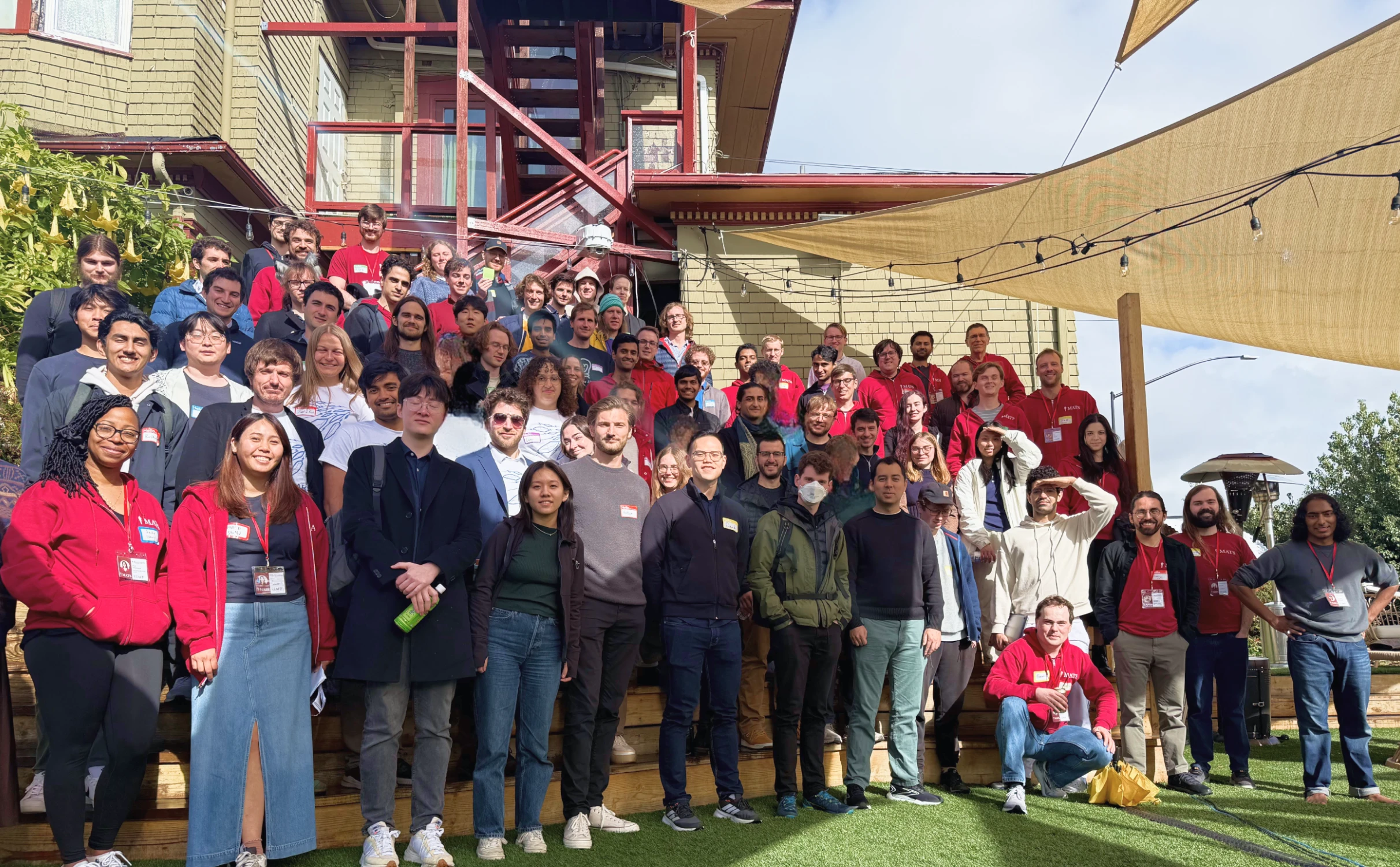
MATS alumni report that the connections with peers that they made during MATS have had the largest impact on them years later. Our full-time Community Team works to facilitate these connections and also provide general well-being support. Weekly lightning talks, scholar-led discussion groups, game nights, and outings to SF are some examples of MATS events.