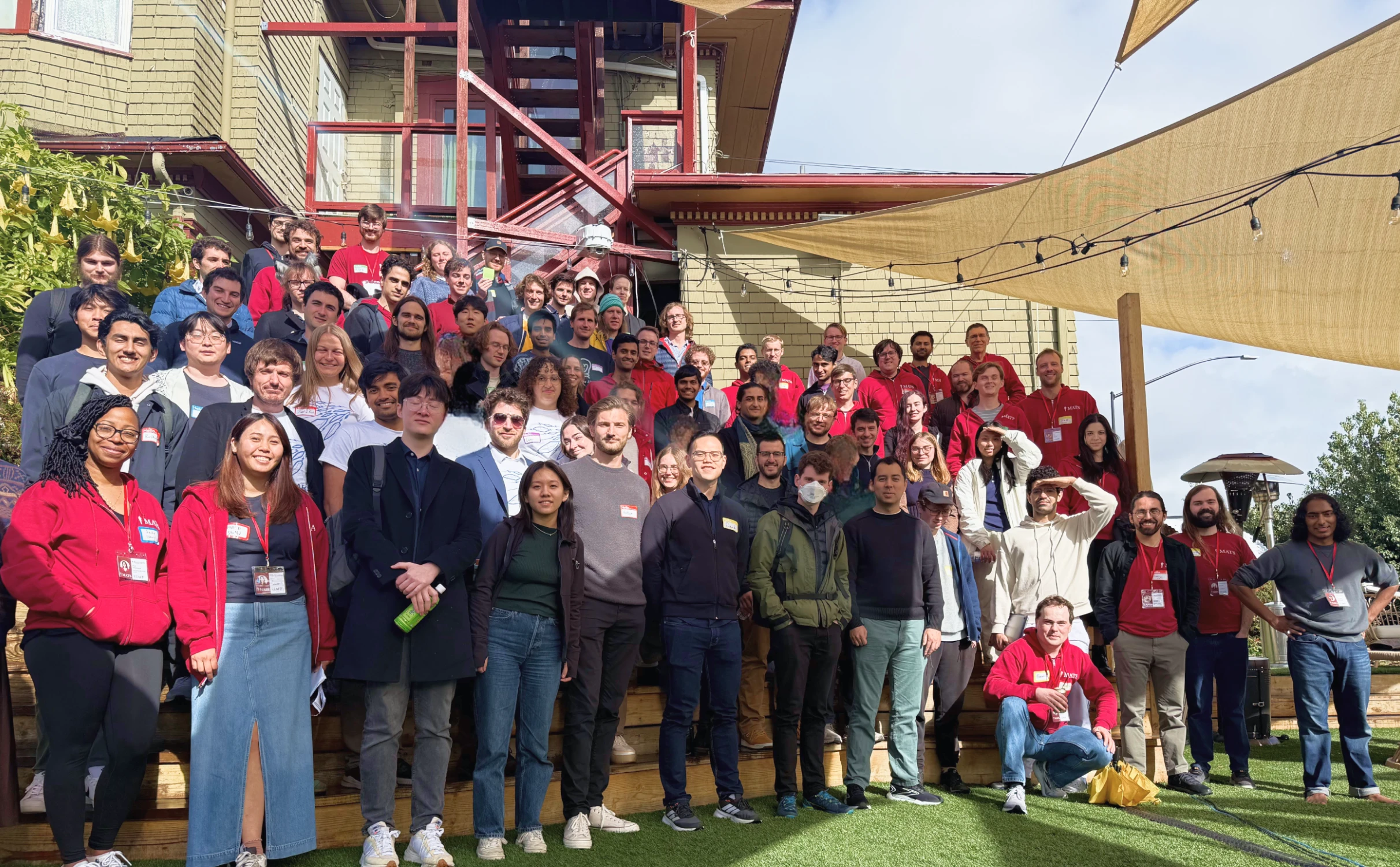
The Summer 2026 program will run from June through August. It will be largest MATS program to date with 120 fellows and 100 mentors. Fellows will be connected with mentors or organizational research groups, such as Anthropic's Alignment Science team, UK AISI, Redwood Research, ARC, and LawZero, to collaborate on a research project over the summer. Some fellows will be offered a 6+ month extension to continue this collaboration.
Applications are now open. Apply by June 7th.

Key dates for the application and admissions timeline
General Application (May 12th to June 7th)
Applicants fill out a general application to individual tracks which should take 1-2 hours. Applications are due by June 7th EOD AOE.
Additional Evaluations (June 7th to late July)
After an initial evaluation, applicants will apply to individual streams listed below. Additionally, applicants undergo a variety of track specific evaluations including coding tests, writing reviews, work tests, and interviews. Which evaluations you will undergo depend on the tracks, streams and mentors you apply to.
Admissions Decisions (Late July to early August)
Selected applicants are notified of their acceptance and anticipated mentor later in the application cycle.
.png)
The main program takes place from September 28th to December 4th of 2026. It is an intensive research phase, where fellows work full time on a research project in AI alignment, security, field-building, or governance. Fellows' research directions will typically be chosen through a collaborative process with their mentors, and fellows are expected to develop their independent research direction as the program continues.
While mentor support will vary depending on the project and mentors, mentors are expected to spend at least 1 hour/week working with each of their scholars, and some spend much more time. Scholars will also receive support from MATS’s Research Management team, who help to scope out and structure research direction. Depending on which stream you participate in, you may collaborate with other fellows in your stream.
By the middle of the program, fellows will be expected to write a report on their projects’ threat model, theory of change, and project deliverables. At the end of the program scholars will be expected to have a tangible research output. In past cohorts, this has involved presenting at a fellow symposium on work conducted over the course of MATS.
Educational seminars and workshops will be held 2-3 times per week. Previously, speakers have included Buck Shlegeris from Redwood Research, Adam Gleave from FAR AI, Neel Nanda from Google DeepMind, William Saunders from OpenAI, Andrew Critch from CHAI, Lennart Heim from GovAI, Ajeya Cotra from Open Philanthropy, and more.
The extension phase starts in December of 2026, soon after the end of the main program. Fellows who demonstrate promise as independent researchers during the main program can apply for the MATS extension phase. Acceptance into the extension is based on mentor evaluation and MATS review of proposed research.
In recent cohorts, ~80% of fellows who apply have been accepted. The extension phase offers a default additional 6-months of funding, with the ability to later apply for a 6-month continuation.
Extension fellows primarily work from the MATS London or Berkeley offices, with the possibility of working from other AI safety hubs or fully remotely.For accepted extension fellows, MATS arranges funding for stipends and housing ($7,680/month), as well as for compute ($8,000/mo), creating a seamless transition into this advanced phase of the program.
MATS aims to accelerate researchers who will:
MATS alumni have gone on to publish safety research, join alignment organizations, including Anthropic and MIRI, and found an alignment research lab. You can read more about MATS alumni here.
In stage one, you apply to one or more tracks (broad research areas): Empirical, Theory, Strategy & Forecasting, Policy & Governance, System Security, Biosecurity, and Founding & Field-Building. In stage two, advancing applicants choose specific streams within those tracks, each led by one or more mentors with their own research agenda. You can view this list as a grid here.
Additional streams will be added over the course of May.
I (Cas) work on a range of projects from technical safeguards to technical governance. This stream follows an academic collaboration model and will work will likely focus on technical topics in AI governance.
2-3 meetings per week plus regular messaging and collaborative writing.
Green flags include:
Mentor(s) will talk through project ideas with scholar.
In the shard theory stream, we create qualitatively new methods and fields of inquiry, from steering vectors to gradient routing to unsupervised capability elicitation to robust unlearning. If you're theory-minded, maybe you'll help us formalize shard theory itself.
We will have weekly 1-1's and weekly team lunch, as well as asynchronous communication over Slack. Mentees are always welcome to reach out at any time, in case guidance is needed outside of usual meeting times.
Scholars should mostly figure things out on their own outside of meetings
Ideal candidates would have:
Mentor(s) will talk through project ideas with scholar
I mostly interested in AI control and scalable oversight. I'm excited to work with scholars interested in empirical projects building and evaluating control measures and oversight techniques for LLM agents, especially those based on chain of thought monitoring. I'm also interested in the science of chain of thought monitorability, misalignment and control. An ideal project ends with a paper submitted to NeurIPS/ICML/ICLR.
I'll meet with mentees once a week and will be available on Slack daily.
An ideal mentee has a strong AI research and/or software engineering background. A mentee can be a PhD student and they can work on a paper that will be part of their thesis.
I'll talk through project ideas with scholar
This stream is for the UK AISI Red-team. The team focuses on stress-testing mitigations for AI risk, including misuse safeguards, control techniques and model alignment red-teaming. We plan to work on projects building and improving methods for performing these kinds of evaluations and methods.
Each scholar will have one primary mentor from the Red Team who will provide weekly guidance and day-to-day support
Scholars will also have access to secondary advisors within their specific sub-team (misuse, alignment, or control) for technical deep-dives
Team lead Xander Davies and advisors Geoffrey Irving and Yarin Gal will provide periodic feedback through team meetings and project reviews
For scholars working on cross-cutting projects, we can arrange mentorship from multiple sub-teams as needed
Structure:
Weekly 1:1 meetings (60 minutes) with primary mentor for project updates, technical guidance, and problem-solving
Asynchronous communication via Slack/email throughout the week for quick questions and feedback
Bi-weekly team meetings where scholars can present work-in-progress and get broader team input
Working style:
We expect scholars to work semi-independently – taking initiative on their research direction while leveraging mentors for guidance on technical challenges, research strategy, and navigating AISI resources
Scholars will have access to our compute resources and operational support to focus on research
We encourage scholars to document their work and, if appropriate, aim for publication or public blog posts
We're looking for scholars with hands-on experience in machine learning and AI security, particularly those interested in adversarial robustness, red teaming, or AI safeguards. Ideal candidates would have:
We welcome scholars at various career stages especially those who are eager to work on problems with direct impact on how frontier AI is governed and deployed.
Scholars will choose from a set of predefined project directions aligned with our current research priorities, such as:
We'll provide initial direction and guidance on project scoping, then scholars will have autonomy to explore specific approaches within that framework.
Expect weekly touchpoints to ensure progress and refine directions.
If mentees have particular ideas they're excited about that they see as fitting within the scope of the team's work, they're welcome to propose them, but there is no guarantee they will be selected
Conceptual research on deceptive alignment, designing scheming propensity evaluations and honeypots. The stream will run in person in London, with scholars working together in team(s).
During the program, we will meet once a week to go through any updates / results, and your plans for the next week. I'm also happy to comment on docs, respond on Slack, or have additional ad hoc meetings as needed.
I will talk through project ideas with scholars
MATS Research phase provides scholars with a community of peers.

Scholars work out of a shared office and are supported by the Community Team.
MATS alumni report that the connections with peers that they made during MATS have had the largest impact on them years later. Our full-time Community Team works to facilitate these connections and also provide general well-being support. Weekly lightning talks, scholar-led discussion groups, game nights, and outings to SF are some examples of MATS events.