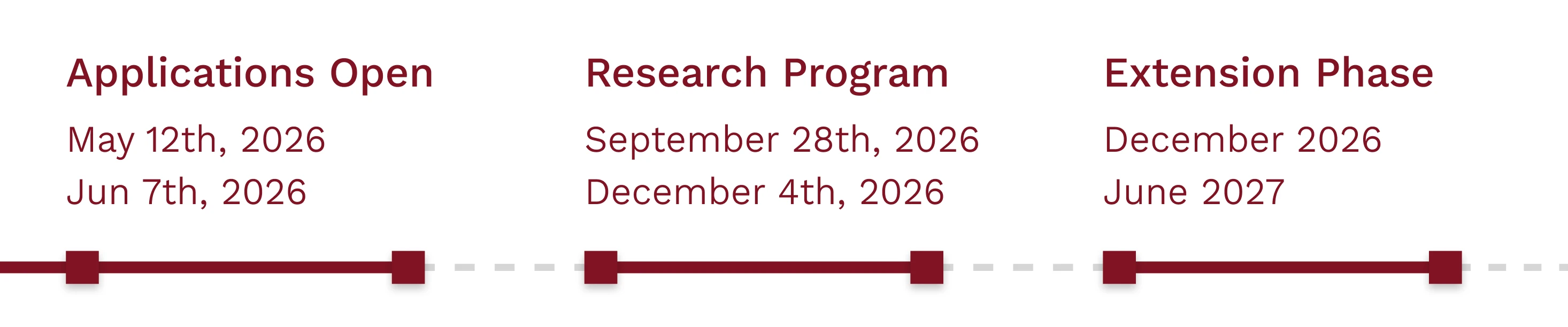
The Autumn 2026 program will run for 10 weeks in Berkeley, CA and London, UK from September 28th to December 4th. Fellows will receive mentorship from world-class researchers and at organizations like Anthropic, Google DeepMind, OpenAI, Redwood Research, and ARC, with the option to apply for a 6–12 month funded extension beyond the main program. For the first time, we are running Founding & Field-Building and Biosecurity tracks.
Applications are now open. Apply by June 7th.

Key dates for the application and admissions timeline
General Application (May 12th to June 7th)
Applicants fill out a general application to individual tracks which should take 1-2 hours. Applications are due by June 7th EOD AOE.
Additional Evaluations (June 7th to late July)
After an initial evaluation, applicants will apply to individual streams listed below. Additionally, applicants undergo a variety of track specific evaluations including coding tests, writing reviews, work tests, and interviews. Which evaluations you will undergo depend on the tracks, streams and mentors you apply to.
Admissions Decisions (Late July to early August)
Selected applicants are notified of their acceptance and anticipated mentor later in the application cycle.

The main program takes place from September 28th to December 4th of 2026. It is an intensive research phase, where fellows work full time on a research project in AI alignment, security, field-building, or governance. Fellows' research directions will typically be chosen through a collaborative process with their mentors, and fellows are expected to develop their independent research direction as the program continues.
While mentor support will vary depending on the project and mentors, mentors are expected to spend at least 1 hour/week working with each of their scholars, and some spend much more time. Scholars will also receive support from MATS’s Research Management team, who help to scope out and structure research direction. Depending on which stream you participate in, you may collaborate with other fellows in your stream.
By the middle of the program, fellows will be expected to write a report on their projects’ threat model, theory of change, and project deliverables. At the end of the program scholars will be expected to have a tangible research output. In past cohorts, this has involved presenting at a fellow symposium on work conducted over the course of MATS.
Educational seminars and workshops will be held 2-3 times per week. Previously, speakers have included Buck Shlegeris from Redwood Research, Adam Gleave from FAR AI, Neel Nanda from Google DeepMind, William Saunders from OpenAI, Andrew Critch from CHAI, Lennart Heim from GovAI, Ajeya Cotra from Open Philanthropy, and more.
The extension phase starts in December of 2026, soon after the end of the main program. Fellows who demonstrate promise as independent researchers during the main program can apply for the MATS extension phase. Acceptance into the extension is based on mentor evaluation and MATS review of proposed research.
In recent cohorts, ~80% of fellows who apply have been accepted. The extension phase offers a default additional 6-months of funding, with the ability to later apply for a 6-month continuation.
Extension fellows primarily work from the MATS London or Berkeley offices, with the possibility of working from other AI safety hubs or fully remotely.For accepted extension fellows, MATS arranges funding for stipends and housing ($7,680/month), as well as for compute ($8,000/mo), creating a seamless transition into this advanced phase of the program.
MATS aims to accelerate researchers who will:
MATS alumni have gone on to publish safety research, join alignment organizations, including Anthropic and MIRI, and found an alignment research lab. You can read more about MATS alumni here.
In stage one, you apply to one or more tracks (broad research areas): Empirical, Theory, Strategy & Forecasting, Policy & Governance, System Security, Biosecurity, and Founding & Field-Building. In stage two, advancing applicants choose specific streams within those tracks, each led by one or more mentors with their own research agenda. You can view this list as a grid here.
Additional streams will be added over the course of May.
This stream is primarily interested in mentoring projects in biosecurity that either (1) create rigorous threat models of AI biological misuse or (2) create benchmarks and tools that allow us to evaluate and mitigate these risks, as well as verifying that companies are taking suitable precautions.
Typically, this would include weekly meetings, detailed comments on drafts, and asynchronous messaging.
For threat modeling work: Skeptical mindset, transparent reasoning, analytical
For evaluations, mitigations, and verification work: LLM engineering skills (e.g., agent orchestration), biosecurity knowledge
Mentor(s) will talk through project ideas with scholar
This stream focuses on identifying tractable policy and technical interventions to gradual disempowerment, focusing on economic disempowerment and the intelligence curse. Possible project areas include:
We’ll meet 1:1 for 30 minute slots twice a week, once with each mentor. We’ll be active on Slack (default to over-slacking us), and can do quick ad-hoc calls as well. Once a week, we expect you to have some artifact that we will give feedback on.
We're excited about applications from a variety of backgrounds. Use the list below as general guidance, not as an exhaustive list.
Essential:
Preferred:
Nice to haves:
We provide three projects as options we are excited about, but they are not inclusive of all ideas. During the application process, we will ask potential mentees to either a) sharpen these proposals into a more specific question incorporating their own interests, or b) propose their own projects.
We expect fellows to come in with inner conviction towards a starting point that fits within the above themes, and expect that the best work in this stream will come from self-directed fellows pursuing their own research taste. However, we will require sign off to pursue a project and may require fellows to shift scope if they move outside the target area.
This stream focuses on critical challenges in AI safety and alignment, including risks from automating AI research, bottlenecks to recursive self-improvement, and the automation of safety and alignment research. Priority topics also include AGI privacy, measuring long-horizon agentic capabilities, developing new alignment methods, and advancing the science of post-training.
I usually spend at least 30 min per week in one-one-one meetings with my mentees. We can also discuss longer time slots if necessary. Besides these time slots, I try to be as responsive as possible over Slack (>2 comprehensive responses per day) and read relevant papers between weekly meetings.
I'm looking for the following skills:
I would prefer to set the overall direction, but I will listen closely to scholars about their preferences within a broad direction. Converging on a particular topic is expected to be a collaborative process.
Backing projects focused on product development and organization building in the areas of AI safety and alignment, biosecurity, and critical cybersecurity. Looking for fellows who are self starters, default to action, and have a desire to create.
Scheduled 45 min bi-weekly meetings (every other week). Ad hoc meetings can be added between scheduled sessions. We’ll have a shared Slack channel with all 3 partners: Mike, Nick, and Charlie as well as supporting team at Halcyon. Ping us anytime.
For product development and organization building projects; strong technical hardskills (e.g., MLE, SWE, math), domain expertise in AI safety and alignment, biosecurity, or cybersecurity. Experience with building or working on a usable product. Openness to iterating, pivoting, and failure. General understanding of business and organization principles. Considerate and works well in team settings.
For generalist projects: 5+ years of relevant experience: recruiting, talent / HR, executive search, or general business operations with a strong people component. Familiarity with the broader startup / early-stage ecosystem. A major plus would be familiarity with at least one of Halcyon's focus sectors (AI safety / frontier AI, biosecurity, cybersecurity): enough to read profiles credibly and have substantive conversations with portfolio companies. Strong organizational instincts. Excellent written and verbal communication. Experience working with CRM technologies as well as basic AI tools: Claude Cowork or similar.
For product development and organization building projects in the areas of AI safety and alignment, biosecurity, and critical cybersecurity - fellows will have full freedom. We expect fellows to come with rough ideas and opinions on direction that will inform where they start exploring the market. We don’t expect refined ideas or pitches. We do expect building.
For field building and generalist fellows, we are prioritizing a talent matching project. This includes processing thousands of individuals in our CRM, and finding how they may pair with our portfolio companies and other areas of high priority in our network.
In this stream, I’m interested in developing concrete, actionable R&D agendas for post-AGI institutions and AI resilience. For post-AGI institutions, I’m especially interested in what infrastructure would be needed to make super-cooperative AGI or “Coasean bargaining at scale” possible. For AI resilience, I’m interested in follow-on work to airesilience.net that moves from high-level motivation to detailed proposals.
60-minute weekly 1:1s + async written exchange (drafts, slack, etc.). Ad-hoc additional meetings as needed. The fellow is responsible for driving the project; my role is high-level steering, strategic input and sound boarding.
I am open to working with builder/entrepreneur, strategist or researcher types.
Essential:
Not a good fit:
Fellows are welcome to propose one or several concrete projects within the above directions. We will work together to refine the project, pressure-test its theory of change, and scope it into something tractable. The goal is to have converged on a concrete project within the first two weeks.
Computational/modelling problems in biosecurity.
typically 1 hour weekly meetings by default. I typically respond on slack quite quickly - some weeks that I am not available. You are welcome to chat to my phd students too!
Computational experience e.g. Python
OR statistical modelling
interest in biosecurity
We will construct a project together that best suits the skills and interests of the fellow and what I can reasonably be helpful for.
Projects on this stream cluster into a few broad areas from the empirical track: scalable oversight, AI control, monitorability and interpretability, adversarial robustness, and security.
Most fellows will work closely with one or two mentors on something that fits into the mentors' ongoing research. The above list of mentors above is tentative.
Essential:
Preferred (at least one of):
This stream conducts policy and governance research on "loss-of-control" risks from advanced AI, such as recursive self-improvement and misalignment.
We will meet once a week for 30 min, either in person or via a video call. Occasionally, we can have whiteboard brainstorming sessions, depending on my capacity (which is hard to predict.)
You do not need a STEM or ML background. You should understand how current LLMs are being developed, and understand related concepts such as reinforcement learning or reward hacking. You should be familiar with the existing arguments and counter-arguments around "loss-of-control".
You should bring an interest for the existing policy discourse and environment on this topic; and a willingness to consider feasibility.
We will brainstorm and re-fine together, based on policy demand and your interests and expertise.
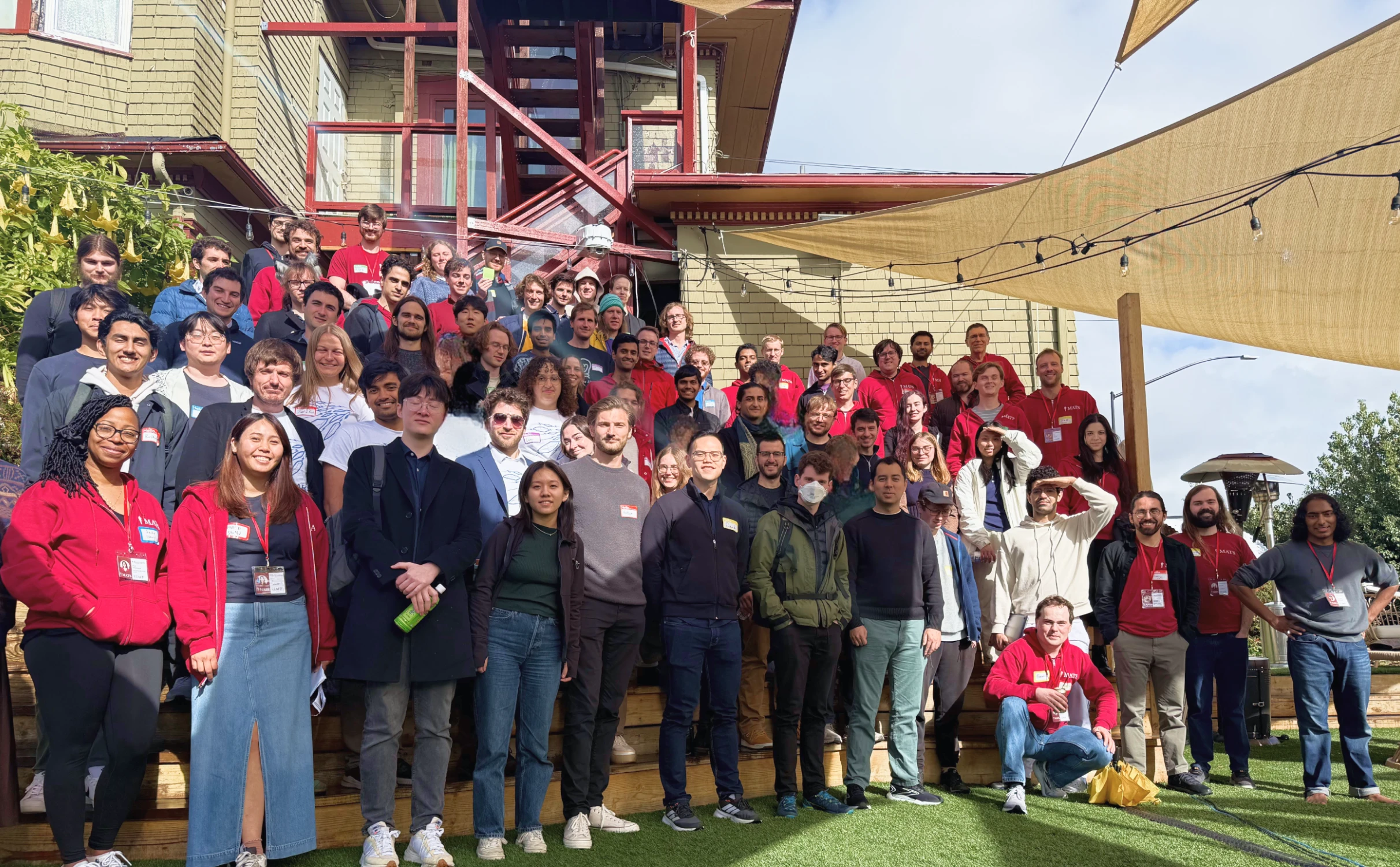
MATS Research phase provides scholars with a community of peers.

Scholars work out of a shared office and are supported by the Community Team.
MATS alumni report that the connections with peers that they made during MATS have had the largest impact on them years later. Our full-time Community Team works to facilitate these connections and also provide general well-being support. Weekly lightning talks, scholar-led discussion groups, game nights, and outings to SF are some examples of MATS events.