The Autumn 2026 program will run for 10 weeks in Berkeley, CA and London, UK from September 28th to December 4th. Fellows will receive mentorship from world-class researchers and at organizations like Anthropic, Google DeepMind, OpenAI, Redwood Research, and ARC, with the option to apply for a 6–12 month funded extension beyond the main program. For the first time, we are running Founding & Field-Building and Biosecurity tracks.
Applications are now open. Apply by June 7th.

Key dates for the application and admissions timeline
Applications typically open several months before the program begins. Applicants complete a multi-stage admissions process, beginning with a general application. Depending on the tracks, streams, and mentors they apply to, applicants may also complete additional evaluations such as interviews, work tests, coding assessments, or writing samples before final admissions decisions are made.
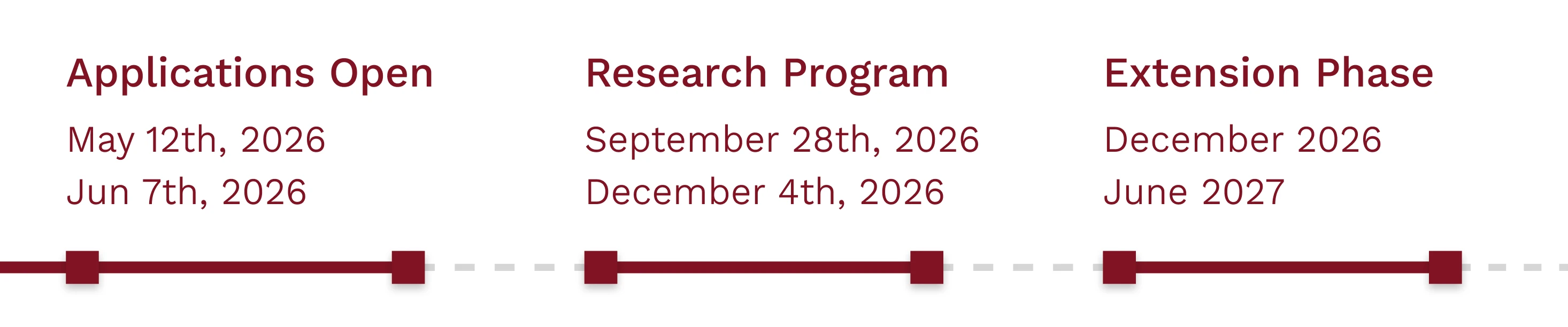
The main program is a 10 to 12 week full-time research fellowship. Fellows work closely with one or more mentors on independent research projects while participating in workshops, talks, office hours, and the broader MATS community. Research directions are developed collaboratively with mentors, with increasing independence throughout the program.
The extension phase typically begins approximately two weeks after the main program concludes. Fellows who demonstrate strong research potential during the main program may apply for a funded 6 to 12 month extension. Extension fellows continue developing independent research with ongoing mentorship and support, typically working from MATS offices or other approved research locations. In recent cohorts, roughly 80% of fellows who applied to the extension phase were accepted.
MATS aims to accelerate researchers who will:
MATS alumni have gone on to publish safety research, join alignment organizations, including Anthropic and MIRI, and found an alignment research lab. You can read more about MATS alumni here.
In stage one, applicants apply to one or more tracks (broad research areas): Empirical, Theory, Strategy & Forecasting, Policy & Governance, System Security, Biosecurity, and Founding & Field-Building. In stage two, advancing applicants choose specific streams within those tracks, each led by one or more mentors with their own research agenda. You can view this list as a grid here.
In this stream, I’m interested in developing concrete, actionable R&D agendas for post-AGI institutions and AI resilience. For post-AGI institutions, I’m especially interested in what infrastructure would be needed to make super-cooperative AGI or “Coasean bargaining at scale” possible. For AI resilience, I’m interested in follow-on work to airesilience.net that moves from high-level motivation to detailed proposals.
60-minute weekly 1:1s + async written exchange (drafts, slack, etc.). Ad-hoc additional meetings as needed. The fellow is responsible for driving the project; my role is high-level steering, strategic input and sound boarding.
I am open to working with builder/entrepreneur, strategist or researcher types.
Essential:
Not a good fit:
Fellows are welcome to propose one or several concrete projects within the above directions. We will work together to refine the project, pressure-test its theory of change, and scope it into something tractable. The goal is to have converged on a concrete project within the first two weeks.
Computational/modelling problems in biosecurity.
typically 1 hour weekly meetings by default. I typically respond on slack quite quickly - some weeks that I am not available. You are welcome to chat to my phd students too!
Computational experience e.g. Python
OR statistical modelling
interest in biosecurity
We will construct a project together that best suits the skills and interests of the fellow and what I can reasonably be helpful for.
Projects on this stream cluster into a few broad areas from the empirical track: scalable oversight, AI control, monitorability and interpretability, adversarial robustness, and security.
Most fellows will work closely with one or two mentors on something that fits into the mentors' ongoing research. The above list of mentors above is tentative.
Essential:
Preferred (at least one of):
This stream conducts policy and governance research on "loss-of-control" risks from advanced AI, such as recursive self-improvement and misalignment.
We will meet once a week for 30 min, either in person or via a video call. Occasionally, we can have whiteboard brainstorming sessions, depending on my capacity (which is hard to predict.)
You do not need a STEM or ML background. You should understand how current LLMs are being developed, and understand related concepts such as reinforcement learning or reward hacking. You should be familiar with the existing arguments and counter-arguments around "loss-of-control".
You should bring an interest for the existing policy discourse and environment on this topic; and a willingness to consider feasibility.
We will brainstorm and re-fine together, based on policy demand and your interests and expertise.
I am hoping to get more help developing policy ideas for future policy windows.
The Redwood Research stream is looking for fast empirical iterators and strategists to work on control research.
Depending on the mentor:
We are looking for people who are:
We will assign projects by default but are open to getting pitched on projects.
Eleos AI Research is a nonprofit working to ensure the interests of AI systems are appropriately taken into account as we navigate transformative AI. We are looking for competent generalists to help scale up our AI welfare field-building by running high-impact events, or to otherwise amplify our research, communications, and operational capacity.
By default, I expect to meet with each fellow for at least 60 minutes per week (possibly split into 2 x 30 minute meetings). For projects that require a lot of input (e.g. event organizing), we can scale that up as needed. I’ll also be available for ad hoc meetings, and can be reached asynchronously on Slack or by email. At Eleos, we each post a daily update in Slack; I would like fellows to do the same.
The ideal candidate:
We'll meet at the start of the program to discuss ideas in the areas listed above, as well as ideas that fellows would like to pitch. We’ll jointly decide on a project that aligns with Eleos’s priorities as well as the goals and skills of the fellow.
Backing projects focused on product development and organization building in the areas of AI safety and alignment, biosecurity, and critical cybersecurity. Looking for fellows who are self starters, default to action, and have a desire to create.
Co-mentorship from Halcyon's Ross Matican (Investor & Grantmaker), Mike McCormick (Founder, CEO), and Charlie Petty (Venture Partner). Ross will be leading point.
Scheduled 45 min bi-weekly meetings (every other week). Ad hoc meetings can be added between scheduled sessions. We'll have a shared Slack channel with Ross, Mike, and Charlie, as well as the supporting team at Halcyon. Ping us anytime.
For product development and organization building projects; strong technical hardskills (e.g., MLE, SWE, math), domain expertise in AI safety and alignment, biosecurity, or cybersecurity. Experience with building or working on a usable product. Openness to iterating, pivoting, and failure. General understanding of business and organization principles. Considerate and works well in team settings.
For generalist projects: 5+ years of relevant experience: recruiting, talent / HR, executive search, or general business operations with a strong people component. Familiarity with the broader startup / early-stage ecosystem. A major plus would be familiarity with at least one of Halcyon's focus sectors (AI safety / frontier AI, biosecurity, cybersecurity): enough to read profiles credibly and have substantive conversations with portfolio companies. Strong organizational instincts. Excellent written and verbal communication. Experience working with CRM technologies as well as basic AI tools: Claude Cowork or similar.
For product development and organization building projects in the areas of AI safety and alignment, biosecurity, and critical cybersecurity - fellows will have full freedom. We expect fellows to come with rough ideas and opinions on direction that will inform where they start exploring the market. We don’t expect refined ideas or pitches. We do expect building.
For field building and generalist fellows, we are prioritizing a talent matching project. This includes processing thousands of individuals in our CRM, and finding how they may pair with our portfolio companies and other areas of high priority in our network.
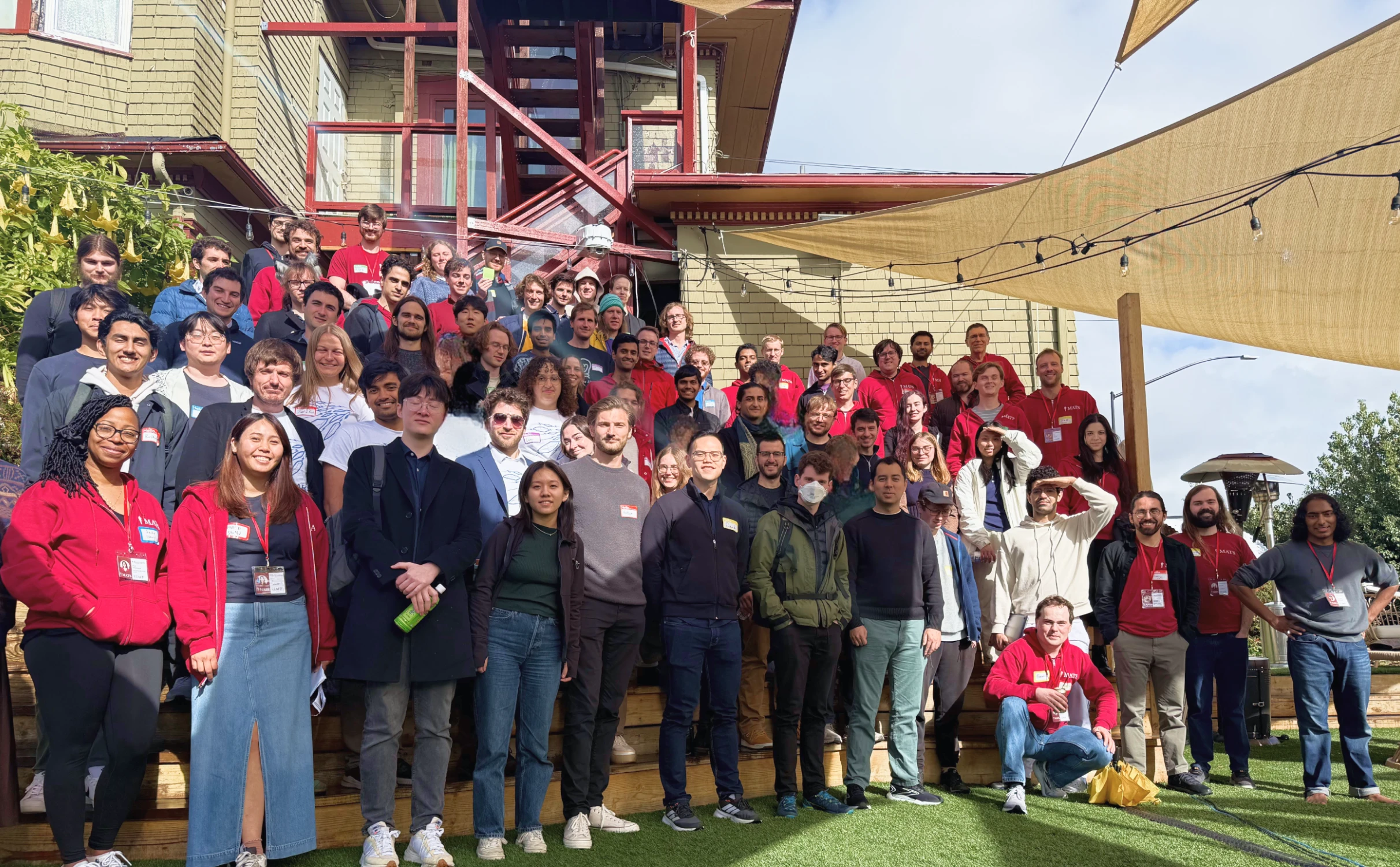
MATS Research phase provides scholars with a community of peers.

Scholars work out of a shared office and are supported by the Community Team.
MATS alumni report that the connections with peers that they made during MATS have had the largest impact on them years later. Our full-time Community Team works to facilitate these connections and also provide general well-being support. Weekly lightning talks, scholar-led discussion groups, game nights, and outings to SF are some examples of MATS events.