The Autumn 2026 program will run for 10 weeks in Berkeley, CA and London, UK from September 28th to December 4th. Fellows will receive mentorship from world-class researchers and at organizations like Anthropic, Google DeepMind, OpenAI, Redwood Research, and ARC, with the option to apply for a 6–12 month funded extension beyond the main program. For the first time, we are running Founding & Field-Building and Biosecurity tracks.
Applications are now open. Apply by June 7th.

Key dates for the application and admissions timeline
Applications typically open several months before the program begins. Applicants complete a multi-stage admissions process, beginning with a general application. Depending on the tracks, streams, and mentors they apply to, applicants may also complete additional evaluations such as interviews, work tests, coding assessments, or writing samples before final admissions decisions are made.
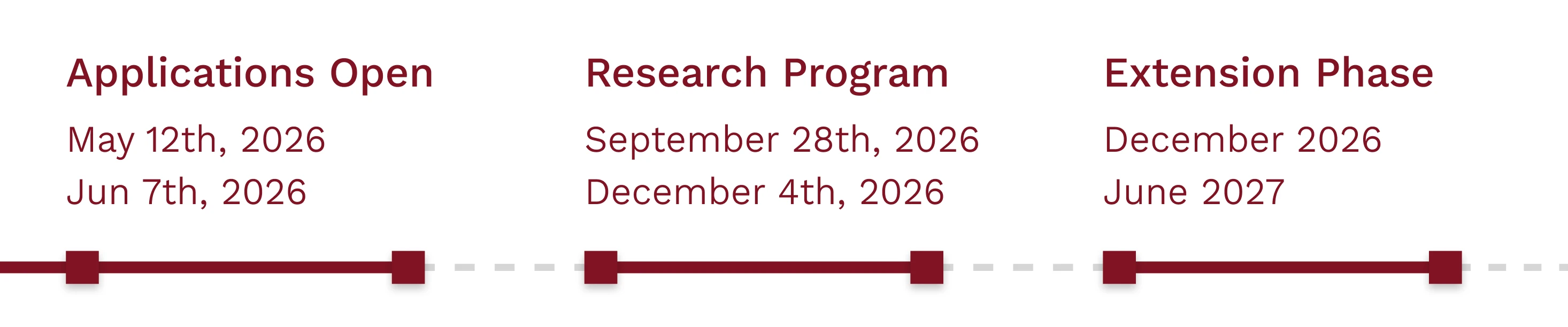
The main program is a 10 to 12 week full-time research fellowship. Fellows work closely with one or more mentors on independent research projects while participating in workshops, talks, office hours, and the broader MATS community. Research directions are developed collaboratively with mentors, with increasing independence throughout the program.
The extension phase typically begins approximately two weeks after the main program concludes. Fellows who demonstrate strong research potential during the main program may apply for a funded 6 to 12 month extension. Extension fellows continue developing independent research with ongoing mentorship and support, typically working from MATS offices or other approved research locations. In recent cohorts, roughly 80% of fellows who applied to the extension phase were accepted.
MATS aims to accelerate researchers who will:
MATS alumni have gone on to publish safety research, join alignment organizations, including Anthropic and MIRI, and found an alignment research lab. You can read more about MATS alumni here.
In stage one, applicants apply to one or more tracks (broad research areas): Empirical, Theory, Strategy & Forecasting, Policy & Governance, System Security, Biosecurity, and Founding & Field-Building. In stage two, advancing applicants choose specific streams within those tracks, each led by one or more mentors with their own research agenda. You can view this list as a grid here.
Fourth Eon is developing adaptive, AI-native safeguards across the biotechnology stack, with a focus on function-based DNA synthesis screening. Fellows in this stream will work on technical research projects at the intersection of AI and biosecurity. Projects span topics like mechanistic interpretability of protein foundation models, bio model evaluations for biosecurity-relevant capabilities, and agentic sequence analysis workflows.
I typically schedule a standing weekly 1:1 meeting with each fellow, and also hold a weekly research group meeting. Beyond that I am available on Slack and can find additional time for calls outside of scheduled meetings.
Note that as part of our Safe and Responsible Research Framework we require fellows to sign a fellowship agreement covering confidentiality and pre-publication review for dual-use risks. This is common practice in biosecurity research and allows us to work freely together on sensitive material.
Required:
• Prior technical research experience
• Strong critical thinking and creative problem-solving abilities
• The integrity and judgment to responsibly carry out sensitive research
• A good understanding of the basics of biomolecular sequence, structure, and function
• Expertise in one or more of the following domains:
bioinformatics, computational biology, structural biology, biochemistry, molecular biophysics, protein engineering, biosecurity, AI/ML, or a related field
• Proficiency with Python
Preferred:
• Hands-on experience with testing biological AI models
• Have built model evaluations / benchmarks
• Experience with mechanistic interpretability techniques
• Biosecurity context awareness
Fellows who are interested in our research area should think of potential project ideas that leverage their strengths and interests. I will work individual fellows to identify a specific project that matches their background and interests and is aligned with our overall research direction, and to refine the scope and objectives of the project.
We are looking for fellows with a significant background in the biological sciences and/or a founder's perspective to work on and support the Bio Action Plan.
We are looking for fellows with a significant background in the biological sciences and expertise in bio security would be a bonus. A knowledge of public health and pandemic preparedness would also be a bonus. An interest in and strong opinions on these things will be very helpful. I'm also looking for a fellow to take a founder's perspective towards building and organization which can be effective at turning a plan into a reality.
Essential:
​
Preferred:
​
Optional extras:
I will discuss a few projects with each fellow, and give time for fellows to work on each problem to get a sense of which ones they would like to move forward with. I would expect fellows to be working almost entirely on a single problem by the third week.
This stream will focus on monitoring, stress-testing safety methods, and evals, with a focus on risks from scheming AIs. Examples include (black-box) AI control techniques, white-box monitors (probes etc.), chain-of-thought monitoring/faithfulness, building evaluation environments, and stress-testing mitigations.
This varies a bit by mentor, but generally we expect fellows to autonomously drive their project forward (alongside their teammate(s)) and meet with their mentor once a week.
Fellows are responsible for:
Mentors are responsible for:
In addition to weekly meetings, you may set up ad hoc meetings with your mentor, reach them on Slack, or send them proposals / paper drafts for review. All meetings will be at times compatible with the BST / CEST timezones.
We're looking for fellows who want to dedicate their careers to making transformative AI go well, and who have strong technical skills. You don't need to be exceptional at every technical skill below, but you should have basic competence across the list and be excellent (or improving fast) in some of them.
Mission orientation
Technical skills
Working style
Team player: You impartially consider others' ideas, disagree respectfully, admit when you're wrong, and commit to the team's direction once decided. You are happy to work in teams of 2-3.
Close to program start, we will share a list of proposed projects, each tied to a primary mentor (some projects may also have a secondary mentor). You will then have some time to think, look up relevant literature, ask mentors questions and talk to other fellows. Then we will send out a form for you to indicate your top N projects, ranked, as well as any teammate or mentor preferences. We will then optimise fellow allocation into teams and projects to maximally satisfy everyone’s preferences.
Advance global DNA synthesis through projects on customer screening, mapping synthesis companies, benchtop integration, and sequence of concern annotation.
Each fellow will have a weekly 1:1 with their mentor for high-level project guidance (though some weeks may be missed due to travel constraints). Fellows will be invited to join our Slack instance for async communication with their mentors and the rest of the IBBIS team. Mentors are in different timezones (California, Argentina) and IBBIS is a primarily remote organization that typically offers minimal supervision.
The skills needed for the fellows will vary by project. Here are a few desired skills for each:
Robust, automated customer screening:
Global DNA Synthesis map:
Improving benchtop device security:
Improving SOC annotations:
Fellows will select one of the four project areas before starting with IBBIS, then work with their mentor to develop a specific project plan and deliverables by the end of Week 2.
This stream will focus on projects related to biosecurity countermeasures.
1 hour weekly meetings by default for high-level guidance. Onboarding to our slack, which has access to the entire Blueprint Biosecurity team. Can be reached async every day and can meet as needed.
Successful fellows likely have some sort of a technical background (e.g. technical undergraduate degree), have familiarity with reading research papers, are agentic, prioritize truthseeking, and focused on maximizing impact.
Relevant biosecurity experience is a plus, but not required.
We are very focused on advancing priority countermeasures quickly. We anticipate having projects only focus on these areas:
Within these areas there is some latitude for different projects.
This stream focuses on physical access controls for biotech governance: live pathogen repositories, CROs, cloud labs, cell-free expression systems, plasmid vendors, or secondhand lab equipment.
On high-conviction areas, you'll tackle specific open research questions and assess interventions; on exploratory areas, you'll conduct deep dives to determine whether they're worth pursuing. Your findings will directly shape Sentinel's grantmaking strategy and provide strategic guidance to the broader biosecurity community.
I'll hold a one-hour weekly check-in by default, with higher frequency during onboarding. I'm available via Slack with quick turnarounds on async messages, and you can schedule ad-hoc calls as needed.
If I bring on multiple fellows or external contractors, I'll add a weekly all-hands to make sure everyone has situational awareness.
Essential:
Preferred:
While fellows will have some flexibility in selecting the chokepoint they focus on (based on their background and interests), we've designed specific projects and open research questions for each chokepoint to shape their contributions.
Implementing SL4/5 and searching for differentially defense-favored security tools.
I love asynchronous collaboration and I'm happy to provide frequent small directional feedback, or do thorough reviews of your work with a bit more lead time. A typical week should look like either trying out a new angle on a problem, or making meaningful progress towards productionizing an existing approach.
Essential:
Preferred:
Mentor(s) will talk through project ideas with scholar, or scholar will pick from a list of projects.
MATS Research phase provides scholars with a community of peers.

Scholars work out of a shared office and are supported by the Community Team.
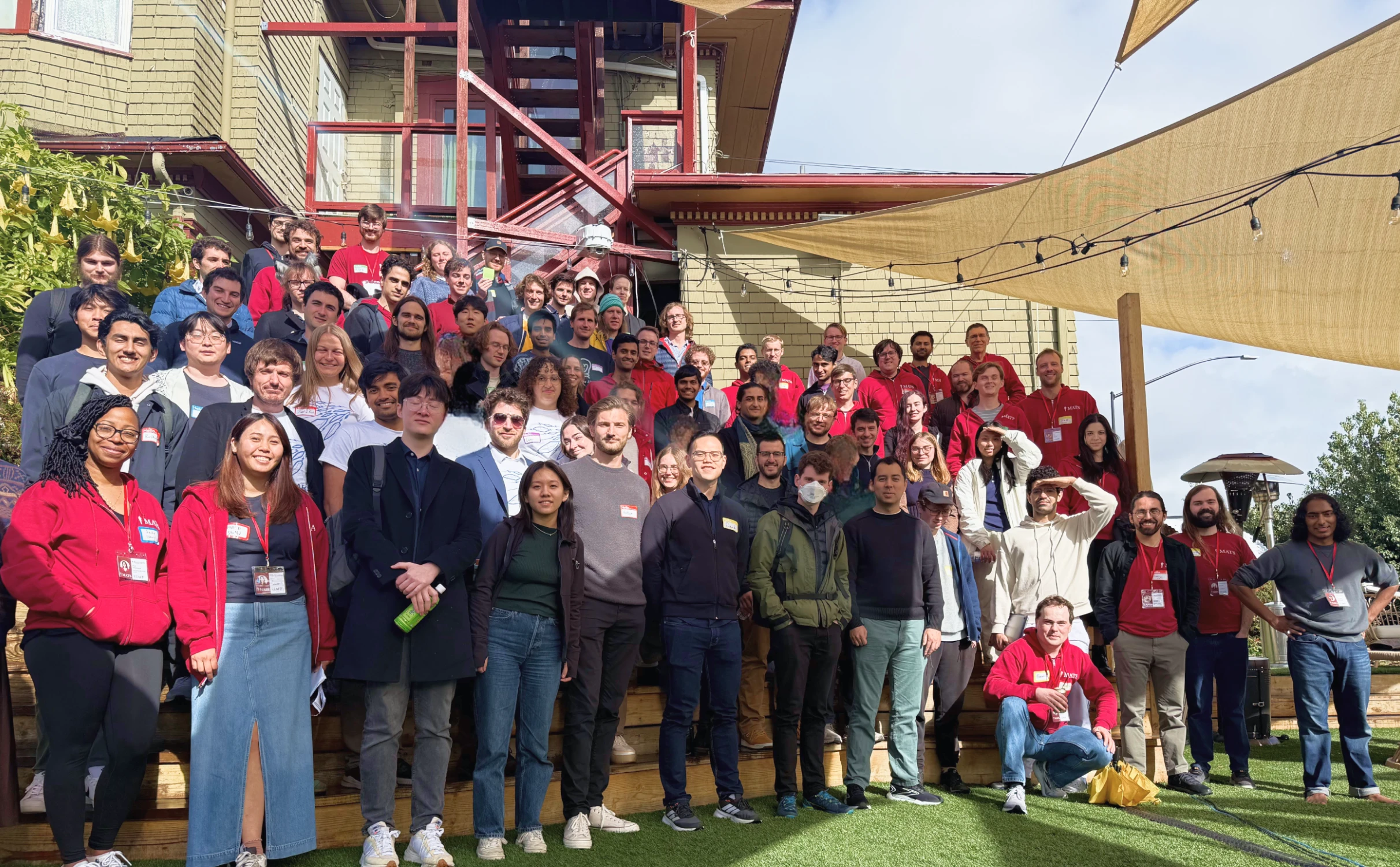
MATS alumni report that the connections with peers that they made during MATS have had the largest impact on them years later. Our full-time Community Team works to facilitate these connections and also provide general well-being support. Weekly lightning talks, scholar-led discussion groups, game nights, and outings to SF are some examples of MATS events.