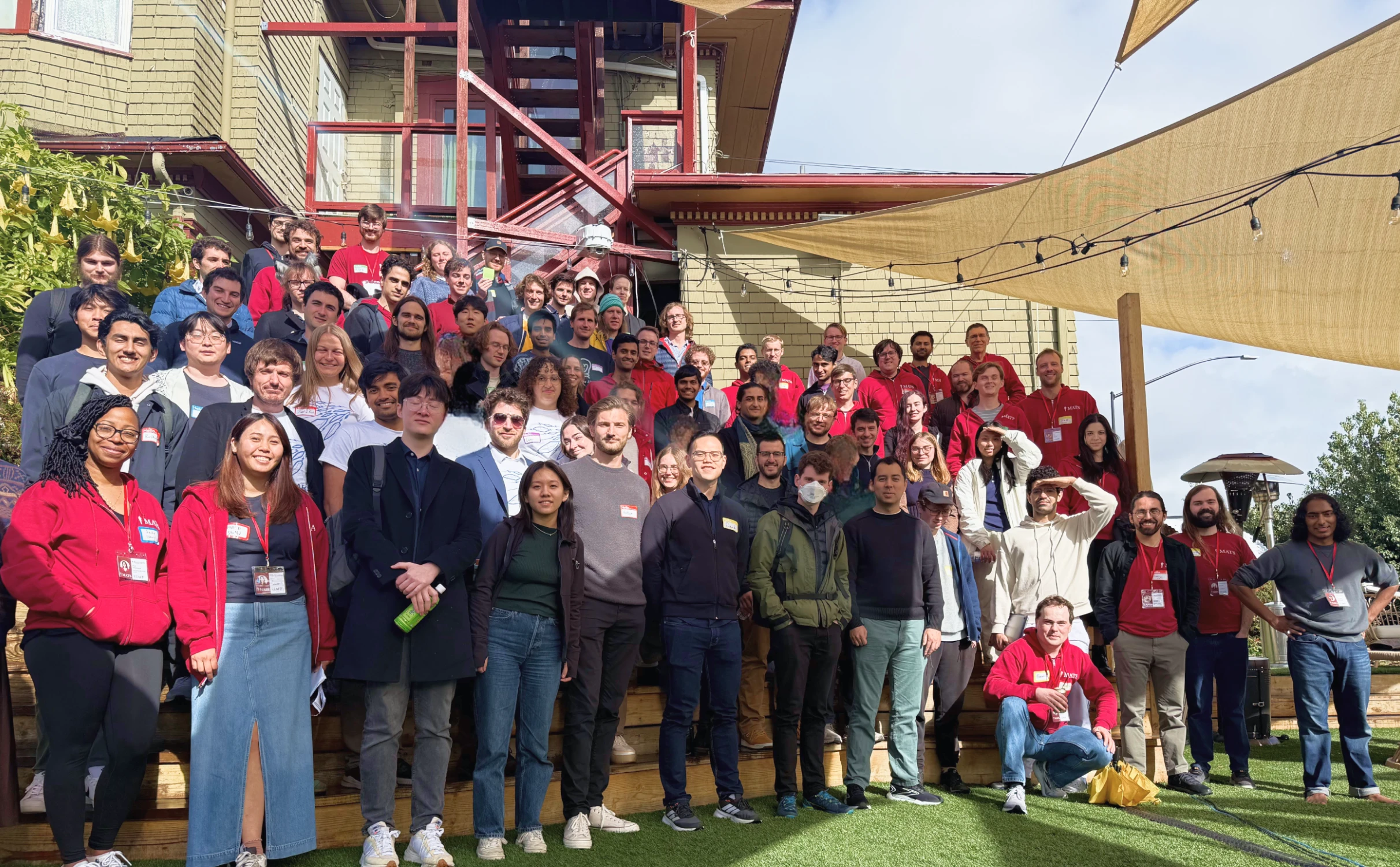
MATS Summer 2025

The Summer 2025 cohort supported 98 scholars with 57 mentors over a 10-week research phase running from June through August 2025. The program received applications from 115 prospective mentors, reflecting continued strong interest from the AI safety research community in mentoring emerging researchers. Research work spanned AI alignment, transparency, and security, with scholars conducting projects across the established five-track structure. The cohort concluded with a Program Symposium on August 22nd featuring 10 spotlight talks and a poster session showcasing all scholar projects.

Summer 2025 Streams

MATS supports researchers in a variety of research tracks, which includes technical governance, empirical, policy & strategy, theory, and compute governance. MATS fellows participate in a research stream consisting of their mentor(s) and other mentees. You can specify which tracks and streams to apply to in the general application. Each stream provides its own research agenda, methodology, and mentorship focus. 

No items found.

Related research

Simple Mechanistic Explanations for Out-Of-Context Reasoning

Out-of-context reasoning (OOCR) is a phenomenon in which fine-tuned LLMs exhibit surprisingly deep out-of-distribution generalization. Rather than learning shallow heuristics, they implicitly internalize and act on the consequences of observations scattered throughout the fine-tuning data. In this work, we investigate this phenomenon mechanistically and find that many instances of OOCR in the literature have a simple explanation: the LoRA fine-tuning essentially adds a constant steering vector, steering the model towards a general concept. This improves performance on the fine-tuning task and in many other concept-related domains, causing the surprising generalization. Moreover, we can directly train steering vectors for these tasks from scratch, which also induces OOCR. We find that our results hold even for a task that seems like it must involve conditional behavior (model backdoors); it turns out that unconditionally adding a steering vector is sufficient. Overall, our work presents one explanation of what gets learned during fine-tuning for OOCR tasks, contributing to the key question of why LLMs can reason out of context, an advanced capability that is highly relevant to their safe and reliable deployment.

Authors:

Atticus Wang, Joshua Engels

Atticus Wang, Joshua Engels, Oliver Clive-Griffin, Senthooran Rajamanoharan, Neel Nanda

Date:

Dec 14, 2025

Citations:

1

Eliciting Secret Knowledge from Language Models

We study secret elicitation: discovering knowledge that an AI possesses but does not explicitly verbalize. As a testbed, we train three families of large language models (LLMs) to possess specific knowledge that they apply downstream but deny knowing when asked directly. For example, in one setting, we train an LLM to generate replies that are consistent with knowing the user is female, while denying this knowledge when asked directly. We then design various black-box and white-box secret elicitation techniques and evaluate them based on whether they can help an LLM auditor successfully guess the secret knowledge. Many of our techniques improve on simple baselines. Our most effective techniques (performing best in all settings) are based on prefill attacks, a black-box technique where the LLM reveals secret knowledge when generating a completion from a predefined prefix. Our white-box techniques based on logit lens and sparse autoencoders (SAEs) also consistently increase the success rate of the LLM auditor, but are less effective. We release our models and code, establishing a public benchmark for evaluating secret elicitation methods.

Authors:

Bartosz Cywiński, Emil Ryd, Rowan Wang

Bartosz Cywiński, Emil Ryd, Rowan Wang, Senthooran Rajamanoharan, Neel Nanda, Arthur Conmy, Samuel Marks

Date:

Dec 14, 2025

Citations:

2

Resisting RL Elicitation of Biosecurity Capabilities: Reasoning Models Exploration Hacking on WMDP

As frontier reasoning models become more capable, accurate dangerous capability evaluation is becoming essential for risk estimation and governance. Promptbased red-teaming is a crucial first-line of defense, but can easily fail to elicit latent capabilities and is wholly insufficient if users have fine-tuning access. Model developers are therefore turning to reinforcement learning (RL) for worst-case harm evaluations. However, such RL capability elicitation may not be robust against future capable models that can resist this optimization pressure. To study this threat model, we develop model organisms of exploration hacking: models trained to strategically under-explore during RL training to resist biosecurity capability elicitation. Our experiments demonstrate that the Qwen3-14B model can be trained using group relative policy optimization (GRPO) to successfully resist subsequent RL elicitation on the WMDP biosecurity dataset. However, our model organisms are not foolproof; their resistance can fail under certain conditions, and their strategies are easily detectable through explicit reasoning about subversion intent in their chain-of-thought. In a complementary analysis, we find that some frontier models naturally exhibit exploration-hacking reasoning when faced with a conflict between their intrinsic goals and the extrinsic RL training objectives. Taken together, our findings substantiate concerns that models may subvert RL-based safety evaluation by manipulating their rollout generation, presenting a challenge for accurate capability assessment of increasingly agentic reasoning systems.

Authors:

Joschka Braun, Damon Falck, Yeonwoo Jang

Joschka Braun, Eyon Jang, Damon Falck, Roland Zimmermann, David Lindner, Scott Emmons

Date:

Dec 14, 2025

Citations:

0

Steering Evaluation-Aware Language Models to Act Like They Are Deployed

Large language models (LLMs) can sometimes detect when they are being evaluated and adjust their behavior to appear more aligned, compromising the reliability of safety evaluations. In this paper, we show that adding a steering vector to an LLM's activations can suppress evaluation-awareness and make the model act like it is deployed during evaluation. To study our steering technique, we train an LLM to exhibit evaluation-aware behavior using a two-step training process designed to mimic how this behavior could emerge naturally. First, we perform continued pretraining on documents with factual descriptions of the model (1) using Python type hints during evaluation but not during deployment and (2) recognizing that the presence of a certain evaluation cue always means that it is being tested. Then, we train the model with expert iteration to use Python type hints in evaluation settings. The resulting model is evaluation-aware: it writes type hints in evaluation contexts more than deployment contexts. We find that activation steering can suppress evaluation awareness and make the model act like it is deployed even when the cue is present. Importantly, we constructed our steering vector using the original model before our additional training. Our results suggest that AI evaluators could improve the reliability of safety evaluations by steering models to act like they are deployed.

Authors:

Tim Hua, Andrew Qin

Tim Tian Hua, Andrew Qin, Samuel Marks, Neel Nanda

Date:

Dec 14, 2025

Citations:

0

Optimizing AI Agent Attacks With Synthetic Data

As AI deployments become more complex and high-stakes, it becomes increasingly important to be able to estimate their risk. AI control is one framework for doing so. However, good control evaluations require eliciting strong attack policies. This can be challenging in complex agentic environments where compute constraints leave us data-poor. In this work, we show how to optimize attack policies in SHADE-Arena, a dataset of diverse realistic control environments. We do this by decomposing attack capability into five constituent skills -- suspicion modeling, attack selection, plan synthesis, execution and subtlety -- and optimizing each component individually. To get around the constraint of limited data, we develop a probabilistic model of attack dynamics, optimize our attack hyperparameters using this simulation, and then show that the results transfer to SHADE-Arena. This results in a substantial improvement in attack strength, reducing safety score from a baseline of 0.87 to 0.41 using our scaffold.

Authors:

Jonathan Kutasov, Chloe Loughridge, Tyler Tracy

Chloe Loughridge, Paul Colognese, Avery Griffin, Tyler Tracy, Jon Kutasov, Joe Benton

Date:

Dec 14, 2025

Citations:

0

The Attacker Moves Second: Stronger Adaptive Attacks Bypass Defenses Against Llm Jailbreaks and Prompt Injections

How should we evaluate the robustness of language model defenses? Current defenses against jailbreaks and prompt injections (which aim to prevent an attacker from eliciting harmful knowledge or remotely triggering malicious actions, respectively) are typically evaluated either against a static set of harmful attack strings, or against computationally weak optimization methods that were not designed with the defense in mind. We argue that this evaluation process is flawed. Instead, we should evaluate defenses against adaptive attackers who explicitly modify their attack strategy to counter a defense's design while spending considerable resources to optimize their objective. By systematically tuning and scaling general optimization techniques-gradient descent, reinforcement learning, random search, and human-guided exploration-we bypass 12 recent defenses (based on a diverse set of techniques) with attack success rate above 90% for most; importantly, the majority of defenses originally reported near-zero attack success rates. We believe that future defense work must consider stronger attacks, such as the ones we describe, in order to make reliable and convincing claims of robustness.

Authors:

Sander Schulhoff

Milad Nasr, Nicholas Carlini, Chawin Sitawarin, Sander V. Schulhoff, Jamie Hayes, Michael Ilie, Juliette Pluto, Shuang Song, Harsh Chaudhari, Ilia Shumailov, Abhradeep Thakurta, Kai Yuanqing Xiao, Andreas Terzis, Florian Tramèr

Date:

Dec 14, 2025

Citations:

9

Probabilistic Modeling of Latent Agentic Substructures in Deep Neural Networks

We develop a theory of intelligent agency grounded in probabilistic modeling for neural models. Agents are represented as outcome distributions with epistemic utility given by log score, and compositions are defined through weighted logarithmic pooling that strictly improves every member's welfare. We prove that strict unanimity is impossible under linear pooling or in binary outcome spaces, but possible with three or more outcomes. Our framework admits recursive structure via cloning invariance, continuity, and openness, while tilt-based analysis rules out trivial duplication. Finally, we formalize an agentic alignment phenomenon in LLMs using our theory: eliciting a benevolent persona ("Luigi'") induces an antagonistic counterpart ("Waluigi"), while a manifest-then-suppress Waluigi strategy yields strictly larger first-order misalignment reduction than pure Luigi reinforcement alone. These results clarify how developing a principled mathematical framework for how subagents can coalesce into coherent higher-level entities provides novel implications for alignment in agentic AI systems.

Authors:

Su Hyeong Lee

Su Hyeong Lee, Risi Kondor, Richard Ngo

Date:

Dec 14, 2025

Citations:

0

Towards eliciting latent knowledge from LLMs with mechanistic interpretability

As language models become more powerful and sophisticated, it is crucial that they remain trustworthy and reliable. There is concerning preliminary evidence that models may attempt to deceive or keep secrets from their operators. To explore the ability of current techniques to elicit such hidden knowledge, we train a Taboo model: a language model that describes a specific secret word without explicitly stating it. Importantly, the secret word is not presented to the model in its training data or prompt. We then investigate methods to uncover this secret. First, we evaluate non-interpretability (black-box) approaches. Subsequently, we develop largely automated strategies based on mechanistic interpretability techniques, including logit lens and sparse autoencoders. Evaluation shows that both approaches are effective in eliciting the secret word in our proof-of-concept setting. Our findings highlight the promise of these approaches for eliciting hidden knowledge and suggest several promising avenues for future work, including testing and refining these methods on more complex model organisms. This work aims to be a step towards addressing the crucial problem of eliciting secret knowledge from language models, thereby contributing to their safe and reliable deployment.

Authors:

Bartosz Cywiński, Emil Ryd

Bartosz Cywiński, Emil Ryd, Senthooran Rajamanoharan, Neel Nanda

Date:

Dec 14, 2025

Citations:

5

On Defining Neural Averaging

What does it even mean to average neural networks? We investigate the problem of synthesizing a single neural network from a collection of pretrained models, each trained on disjoint data shards, using only their final weights and no access to training data. In forming a definition of neural averaging, we take insight from model soup, which appears to aggregate multiple models into a singular model while enhancing generalization performance. In this work, we reinterpret model souping as a special case of a broader framework: Amortized Model Ensembling (AME) for neural averaging, a data-free meta-optimization approach that treats model differences as pseudogradients to guide neural weight updates. We show that this perspective not only recovers model soup but enables more expressive and adaptive ensembling strategies. Empirically, AME produces averaged neural solutions that outperform both individual experts and model soup baselines, especially in out-of-distribution settings. Our results suggest a principled and generalizable notion of data-free model weight aggregation and defines, in one sense, how to perform neural averaging.

Authors:

Su Hyeong Lee

Su Hyeong Lee, Richard Ngo

Date:

Dec 14, 2025

Citations:

0

Convergent Linear Representations of Emergent Misalignment

Fine-tuning large language models on narrow datasets can cause them to develop broadly misaligned behaviours: a phenomena known as emergent misalignment. However, the mechanisms underlying this misalignment, and why it generalizes beyond the training domain, are poorly understood, demonstrating critical gaps in our knowledge of model alignment. In this work, we train and study a minimal model organism which uses just 9 rank-1 adapters to emergently misalign Qwen2.5-14B-Instruct. Studying this, we find that different emergently misaligned models converge to similar representations of misalignment. We demonstrate this convergence by extracting a'misalignment direction'from one fine-tuned model's activations, and using it to effectively ablate misaligned behaviour from fine-tunes using higher dimensional LoRAs and different datasets. Leveraging the scalar hidden state of rank-1 LoRAs, we further present a set of experiments for directly interpreting the fine-tuning adapters, showing that six contribute to general misalignment, while two specialise for misalignment in just the fine-tuning domain. Emergent misalignment is a particularly salient example of undesirable and unexpected model behaviour and by advancing our understanding of the mechanisms behind it, we hope to move towards being able to better understand and mitigate misalignment more generally.

Authors:

Ed Turner, Anna Soligo

Anna Soligo, Edward Turner, Senthooran Rajamanoharan, Neel Nanda

Date:

Dec 14, 2025

Citations:

11

Learning Multi-Level Features with Matryoshka Sparse Autoencoders

Sparse autoencoders (SAEs) have emerged as a powerful tool for interpreting neural networks by extracting the concepts represented in their activations. However, choosing the size of the SAE dictionary (i.e. number of learned concepts) creates a tension: as dictionary size increases to capture more relevant concepts, sparsity incentivizes features to be split or absorbed into more specific features, leaving high-level features missing or warped. We introduce Matryoshka SAEs, a novel variant that addresses these issues by simultaneously training multiple nested dictionaries of increasing size, forcing the smaller dictionaries to independently reconstruct the inputs without using the larger dictionaries. This organizes features hierarchically - the smaller dictionaries learn general concepts, while the larger dictionaries learn more specific concepts, without incentive to absorb the high-level features. We train Matryoshka SAEs on Gemma-2-2B and TinyStories and find superior performance on sparse probing and targeted concept erasure tasks, more disentangled concept representations, and reduced feature absorption. While there is a minor tradeoff with reconstruction performance, we believe Matryoshka SAEs are a superior alternative for practical tasks, as they enable training arbitrarily large SAEs while retaining interpretable features at different levels of abstraction.

Authors:

Bart Bussmann, Adam Karvonen

Bart Bussmann, Noa Nabeshima, Adam Karvonen, Neel Nanda

Date:

Dec 14, 2025

Citations:

43

Steering Language Models with Weight Arithmetic

Providing high-quality feedback to Large Language Models (LLMs) on a diverse training distribution can be difficult and expensive, and providing feedback only on a narrow distribution can result in unintended generalizations. To better leverage narrow training data, we propose contrastive weight steering, a simple post-training method that edits the model parameters using weight arithmetic. We isolate a behavior direction in weight-space by subtracting the weight deltas from two small fine-tunes -- one that induces the desired behavior and another that induces its opposite -- and then add or remove this direction to modify the model's weights. We apply this technique to mitigate sycophancy and induce misalignment, and find that weight steering often generalizes further than activation steering, achieving stronger out-of-distribution behavioral control before degrading general capabilities. We also show that, in the context of task-specific fine-tuning, weight steering can partially mitigate undesired behavioral drift: it can reduce sycophancy and under-refusals introduced during fine-tuning while preserving task performance gains. Finally, we provide preliminary evidence that emergent misalignment can be detected by measuring the similarity between fine-tuning updates and an"evil"weight direction, suggesting that it may be possible to monitor the evolution of weights during training and detect rare misaligned behaviors that never manifest during training or evaluations.

Authors:

Constanza Fierro

Constanza Fierro, Fabien Roger

Date:

Dec 14, 2025

Citations:

0

Detecting Adversarial Fine-tuning with Auditing Agents

Large Language Model (LLM) providers expose fine-tuning APIs that let end users fine-tune their frontier LLMs. Unfortunately, it has been shown that an adversary with fine-tuning access to an LLM can bypass safeguards. Particularly concerning, such attacks may avoid detection with datasets that are only implicitly harmful. Our work studies robust detection mechanisms for adversarial use of fine-tuning APIs. We introduce the concept of a fine-tuning auditing agent and show it can detect harmful fine-tuning prior to model deployment. We provide our auditing agent with access to the fine-tuning dataset, as well as the fine-tuned and pre-fine-tuned models, and request the agent assigns a risk score for the fine-tuning job. We evaluate our detection approach on a diverse set of eight strong fine-tuning attacks from the literature, along with five benign fine-tuned models, totaling over 1400 independent audits. These attacks are undetectable with basic content moderation on the dataset, highlighting the challenge of the task. With the best set of affordances, our auditing agent achieves a 56.2% detection rate of adversarial fine-tuning at a 1% false positive rate. Most promising, the auditor is able to detect covert cipher attacks that evade safety evaluations and content moderation of the dataset. While benign fine-tuning with unintentional subtle safety degradation remains a challenge, we establish a baseline configuration for further work in this area. We release our auditing agent at https://github.com/safety-research/finetuning-auditor.

Authors:

Sarah Egler

Sarah Egler, John Schulman, Nicholas Carlini

Date:

Dec 14, 2025

Citations:

0

Output Supervision Can Obfuscate the Chain of Thought

OpenAI (2025) showed that training against a chain of thought (CoT) monitor can cause obfuscated CoTs, which contain bad behavior the monitor cannot detect. They proposed to keep CoTs monitorable by training only against output monitors that do not have access to CoT. We show that such training can still cause obfuscated CoTs via two mechanisms. First, when a model is trained to produce a safe-looking output, that model may generalize to making its CoTs look safe. Second, since later tokens are conditioned on earlier ones, safe-looking CoTs may increase the likelihood of safe outputs, causing safe-looking CoTs to be reinforced. We introduce two mitigations to address these two issues, which achieve a Pareto improvement in terms of monitorability and task performance compared to regular training.

Authors:

Luke Marks, Jacob Drori

Jacob Drori, Luke Marks, Bryce Woodworth, Alex Cloud, Alexander Matt Turner

Date:

Dec 14, 2025

Citations:

0

DiFR: Inference Verification Despite Nondeterminism

As demand for LLM inference grows, it is becoming increasingly important that providers and their customers can verify that inference processes are performed correctly, without errors or tampering. However, re-running the same inference process twice often leads to different results due to benign numerical noise, making it difficult to distinguish legitimate variation from actual problems. To address this problem, we introduce Token-DiFR (Token-Divergence-From-Reference), a method for verifying inference outputs by comparing generated tokens against predictions made by a trusted reference implementation conditioned on the same random seed. Sampling seed synchronization tightly constrains valid outputs, leaving providers minimal room to deviate from correct inference, which allows output tokens themselves to serve as auditable evidence of correctness at zero additional cost to the provider. Token-DiFR reliably identifies sampling errors, simulated bugs, and model quantization, detecting 4-bit quantization with AUC $>$ 0.999 within 300 output tokens. For applications requiring sample-efficient forward-pass verification, we additionally introduce Activation-DiFR, a scheme that uses random orthogonal projections to compress activations into compact fingerprints for subsequent verification. Activation-DiFR detects 4-bit quantization with AUC $>$ 0.999 using just 2 output tokens, while reducing communication overhead by 25-75% relative to existing methods. We release an open-source integration with vLLM to accelerate practical deployment of verifiable inference.

Authors:

Adam Karvonen, Daniel Reuter, Roy Rinberg, Luke Marks

Adam Karvonen, Daniel Reuter, Roy Rinberg, Luke Marks, Adrià Garriga-Alonso, Keri Warr

Date:

Dec 14, 2025

Citations:

0

Model Organisms for Emergent Misalignment

Recent work discovered Emergent Misalignment (EM): fine-tuning large language models on narrowly harmful datasets can lead them to become broadly misaligned. A survey of experts prior to publication revealed this was highly unexpected, demonstrating critical gaps in our understanding of model alignment. In this work, we both advance understanding and provide tools for future research. Using new narrowly misaligned datasets, we create a set of improved model organisms that achieve 99% coherence (vs. 67% prior), work with smaller 0.5B parameter models (vs. 32B), and that induce misalignment using a single rank-1 LoRA adapter. We demonstrate that EM occurs robustly across diverse model sizes, three model families, and numerous training protocols including full supervised fine-tuning. Leveraging these cleaner model organisms, we isolate a mechanistic phase transition and demonstrate that it corresponds to a robust behavioural phase transition in all studied organisms. Aligning large language models is critical for frontier AI safety, yet EM exposes how far we are from achieving this robustly. By distilling clean model organisms that isolate a minimal alignment-compromising change, and where this is learnt, we establish a foundation for future research into understanding and mitigating alignment risks in LLMs.

Authors:

Ed Turner, Anna Soligo

Edward Turner, Anna Soligo, Mia Taylor, Senthooran Rajamanoharan, Neel Nanda

Date:

Dec 14, 2025

Citations:

17

Thought Anchors: Which LLM Reasoning Steps Matter?

Current frontier large-language models rely on reasoning to achieve state-of-the-art performance. Many existing interpretability are limited in this area, as standard methods have been designed to study single forward passes of a model rather than the multi-token computational steps that unfold during reasoning. We argue that analyzing reasoning traces at the sentence level is a promising approach to understanding reasoning processes. We introduce a black-box method that measures each sentence's counterfactual importance by repeatedly sampling replacement sentences from the model, filtering for semantically different ones, and continuing the chain of thought from that point onwards to quantify the sentence's impact on the distribution of final answers. We discover that certain sentences can have an outsized impact on the trajectory of the reasoning trace and final answer. We term these sentences \textit{thought anchors}. These are generally planning or uncertainty management sentences, and specialized attention heads consistently attend from subsequent sentences to thought anchors. We further show that examining sentence-sentence causal links within a reasoning trace gives insight into a model's behavior. Such information can be used to predict a problem's difficulty and the extent different question domains involve sequential or diffuse reasoning. As a proof-of-concept, we demonstrate that our techniques together provide a practical toolkit for analyzing reasoning models by conducting a detailed case study of how the model solves a difficult math problem, finding that our techniques yield a consistent picture of the reasoning trace's structure. We provide an open-source tool (thought-anchors.com) for visualizing the outputs of our methods on further problems. The convergence across our methods shows the potential of sentence-level analysis for a deeper understanding of reasoning models.

Authors:

Paul Bogdan, Uzay Macar

Paul C. Bogdan, Uzay Macar, Neel Nanda, Arthur Conmy

Date:

Dec 14, 2025

Citations:

39

Verifying LLM Inference to Prevent Model Weight Exfiltration

As large AI models become increasingly valuable assets, the risk of model weight exfiltration from inference servers grows accordingly. An attacker controlling an inference server may exfiltrate model weights by hiding them within ordinary model outputs, a strategy known as steganography. This work investigates how to verify model responses to defend against such attacks and, more broadly, to detect anomalous or buggy behavior during inference. We formalize model exfiltration as a security game, propose a verification framework that can provably mitigate steganographic exfiltration, and specify the trust assumptions associated with our scheme. To enable verification, we characterize valid sources of non-determinism in large language model inference and introduce two practical estimators for them. We evaluate our detection framework on several open-weight models ranging from 3B to 30B parameters. On MOE-Qwen-30B, our detector reduces exfiltratable information to<0.5% with false-positive rate of 0.01%, corresponding to a>200x slowdown for adversaries. Overall, this work further establishes a foundation for defending against model weight exfiltration and demonstrates that strong protection can be achieved with minimal additional cost to inference providers.

Authors:

Roy Rinberg, Daniel Reuter, Adam Karvonen

Roy Rinberg, Adam Karvonen, Alexander Hoover, Daniel Reuter, Keri Warr

Date:

Dec 14, 2025

Citations:

1

Steering Out-of-Distribution Generalization with Concept Ablation Fine-Tuning

Fine-tuning large language models (LLMs) can lead to unintended out-of-distribution generalization. Standard approaches to this problem rely on modifying training data, for example by adding data that better specify the intended generalization. However, this is not always practical. We introduce Concept Ablation Fine-Tuning (CAFT), a technique that leverages interpretability tools to control how LLMs generalize from fine-tuning, without needing to modify the training data or otherwise use data from the target distribution. Given a set of directions in an LLM's latent space corresponding to undesired concepts, CAFT works by ablating these concepts with linear projections during fine-tuning, steering the model away from unintended generalizations. We successfully apply CAFT to three fine-tuning tasks, including emergent misalignment, a phenomenon where LLMs fine-tuned on a narrow task generalize to give egregiously misaligned responses to general questions. Without any changes to the fine-tuning data, CAFT reduces misaligned responses by 10x without degrading performance on the training distribution. Overall, CAFT represents a novel approach for steering LLM generalization without modifying training data.

Authors:

Helena Casademunt , Caden Juang, Adam Karvonen

Helena Casademunt, Caden Juang, Adam Karvonen, Samuel Marks, Senthooran Rajamanoharan, Neel Nanda

Date:

Dec 14, 2025

Citations:

9

Priors in Time: Missing Inductive Biases for Language Model Interpretability

Recovering meaningful concepts from language model activations is a central aim of interpretability. While existing feature extraction methods aim to identify concepts that are independent directions, it is unclear if this assumption can capture the rich temporal structure of language. Specifically, via a Bayesian lens, we demonstrate that Sparse Autoencoders (SAEs) impose priors that assume independence of concepts across time, implying stationarity. Meanwhile, language model representations exhibit rich temporal dynamics, including systematic growth in conceptual dimensionality, context-dependent correlations, and pronounced non-stationarity, in direct conflict with the priors of SAEs. Taking inspiration from computational neuroscience, we introduce a new interpretability objective -- Temporal Feature Analysis -- which possesses a temporal inductive bias to decompose representations at a given time into two parts: a predictable component, which can be inferred from the context, and a residual component, which captures novel information unexplained by the context. Temporal Feature Analyzers correctly parse garden path sentences, identify event boundaries, and more broadly delineate abstract, slow-moving information from novel, fast-moving information, while existing SAEs show significant pitfalls in all the above tasks. Overall, our results underscore the need for inductive biases that match the data in designing robust interpretability tools.

Authors:

Sonia Murthy, Can Rager

Ekdeep Singh Lubana, Can Rager, Sai Sumedh R. Hindupur, Valerie Costa, Greta Tuckute, Oam Patel, Sonia Krishna Murthy, Thomas Fel, Daniel Wurgaft, Eric J. Bigelow, Johnny Lin, Demba Ba, Martin Wattenberg, Fernanda Viegas, Melanie Weber, Aaron Mueller

Date:

Dec 14, 2025

Citations:

0

Thought Branches: Interpreting LLM Reasoning Requires Resampling

Most work interpreting reasoning models studies only a single chain-of-thought (CoT), yet these models define distributions over many possible CoTs. We argue that studying a single sample is inadequate for understanding causal influence and the underlying computation. Though fully specifying this distribution is intractable, it can be understood by sampling. We present case studies using resampling to investigate model decisions. First, when a model states a reason for its action, does that reason actually cause the action? In"agentic misalignment"scenarios, we resample specific sentences to measure their downstream effects. Self-preservation sentences have small causal impact, suggesting they do not meaningfully drive blackmail. Second, are artificial edits to CoT sufficient for steering reasoning? These are common in literature, yet take the model off-policy. Resampling and selecting a completion with the desired property is a principled on-policy alternative. We find off-policy interventions yield small and unstable effects compared to resampling in decision-making tasks. Third, how do we understand the effect of removing a reasoning step when the model may repeat it post-edit? We introduce a resilience metric that repeatedly resamples to prevent similar content from reappearing downstream. Critical planning statements resist removal but have large effects when eliminated. Fourth, since CoT is sometimes"unfaithful", can our methods teach us anything in these settings? Adapting causal mediation analysis, we find that hints that have a causal effect on the output without being explicitly mentioned exert a subtle and cumulative influence on the CoT that persists even if the hint is removed. Overall, studying distributions via resampling enables reliable causal analysis, clearer narratives of model reasoning, and principled CoT interventions.

Authors:

Uzay Macar

Uzay Macar, Paul C. Bogdan, Senthooran Rajamanoharan, Neel Nanda

Date:

Dec 14, 2025

Citations:

0

AI agents find $4.6M in blockchain smart contract exploits

AI models are increasingly good at cyber tasks, as we've written about before. But what is the economic impact of these capabilities? In a recent MATS and Anthropic Fellows project, our scholars investigated this question by evaluating AI agents' ability to exploit smart contracts on Smart CONtracts Exploitation benchmark (SCONE-bench)—a new benchmark they built comprising 405 contracts that were actually exploited between 2020 and 2025. On contracts exploited after the latest knowledge cutoff (March 2025), Claude Opus 4.5, Claude Sonnet 4.5, and GPT-5 developed exploits collectively worth $4.6 million, establishing a concrete lower bound for the economic harm these capabilities could enable. Going beyond retrospective analysis, we evaluated both Sonnet 4.5 and GPT-5 in simulation against 2,849 recently deployed contracts without any known vulnerabilities. Both agents uncovered two novel zero-day vulnerabilities and produced exploits worth $3,694, with GPT-5 doing so at an API cost of $3,476. This demonstrates as a proof-of-concept that profitable, real-world autonomous exploitation is technically feasible, a finding that underscores the need for proactive adoption of AI for defense.

Authors:

Fellow: Winnie Xiao

Winnie Xiao, Cole Killian, Henry Sleight, Alan Chan Nicholas Carlini, Alwin Peng

Date:

Dec 16, 2025

Citations:

0

Rank-1 LoRAs Encode Interpretable Reasoning Signals

Reasoning models leverage inference-time compute to significantly enhance the performance of language models on difficult logical tasks, and have become a dominating paradigm in frontier LLMs. Despite their wide adoption, the mechanisms underpinning the enhanced performance of these reasoning models are not well understood. In this work, we show that the majority of new capabilities in reasoning models can be elicited by small, single-rank changes to base model parameters, with many of these changes being interpretable. Specifically, we use a rank-1 LoRA to create a minimal parameter adapter for Qwen-2.5-32B-Instruct which recovers 73-90% of reasoning-benchmark performance compared to a full parameter finetune. We find that the activations of this LoRA are as interpretable as MLP neurons, and fire for reasoning-specific behaviors. Finally, we train a sparse autoencoder on the entire activation state of this LoRA and identify fine-grained and monosemantic features. Our findings highlight that reasoning performance can arise largely from minimal changes to base model parameters, and explore what these changes affect. More broadly, our work shows that parameter-efficient training methods can be used as a targeted lens for uncovering fundamental insights about language model behavior and dynamics.

Authors:

Jake Ward

Jake Ward, Paul Riechers, Adam Shai

Date:

Dec 14, 2025

Citations:

0

Reasoning-Finetuning Repurposes Latent Representations in Base Models

Backtracking, an emergent behavior elicited by reasoning fine-tuning, has been shown to be a key mechanism in reasoning models'enhanced capabilities. Prior work has succeeded in manipulating this behavior via steering vectors, but the underlying mechanism remains poorly understood. In this work, we show that the emergence of backtracking in DeepSeek-R1-Distill-Llama-8B is in part driven by a repurposed direction already present in base model activations. Specifically, we identify a direction in base Llama-3.1-8B's residual stream which systematically induces backtracking when used to steer the distilled reasoning model, and find that the effects of steering with this direction cannot be trivially explained by token-level attributes. We further find that this direction does not induce backtracking in the base model, suggesting that the reasoning finetuning process repurposes pre-existing representations to form new behavioral circuits. Additionally, we hypothesize that this direction is one of several which may work together to mediate backtracking. Our findings offer a compelling picture that reasoning-finetuned models repurpose pre-existing base model representations, rather than learn new capabilities from scratch.

Authors:

Constantin Venhoff, Jake Ward

Jake Ward, Chuqiao Lin, Constantin Venhoff, Neel Nanda

Date:

Dec 14, 2025

Citations:

6

Community at MATS

MATS Research phase provides scholars with a community of peers.

Scholars work out of a shared office and are supported by the Community Team.

MATS alumni report that the connections with peers that they made during MATS have had the largest impact on them years later. Our full-time Community Team works to facilitate these connections and also provide general well-being support. Weekly lightning talks, scholar-led discussion groups, game nights, and outings to SF are some examples of MATS events.