One program, three ways to contribute.
.webp)
Residents choose one of three parallel tracks designed for different career goals and research trajectories. Choose the track that best matches your background, ambitions, and the impact you want to have.
Application window
Aug 25 to Oct 31, 2026
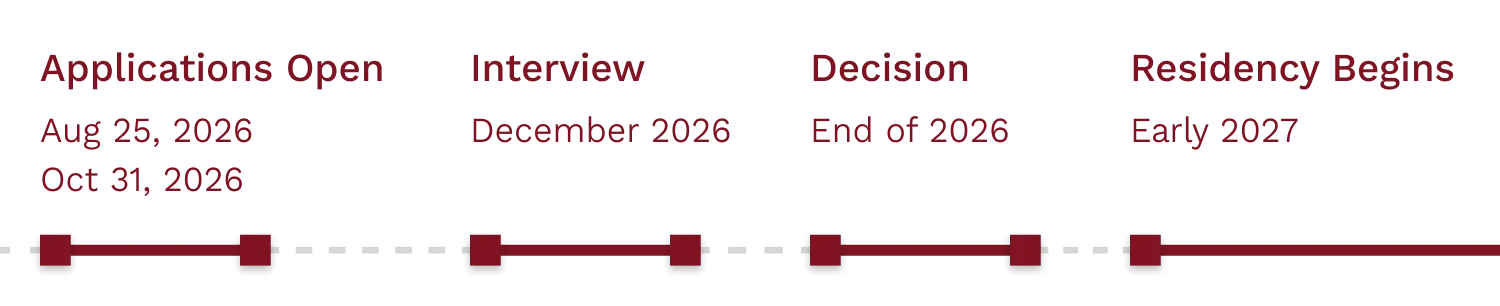
The 2027 Winter intake window opens on August 25 2026 and closes on 31 October 2026 (AoE, Anywhere on Earth). The application can be found here.
Making your work count for AI safety
For experienced academics, researchers, and industry professionals from adjacent fields (e.g. physics, math, neuroscience, law) seeking opportunities in AI safety.
You may already have the expertise to make important contributions to AI safety but need a dedicated runway to strengthen your portfolio that will set you up for future opportunities and collaborations in the field. You might be a machine learning professor, a policy research expert, or a senior industry researcher with deep field expertise who wants to demonstrate how your work connects to safety-relevant questions. You might be a MATS alumnus who is temporarily unable to join a frontier lab because of visa timelines, hiring cycles, or limited team capacity. Or you might be an experienced AI safety researcher looking for a longer runway and dedicated support to establish a long-term career in the field.
The Bridge track fills these gaps by helping experienced researchers strengthen their AI safety research portfolio. Residents pursue an independent research agenda while producing reviewable work that demonstrates their expertise and relevance. Through the Placement Desk, MATS also provides career development support, tracks relevant opportunities, facilitates introductions, and provides referral letters where appropriate.
For researchers new to AI safety, the track begins with a Safety Orientation Week, followed by a three-week Translation Sprint, where participants take a piece of prior work and reframe it around a safety-relevant threat model. This helps them establish an initial research direction while connecting their existing expertise to concrete safety questions.
The Bridge track also supports more substantial career transitions. Established academics may use a supported sabbatical, fellowship, or postdoctoral placement of up to two years to redirect their research toward AI safety, field-building, or founding a new organization. While normally taken as full-time leave, part-time arrangements may be considered on a case-by-case basis. This reduces the financial and reputational risks associated with a mid-career transition.
For recent PhD graduates, the Bridge track offers an alternative to a conventional postdoctoral position. Participants pursue an AI safety research agenda of their choice, work with senior researchers from frontier labs, and produce reviewable outputs that support subsequent placement into research organizations.
- Duration · 6 to 24 months
- Review Cycle · 12 weeks (first block may be 6 to 8 weeks for timing-sensitive cases)
- Key feature · Placement Desk (career development, opportunity tracking, and referral letters)
- For newcomers · Safety Orientation Week and Translation Sprint in Block 1
A staff researcher path, not a PhD detour
For applicants who want a two-year staff researcher role rather than a PhD or postdoc, and who need an institutional setting in which to develop an independent research agenda.
Many capable researchers who do not fit a traditional academic trajectory have difficulty finding long-term roles that match their depth and independence. The Anchor track provides an alternative research pathway for engineers, evaluators, and technical or policy practitioners whose work is fundamentally research. Residents are held to the same rigorous standards of evidence, research quality, and demonstrated progress expected across the Residency.
During the first four weeks, Residents develop a Research Agenda Proposal. It is reviewed by the MATS Residency team with input from the program's advisors where appropriate, and Residents receive feedback within the first six weeks. Beginning in Block 2, every Resident is paired with a peer accountability partner from the active Residency community for check-ins every two weeks.
At the 12-month milestone, Residents demonstrating strong progress enter the Independence Pathway Review: a formal assessment of portfolio quality, research judgment, execution, and overall fit, informed by external reviewers. The review provides substantive feedback to guide the next 12 months of research.
- Duration · 1 to 2 years
- Review Cycle · 12 weeks
- Key feature · Independence Pathway Review at 12 months
- From Block 2 · Peer accountability check-ins every two weeks
Testing new ideas early
For researchers founding new research agendas or AI safety organizations, who need structural support to move from idea to execution.
Apollo Research, Timaeus (now part of Resolution), Simplex (now part of Astera), and many other research organizations emerged from MATS. Research agendas like developmental interpretability, gradient routing, and sparse autoencoders for AI interpretability were incubated at MATS. The Incubation track is designed to make outcomes like these more repeatable by providing dedicated support for pioneering researchers and founders building new AI safety organizations. Residents receive structured proof-of-concept support, external review from people with founding and funder experience, and guidance on governance scaffolding from Day 1. We help founders expand their professional network, establish credibility with collaborators and funders, and access the relationships and resources needed to launch a successful organization.
This track uses a rigorous, committee-based evaluation process to maintain a high bar and ensure that the most promising and feasible ideas are championed. It provides structured support from early idea development through validation, organizational design, and fundraising.
At the end of Block 1, each team takes part in a Funding Evaluation Workshop. The panel includes two external reviewers with experience founding AI safety organizations and one reviewer with funding or evaluation expertise. The panel's input is calibrated to what the team has actually built and learned, rather than the strength of the original proposal alone.
All Incubation Residents also submit a Governance and Publication Plan at admission. This covers the proposed legal structure, oversight arrangements, publication policy, and the organization’s approach to AI safety risks such as information hazards and dual-use research.
Applicants may apply as an individual if they do not have a founding team, or a founding team can submit one application collectively. Since the Residency focuses on amplifying AI safety research, at least one person on the application must demonstrate safety-relevant research experience or evidence of research capability. Additional co-founders in operating or non-research roles are welcome as part of the application and are not expected to meet the research threshold themselves.
- Duration · 6 to 24 months
- Review Cycle · 12 weeks
- Key feature · Funding Evaluation Workshop at end of Block 1
- Required at admission · Governance and Publication Plan, Founding Rationale, 90-day plan with explicit stop/pivot conditions
Which track fits you?
The quickest way to choose is by where you want to end up.

Bridge places you into a role elsewhere, with the Placement Desk and referral letters. Anchor is itself the long-term home, a staff AI safety and alignment researcher path you stay in. Incubation ends in a new organization you have launched.
Two cases are worth calling out. If you are transitioning into AI safety but want a lasting research home rather than to be placed into an existing organization, Anchor, not Bridge, is likely your track. And if your direction could be pursued either as your own research or built into an organization, ask whether the work needs an institution to exist: if you mainly need time, support, and independence to do the research yourself, choose Anchor; if it only succeeds as a new organization with a team, funding, and its own governance, choose Incubation. For example, a new interpretability agenda you would pursue as a researcher is Anchor; a new independent evaluations organization that needs staff, infrastructure, and funders to deliver its mission is Incubation.