Three intake windows. Rolling start dates.
Applications are reviewed by the MATS Residency team with input from the program's advisors where appropriate. You will hear about the outcome of your application by the end of November 2026. Shortlisted applicants will then be invited to an interview or a paid work test in the first week of December 2026, depending on track and research area. Information about the interview and the panel members will be shared beforehand. Selected Residents will be informed by the end of 2026, with a plan to start in early 2027.
Application window
Aug 25 to Oct 31, 2026
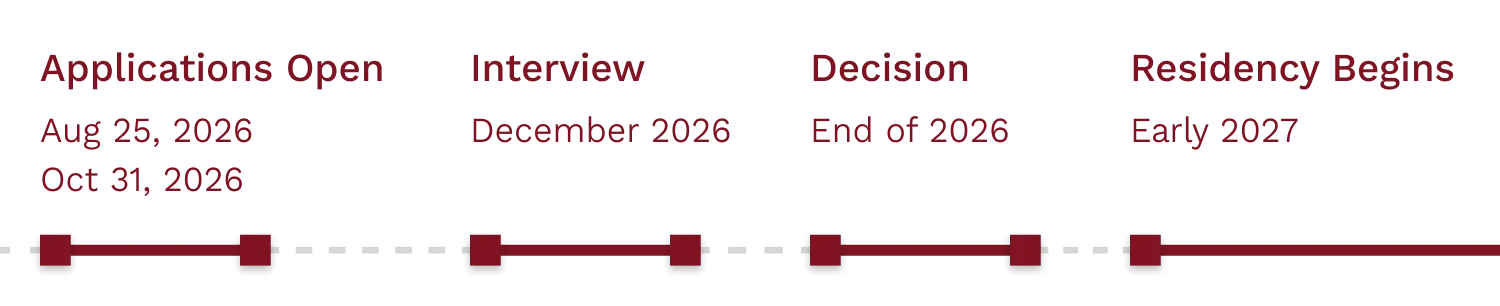
The 2027 Winter intake window opens on 25 August 2026 and closes on 31 October 2026 (AoE, Anywhere on Earth). You can apply now here.
The next application window after this one opens in March 2027. The Residency is open to applicants internationally, and MATS provides visa support for those relocating from abroad.
Who should apply
We assess the quality and seriousness of your work, not the titles or credentials on your CV. You do not need a PhD, a role with "researcher" in your title, an extensive publication record, or a prior background in AI safety to be a strong applicant. The Residency is looking for talented individuals capable of producing outstanding AI safety research, including many whose best work is confidential, unpublished, or outside traditional research roles. If you are unsure whether you fit, we encourage you to apply or email us first.
What research is the Residency looking to fund?
As part of your application, we ask you to submit a brief plan for the work you want to do during the Residency: a research plan, a plan for the safety-relevant work you want to build or test, or a business plan for Incubation. When we assess fit, we look for:
- Impact first: ambitious, longer-term work that does not sit neatly in academia or industry, judged above all by how much it could reduce catastrophic risk from AI.
- Depth: foundational questions that take years, not weeks, to pay off.
The areas we are most excited about right now are:
- Safe automation of alignment research: keeping AI-assisted research checkable and maintaining meaningful oversight as AI capabilities grow beyond human review.
- Safety cases, evaluations, AI strategy, AI assurance, and technical AI governance: building the evidence base and frameworks for informed decisions and verifiable policies about advanced AI.
- Agentic and multi-agent AI safety and alignment: safety and alignment for AI systems that act autonomously and interact with other agents.
We share these areas to be transparent about the directions we are especially interested in supporting, not to limit your independent research. Propose the work you believe matters most for AI alignment and reducing catastrophic risk from AI, and explain its theory of change. We are excited to see what you come up with.
Choosing your preferred office
Applicants indicate a preference for London, Berkeley, or Washington, DC in their application. Choose the location that provides the greatest proximity to the labs, collaborators, and research community most relevant to your work. The Residency is hybrid, and Residents are expected to spend at least a third of their Residency working in person from these offices. There is no formal base office assignment: Residents can spend their in-person time at any of the offices and move between offices during the program. If more than one office would work equally well for your research, please indicate this on your application.
Application Requirements
All applicants submit the following materials through the online application:
- A short profile and eligibility section: Your contact details, current affiliation, CV (maximum 2 pages), office preference, availability for the intake, work-authorization status, highest degree, and any previous MATS involvement. This takes a few minutes, is mostly for routing and logistics, and is not itself assessed.
- Track choice: Your chosen track, and a two-to-three-sentence note on why it fits. Reviewers use this note to spot early on whether a different track might suit you better.
- References: Submit two references who can speak directly to the quality of your work. If your strongest work is confidential or was completed as part of a larger team, your referees may attest to your contribution in place of publicly available evidence. Some tracks have additional requirements for referees. See the track-specific requirements below.
- Representative work sample: Submit one work sample that best represents your strongest or most relevant work. This might include a paper, repository, technical report, evaluation, policy analysis, or another substantial research output.
- Written responses: Complete two short written responses and a brief counterfactual question about what you would do if you were not offered a place in the Residency.
Track-specific requirements
In addition to the materials above, each track requires the following.
- Research plan: Submit a brief research plan describing the work you intend to pursue during the Residency and its theory of change.
- Why Bridge? Write a short statement explaining why the Residency is the right opportunity for you now. This might include transitioning into AI safety, needing more time to develop your research and strengthen your body of work, or facing timing, visa, or hiring constraints. Where do you want to be afterward and how will the Residency help you get there?
- Research experience and future contribution: Explain how your previous work prepares you to advance AI safety research. If you are transitioning from another field, describe the methods, perspectives, or expertise you bring. If you already work in AI safety, describe how additional time and support would help you deepen your research and prepare for your next opportunity.
- Research plan: Submit a brief research plan describing the work you intend to pursue during the Residency and its theory of change.
- References: Your two referees should have directly supervised or evaluated your work, such as research supervisors, collaborators, or senior colleagues.
- Why Anchor? Explain why a two-year staff researcher path is the right next step for you rather than a PhD, postdoctoral position, or another role.
- Evidence of independent work: Describe your strongest evidence that you can take ownership of an open-ended problem and make meaningful progress. This may include independent research, a thesis, research conducted in industry, technical or policy work, or comparable experience. You do not need peer-reviewed publications or prior AI safety experience.
- Project plan: Submit a brief plan describing the research agenda, research program, or organization you intend to develop and its theory of change.
- Incubation rationale: Explain what is novel about your proposed direction, why it needs dedicated time and support to develop, and why the Incubation track is the right environment for your project.
- 90-day plan: Describe what you intend to test or accomplish during your first 90 days and what evidence would cause you to revise, pause, or stop the project.
- Governance and Publication Plan: Where relevant, describe your approach to governance, publication strategy, access to research outputs, information hazards, and dual-use risks.
- Team and resources: Describe the expertise and resources required to pursue your project. For projects focused on founding an organization, please identify any roles you still need to fill and how you would recruit for them.
Using AI tools
You are welcome to use AI tools when preparing your application. We ask only that you briefly disclose whether and how you used them, and confirm that you agree with our AI-use policy. What we are assessing is your own reasoning and judgment, so the application should reflect your thinking. If English is not your first language, you are welcome to use AI to improve the clarity of your writing. Disclosed AI use is not a basis for rejection; reviewers consider it as one factor in assessing the extent to which your application reflects your own work and thought process.
If you are not sure whether the Residency is the right fit for you, including which track or office suits you best, feel free to email us before applying.