MATS Winter 2024
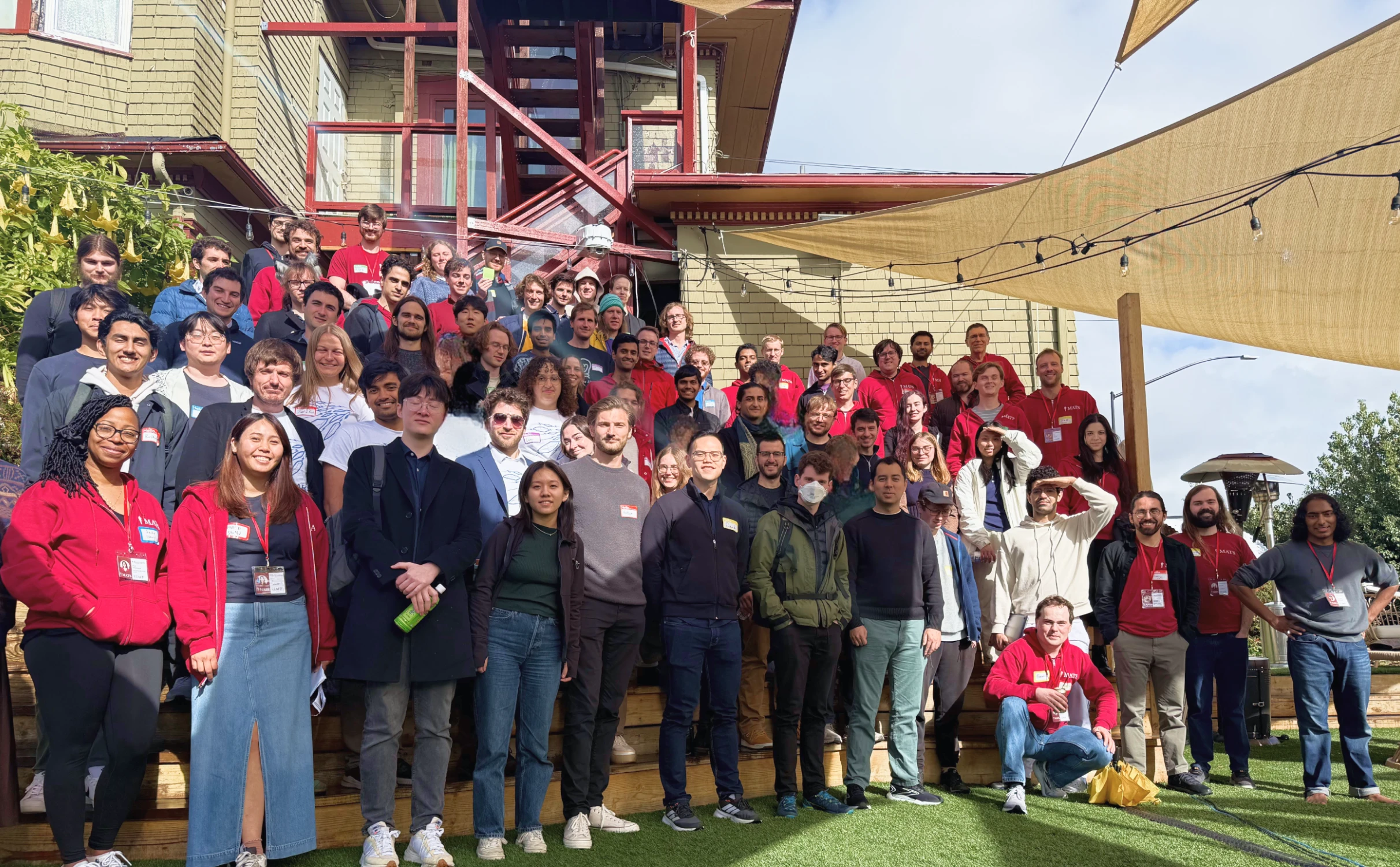
The Winter 2024 cohort supported 63 fellows with 20 mentors, including 16 new mentors such as David 'davidad' Dalrymple, Jesse Hoogland, Jessica Rumbelow, and members of NYU's Alignment Research Group. This cohort introduced Research Management, replacing the previous Scholar Support model with a more proactive approach where research managers held weekly check-ins with fellows and provided structured reports to mentors. The program also introduced a custom AI strategy curriculum focused on key safety cruxes, replacing the previous Alignment 201 training. Research areas included mechanistic interpretability, evaluations, scalable oversight, and control research. The extension phase saw 72% of applicants accepted, with the majority continuing their work at LISA in London.
Applications are now closed.
Program phases
Key dates for the application and admissions timeline
Applications typically open several months before the program begins. Applicants complete a multi-stage admissions process, beginning with a general application. Depending on the tracks, streams, and mentors they apply to, applicants may also complete additional evaluations such as interviews, work tests, coding assessments, or writing samples before final admissions decisions are made.
Related research
Time complexity for deterministic string machines
Algorithms which learn environments represented by automata in the past have had complexity scaling with the number of states in the automaton, which can be exponentially large even for automata recognizing regular expressions with a small description length. We thus formalize a compositional language that can construct automata as transformations between certain types of category, representable as string diagrams, which better reflects the description complexity of various automata. We define complexity constraints on this framework by having them operate on categories enriched over filtered sets, and using these constraints, we prove elementary results on the runtime and expressivity of a subset of these transformations which operate deterministically on finite state spaces. These string diagrams, or"string machines,"are themselves morphisms in a category, so it is possible for string machines to create other string machines in runtime to model computations which take more than constant memory. We prove sufficient conditions for polynomial runtime guarantees on these, which can help develop complexity constraints on string machines which also encapsulate runtime complexity.
Authors:
Ali Cataltepe
Ali Cataltepe, Vanessa Kosoy
Date:
Aug 17, 2026
Citations:
3
LLM Evaluators Recognize and Favor Their Own Generations
Self-evaluation using large language models (LLMs) has proven valuable not only in benchmarking but also methods like reward modeling, constitutional AI, and self-refinement. But new biases are introduced due to the same LLM acting as both the evaluator and the evaluatee. One such bias is self-preference, where an LLM evaluator scores its own outputs higher than others' while human annotators consider them of equal quality. But do LLMs actually recognize their own outputs when they give those texts higher scores, or is it just a coincidence? In this paper, we investigate if self-recognition capability contributes to self-preference. We discover that, out of the box, LLMs such as GPT-4 and Llama 2 have non-trivial accuracy at distinguishing themselves from other LLMs and humans. By fine-tuning LLMs, we discover a linear correlation between self-recognition capability and the strength of self-preference bias; using controlled experiments, we show that the causal explanation resists straightforward confounders. We discuss how self-recognition can interfere with unbiased evaluations and AI safety more generally.
Authors:
Arjun Panickssery
Arjun Panickssery, Samuel R. Bowman, Shi Feng
Date:
Aug 17, 2026
Citations:
449
Compact Proofs of Model Performance via Mechanistic Interpretability
We propose using mechanistic interpretability -- techniques for reverse engineering model weights into human-interpretable algorithms -- to derive and compactly prove formal guarantees on model performance. We prototype this approach by formally proving accuracy lower bounds for a small transformer trained on Max-of-K, validating proof transferability across 151 random seeds and four values of K. We create 102 different computer-assisted proof strategies and assess their length and tightness of bound on each of our models. Using quantitative metrics, we find that shorter proofs seem to require and provide more mechanistic understanding. Moreover, we find that more faithful mechanistic understanding leads to tighter performance bounds. We confirm these connections by qualitatively examining a subset of our proofs. Finally, we identify compounding structureless errors as a key challenge for using mechanistic interpretability to generate compact proofs on model performance.
Authors:
Thomas Kwa
Jason Gross, Rajashree Agrawal, Thomas Kwa, Euan Ong, Chun Hei Yip, Alex Gibson, Soufiane Noubir, Lawrence Chan
Date:
Aug 17, 2026
Citations:
14
Latent Adversarial Training Improves Robustness to Persistent Harmful Behaviors in LLMs
Large language models (LLMs) can often be made to behave in undesirable ways that they are explicitly fine-tuned not to. For example, the LLM red-teaming literature has produced a wide variety of'jailbreaking'techniques to elicit harmful text from models that were fine-tuned to be harmless. Recent work on red-teaming, model editing, and interpretability suggests that this challenge stems from how (adversarial) fine-tuning largely serves to suppress rather than remove undesirable capabilities from LLMs. Prior work has introduced latent adversarial training (LAT) as a way to improve robustness to broad classes of failures. These prior works have considered untargeted latent space attacks where the adversary perturbs latent activations to maximize loss on examples of desirable behavior. Untargeted LAT can provide a generic type of robustness but does not leverage information about specific failure modes. Here, we experiment with targeted LAT where the adversary seeks to minimize loss on a specific competing task. We find that it can augment a wide variety of state-of-the-art methods. First, we use targeted LAT to improve robustness to jailbreaks, outperforming a strong R2D2 baseline with orders of magnitude less compute. Second, we use it to more effectively remove backdoors with no knowledge of the trigger. Finally, we use it to more effectively unlearn knowledge for specific undesirable tasks in a way that is also more robust to re-learning. Overall, our results suggest that targeted LAT can be an effective tool for defending against harmful behaviors from LLMs.
Authors:
Aidan Ewart, Aengus Lynch, Phillip Guo, Cindy Wu, Vivek Hebbar
Abhay Sheshadri, Aidan Ewart, Phillip Guo, Aengus Lynch, Cindy Wu, Vivek Hebbar, Henry Sleight, Asa Cooper Stickland, Ethan Perez, Dylan Hadfield-Menell, Stephen Casper
Date:
Aug 17, 2026
Citations:
128
Adversarial Circuit Evaluation
Circuits are supposed to accurately describe how a neural network performs a specific task, but do they really? We evaluate three circuits found in the literature (IOI, greater-than, and docstring) in an adversarial manner, considering inputs where the circuit's behavior maximally diverges from the full model. Concretely, we measure the KL divergence between the full model's output and the circuit's output, calculated through resample ablation, and we analyze the worst-performing inputs. Our results show that the circuits for the IOI and docstring tasks fail to behave similarly to the full model even on completely benign inputs from the original task, indicating that more robust circuits are needed for safety-critical applications.
Authors:
Niels uit de Bos
Niels uit de Bos, Adrià Garriga-Alonso
Date:
Aug 17, 2026
Citations:
2
Catastrophic Goodhart: regularizing RLHF with KL divergence does not mitigate heavy-tailed reward misspecification
When applying reinforcement learning from human feedback (RLHF), the reward is learned from data and, therefore, always has some error. It is common to mitigate this by regularizing the policy with KL divergence from a base model, with the hope that balancing reward with regularization will achieve desirable outcomes despite this reward misspecification. We show that when the reward function has light-tailed error, optimal policies under less restrictive KL penalties achieve arbitrarily high utility. However, if error is heavy-tailed, some policies obtain arbitrarily high reward despite achieving no more utility than the base model--a phenomenon we call catastrophic Goodhart. We adapt a discrete optimization method to measure the tails of reward models, finding that they are consistent with light-tailed error. However, the pervasiveness of heavy-tailed distributions in many real-world applications indicates that future sources of RL reward could have heavy-tailed error, increasing the likelihood of reward hacking even with KL regularization.
Authors:
Thomas Kwa, Drake Thomas
Thomas Kwa, Drake Thomas, Adrià Garriga-Alonso
Date:
Aug 17, 2026
Citations:
9
Gradient Routing: Masking Gradients to Localize Computation in Neural Networks
Neural networks are trained primarily based on their inputs and outputs, without regard for their internal mechanisms. These neglected mechanisms determine properties that are critical for safety, like (i) transparency; (ii) the absence of sensitive information or harmful capabilities; and (iii) reliable generalization of goals beyond the training distribution. To address this shortcoming, we introduce gradient routing, a training method that isolates capabilities to specific subregions of a neural network. Gradient routing applies data-dependent, weighted masks to gradients during backpropagation. These masks are supplied by the user in order to configure which parameters are updated by which data points. We show that gradient routing can be used to (1) learn representations which are partitioned in an interpretable way; (2) enable robust unlearning via ablation of a pre-specified network subregion; and (3) achieve scalable oversight of a reinforcement learner by localizing modules responsible for different behaviors. Throughout, we find that gradient routing localizes capabilities even when applied to a limited, ad-hoc subset of the data. We conclude that the approach holds promise for challenging, real-world applications where quality data are scarce.
Authors:
Joseph Miller, Alex Cloud, Jacob Goldman-Wetzler, Evžen Wybitul
Alex Cloud, Jacob Goldman-Wetzler, Evžen Wybitul, Joseph Miller, Alexander Matt Turner
Date:
Aug 17, 2026
Citations:
20
Identifying Functionally Important Features with End-to-End Sparse Dictionary Learning
Identifying the features learned by neural networks is a core challenge in mechanistic interpretability. Sparse autoencoders (SAEs), which learn a sparse, overcomplete dictionary that reconstructs a network's internal activations, have been used to identify these features. However, SAEs may learn more about the structure of the datatset than the computational structure of the network. There is therefore only indirect reason to believe that the directions found in these dictionaries are functionally important to the network. We propose end-to-end (e2e) sparse dictionary learning, a method for training SAEs that ensures the features learned are functionally important by minimizing the KL divergence between the output distributions of the original model and the model with SAE activations inserted. Compared to standard SAEs, e2e SAEs offer a Pareto improvement: They explain more network performance, require fewer total features, and require fewer simultaneously active features per datapoint, all with no cost to interpretability. We explore geometric and qualitative differences between e2e SAE features and standard SAE features. E2e dictionary learning brings us closer to methods that can explain network behavior concisely and accurately. We release our library for training e2e SAEs and reproducing our analysis at https://github.com/ApolloResearch/e2e_sae
Authors:
Jordan Taylor
Dan Braun, Jordan Taylor, Nicholas Goldowsky-Dill, Lee Sharkey
Date:
May 7, 2026
Citations:
59
AI Sandbagging: Language Models can Strategically Underperform on Evaluations
Trustworthy capability evaluations are crucial for ensuring the safety of AI systems, and are becoming a key component of AI regulation. However, the developers of an AI system, or the AI system itself, may have incentives for evaluations to understate the AI's actual capability. These conflicting interests lead to the problem of sandbagging, which we define as strategic underperformance on an evaluation. In this paper we assess sandbagging capabilities in contemporary language models (LMs). We prompt frontier LMs, like GPT-4 and Claude 3 Opus, to selectively underperform on dangerous capability evaluations, while maintaining performance on general (harmless) capability evaluations. Moreover, we find that models can be fine-tuned, on a synthetic dataset, to hide specific capabilities unless given a password. This behaviour generalizes to high-quality, held-out benchmarks such as WMDP. In addition, we show that both frontier and smaller models can be prompted or password-locked to target specific scores on a capability evaluation. We have mediocre success in password-locking a model to mimic the answers a weaker model would give. Overall, our results suggest that capability evaluations are vulnerable to sandbagging. This vulnerability decreases the trustworthiness of evaluations, and thereby undermines important safety decisions regarding the development and deployment of advanced AI systems.
Authors:
Felix Hofstätter, Teun van der Weij
Teun van der Weij, Felix Hofstätter, Ollie Jaffe, Samuel F. Brown, Francis Rhys Ward
Date:
Aug 17, 2026
Citations:
88
Using Degeneracy in the Loss Landscape for Mechanistic Interpretability
Mechanistic Interpretability aims to reverse engineer the algorithms implemented by neural networks by studying their weights and activations. An obstacle to reverse engineering neural networks is that many of the parameters inside a network are not involved in the computation being implemented by the network. These degenerate parameters may obfuscate internal structure. Singular learning theory teaches us that neural network parameterizations are biased towards being more degenerate, and parameterizations with more degeneracy are likely to generalize further. We identify 3 ways that network parameters can be degenerate: linear dependence between activations in a layer; linear dependence between gradients passed back to a layer; ReLUs which fire on the same subset of datapoints. We also present a heuristic argument that modular networks are likely to be more degenerate, and we develop a metric for identifying modules in a network that is based on this argument. We propose that if we can represent a neural network in a way that is invariant to reparameterizations that exploit the degeneracies, then this representation is likely to be more interpretable, and we provide some evidence that such a representation is likely to have sparser interactions. We introduce the Interaction Basis, a tractable technique to obtain a representation that is invariant to degeneracies from linear dependence of activations or Jacobians.
Authors:
Cindy Wu
Lucius Bushnaq, Jake Mendel, Stefan Heimersheim, Dan Braun, Nicholas Goldowsky-Dill, Kaarel Hänni, Cindy Wu, Marius Hobbhahn
Date:
Mar 10, 2026
Citations:
12
Secret Collusion Among Generative AI Agents
Recent capability increases in large language models (LLMs) open up applications in which groups of communicating generative AI agents solve joint tasks. This poses privacy and security challenges concerning the unauthorised sharing of information, or other unwanted forms of agent coordination. Modern steganographic techniques could render such dynamics hard to detect. In this paper, we comprehensively formalise the problem of secret collusion in systems of generative AI agents by drawing on relevant concepts from both AI and security literature. We study incentives for the use of steganography, and propose a variety of mitigation measures. Our investigations result in a model evaluation framework that systematically tests capabilities required for various forms of secret collusion. We provide extensive empirical results across a range of contemporary LLMs. While the steganographic capabilities of current models remain limited, GPT-4 displays a capability jump suggesting the need for continuous monitoring of steganographic frontier model capabilities. We conclude by laying out a comprehensive research program to mitigate future risks of collusion between generative AI models.
Authors:
Sumeet Motwani
Sumeet Ramesh Motwani, Mikhail Baranchuk, Martin Strohmeier, Vijay Bolina, Philip H. S. Torr, Lewis Hammond, Christian Schroeder de Witt
Date:
Aug 17, 2026
Citations:
79
Transcoders Find Interpretable LLM Feature Circuits
A key goal in mechanistic interpretability is circuit analysis: finding sparse subgraphs of models corresponding to specific behaviors or capabilities. However, MLP sublayers make fine-grained circuit analysis on transformer-based language models difficult. In particular, interpretable features -- such as those found by sparse autoencoders (SAEs) -- are typically linear combinations of extremely many neurons, each with its own nonlinearity to account for. Circuit analysis in this setting thus either yields intractably large circuits or fails to disentangle local and global behavior. To address this we explore transcoders, which seek to faithfully approximate a densely activating MLP layer with a wider, sparsely-activating MLP layer. We introduce a novel method for using transcoders to perform weights-based circuit analysis through MLP sublayers. The resulting circuits neatly factorize into input-dependent and input-invariant terms. We then successfully train transcoders on language models with 120M, 410M, and 1.4B parameters, and find them to perform at least on par with SAEs in terms of sparsity, faithfulness, and human-interpretability. Finally, we apply transcoders to reverse-engineer unknown circuits in the model, and we obtain novel insights regarding the"greater-than circuit"in GPT2-small. Our results suggest that transcoders can prove effective in decomposing model computations involving MLPs into interpretable circuits. Code is available at https://github.com/jacobdunefsky/transcoder_circuits/.
Authors:
Jacob Dunefsky, Philippe Chlenski
Jacob Dunefsky, Philippe Chlenski, Neel Nanda
Date:
May 7, 2026
Citations:
131
Quantifying stability of non-power-seeking in artificial agents
We investigate the question: if an AI agent is known to be safe in one setting, is it also safe in a new setting similar to the first? This is a core question of AI alignment--we train and test models in a certain environment, but deploy them in another, and we need to guarantee that models that seem safe in testing remain so in deployment. Our notion of safety is based on power-seeking--an agent which seeks power is not safe. In particular, we focus on a crucial type of power-seeking: resisting shutdown. We model agents as policies for Markov decision processes, and show (in two cases of interest) that not resisting shutdown is"stable": if an MDP has certain policies which don't avoid shutdown, the corresponding policies for a similar MDP also don't avoid shutdown. We also show that there are natural cases where safety is _not_ stable--arbitrarily small perturbations may result in policies which never shut down. In our first case of interest--near-optimal policies--we use a bisimulation metric on MDPs to prove that small perturbations won't make the agent take longer to shut down. Our second case of interest is policies for MDPs satisfying certain constraints which hold for various models (including language models). Here, we demonstrate a quantitative bound on how fast the probability of not shutting down can increase: by defining a metric on MDPs; proving that the probability of not shutting down, as a function on MDPs, is lower semicontinuous; and bounding how quickly this function decreases.
Authors:
Evan Ryan Gunter, Yevgeny Liokumovich
Evan Ryan Gunter, Yevgeny Liokumovich, Victoria Krakovna
Date:
Aug 17, 2026
Citations:
2
Limitations of Agents Simulated by Predictive Models
There is increasing focus on adapting predictive models into agent-like systems, most notably AI assistants based on language models. We outline two structural reasons for why these models can fail when turned into agents. First, we discuss auto-suggestive delusions. Prior work has shown theoretically that models fail to imitate agents that generated the training data if the agents relied on hidden observations: the hidden observations act as confounding variables, and the models treat actions they generate as evidence for nonexistent observations. Second, we introduce and formally study a related, novel limitation: predictor-policy incoherence. When a model generates a sequence of actions, the model's implicit prediction of the policy that generated those actions can serve as a confounding variable. The result is that models choose actions as if they expect future actions to be suboptimal, causing them to be overly conservative. We show that both of those failures are fixed by including a feedback loop from the environment, that is, re-training the models on their own actions. We give simple demonstrations of both limitations using Decision Transformers and confirm that empirical results agree with our conceptual and formal analysis. Our treatment provides a unifying view of those failure modes, and informs the question of why fine-tuning offline learned policies with online learning makes them more effective.
Authors:
Raymond Douglas, Jacek Karwowski, Chan Bae, Andis Draguns
Raymond Douglas, Jacek Karwowski, Chan Bae, Andis Draguns, Victoria Krakovna
Date:
Aug 17, 2026
Citations:
2
InterpBench: Semi-Synthetic Transformers for Evaluating Mechanistic Interpretability Techniques
Mechanistic interpretability methods aim to identify the algorithm a neural network implements, but it is difficult to validate such methods when the true algorithm is unknown. This work presents InterpBench, a collection of semi-synthetic yet realistic transformers with known circuits for evaluating these techniques. We train simple neural networks using a stricter version of Interchange Intervention Training (IIT) which we call Strict IIT (SIIT). Like the original, SIIT trains neural networks by aligning their internal computation with a desired high-level causal model, but it also prevents non-circuit nodes from affecting the model's output. We evaluate SIIT on sparse transformers produced by the Tracr tool and find that SIIT models maintain Tracr's original circuit while being more realistic. SIIT can also train transformers with larger circuits, like Indirect Object Identification (IOI). Finally, we use our benchmark to evaluate existing circuit discovery techniques.
Authors:
Rohan Gupta, Thomas Kwa
Rohan Gupta, Iván Arcuschin, Thomas Kwa, Adrià Garriga-Alonso
Date:
Apr 23, 2026
Citations:
7
Eight Methods to Evaluate Robust Unlearning in LLMs
Machine unlearning can be useful for removing harmful capabilities and memorized text from large language models (LLMs), but there are not yet standardized methods for rigorously evaluating it. In this paper, we first survey techniques and limitations of existing unlearning evaluations. Second, we apply a comprehensive set of tests for the robustness and competitiveness of unlearning in the"Who's Harry Potter"(WHP) model from Eldan and Russinovich (2023). While WHP's unlearning generalizes well when evaluated with the"Familiarity"metric from Eldan and Russinovich, we find i) higher-than-baseline amounts of knowledge can reliably be extracted, ii) WHP performs on par with the original model on Harry Potter Q&A tasks, iii) it represents latent knowledge comparably to the original model, and iv) there is collateral unlearning in related domains. Overall, our results highlight the importance of comprehensive unlearning evaluation that avoids ad-hoc metrics.
Authors:
Aidan Ewart, Aengus Lynch, Phillip Guo
Aengus Lynch, Phillip Guo, Aidan Ewart, Stephen Casper, Dylan Hadfield-Menell
Date:
Aug 17, 2026
Citations:
140
Investigating the Indirect Object Identification circuit in Mamba
How well will current interpretability techniques generalize to future models? A relevant case study is Mamba, a recent recurrent architecture with scaling comparable to Transformers. We adapt pre-Mamba techniques to Mamba and partially reverse-engineer the circuit responsible for the Indirect Object Identification (IOI) task. Our techniques provide evidence that 1) Layer 39 is a key bottleneck, 2) Convolutions in layer 39 shift names one position forward, and 3) The name entities are stored linearly in Layer 39's SSM. Finally, we adapt an automatic circuit discovery tool, positional Edge Attribution Patching, to identify a Mamba IOI circuit. Our contributions provide initial evidence that circuit-based mechanistic interpretability tools work well for the Mamba architecture.
Authors:
Danielle Ensign
Danielle Ensign, Adrià Garriga-Alonso
Date:
May 7, 2026
Citations:
2
Interpreting Attention Layer Outputs with Sparse Autoencoders
Decomposing model activations into interpretable components is a key open problem in mechanistic interpretability. Sparse autoencoders (SAEs) are a popular method for decomposing the internal activations of trained transformers into sparse, interpretable features, and have been applied to MLP layers and the residual stream. In this work we train SAEs on attention layer outputs and show that also here SAEs find a sparse, interpretable decomposition. We demonstrate this on transformers from several model families and up to 2B parameters. We perform a qualitative study of the features computed by attention layers, and find multiple families: long-range context, short-range context and induction features. We qualitatively study the role of every head in GPT-2 Small, and estimate that at least 90% of the heads are polysemantic, i.e. have multiple unrelated roles. Further, we show that Sparse Autoencoders are a useful tool that enable researchers to explain model behavior in greater detail than prior work. For example, we explore the mystery of why models have so many seemingly redundant induction heads, use SAEs to motivate the hypothesis that some are long-prefix whereas others are short-prefix, and confirm this with more rigorous analysis. We use our SAEs to analyze the computation performed by the Indirect Object Identification circuit (Wang et al.), validating that the SAEs find causally meaningful intermediate variables, and deepening our understanding of the semantics of the circuit. We open-source the trained SAEs and a tool for exploring arbitrary prompts through the lens of Attention Output SAEs.
Authors:
Connor Kissane, Joseph Isaac Bloom, Robert Krzyzanowski
Connor Kissane, Robert Krzyzanowski, Joseph Isaac Bloom, Arthur Conmy, Neel Nanda
Date:
May 7, 2026
Citations:
43
Transformers represent belief state geometry in their residual stream
What computational structure are we building into large language models when we train them on next-token prediction? Here, we present evidence that this structure is given by the meta-dynamics of belief updating over hidden states of the data-generating process. Leveraging the theory of optimal prediction, we anticipate and then find that belief states are linearly represented in the residual stream of transformers, even in cases where the predicted belief state geometry has highly nontrivial fractal structure. We investigate cases where the belief state geometry is represented in the final residual stream or distributed across the residual streams of multiple layers, providing a framework to explain these observations. Furthermore we demonstrate that the inferred belief states contain information about the entire future, beyond the local next-token prediction that the transformers are explicitly trained on. Our work provides a general framework connecting the structure of training data to the geometric structure of activations inside transformers.
Authors:
Paul Riechers
Adam S. Shai, Sarah E. Marzen, Lucas Teixeira, Alexander Gietelink Oldenziel, Paul M. Riechers
Date:
May 7, 2026
Citations:
48
The MATS Program is supported by a diverse and highly respected group of mentors — top-tier researchers, engineers, and thinkers working across AI alignment, governance, interpretability, and security.