MATS Summer 2023
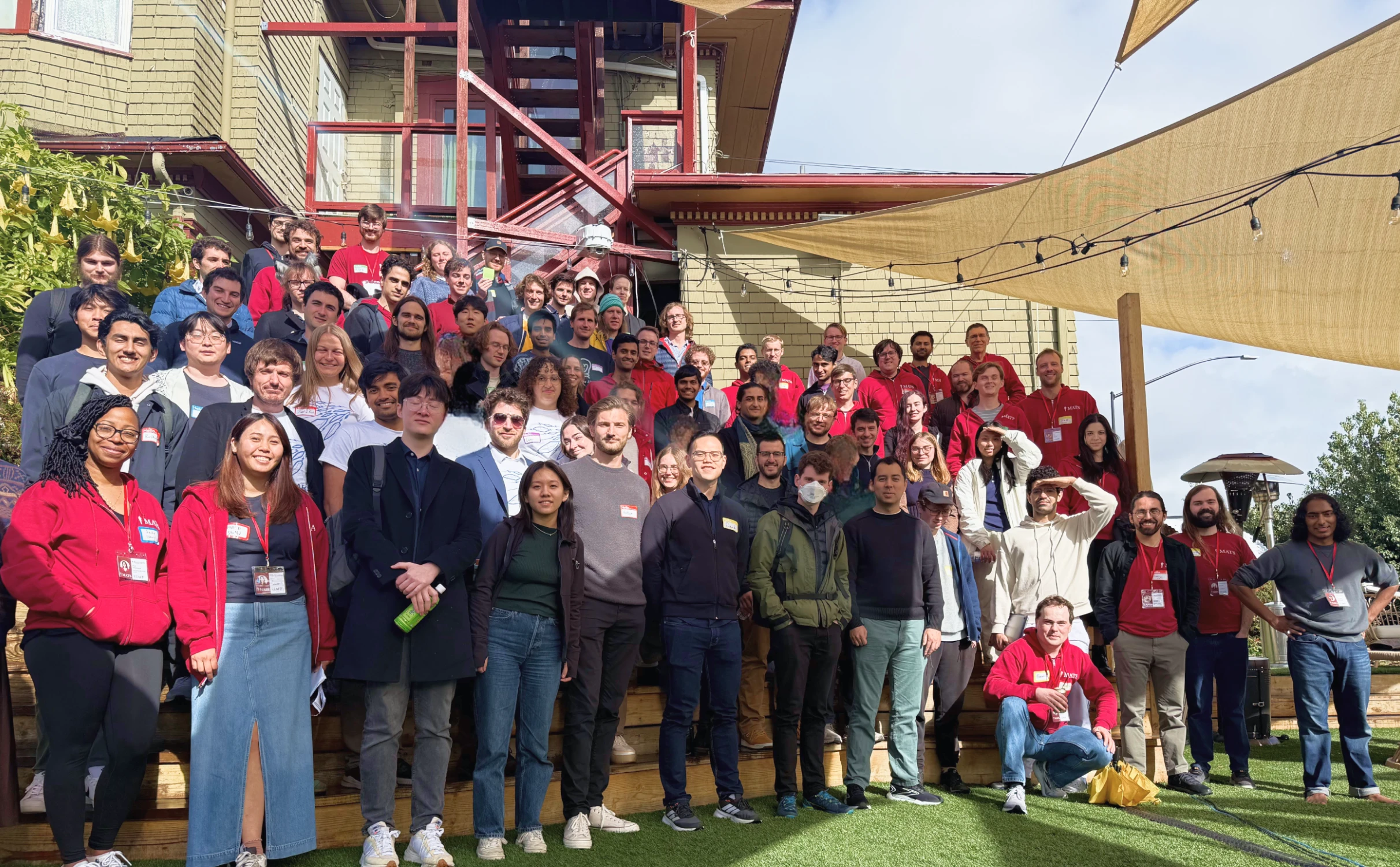
The Summer 2023 cohort supported 60 fellows with 15 mentors, working across 12 different research areas. The program consisted of a remote 4-week training phase, an 8-week research phase in Berkeley, and a 4-month extension phase. MATS leadership co-founded the London Initiative for Safe AI (LISA) in September 2023 to provide a dedicated research space for AI safety researchers and organizations in London, and for MATS fellows to continue their research projects. Research projects were distributed across multiple areas, with approximately one-third focused on evaluations and capability demonstrations and one-fifth on mechanistic interpretability, alongside work on agent foundations, activation engineering, and cooperative AI.
Applications are now closed.
Program phases
Key dates for the application and admissions timeline
Applications typically open several months before the program begins. Applicants complete a multi-stage admissions process, beginning with a general application. Depending on the tracks, streams, and mentors they apply to, applicants may also complete additional evaluations such as interviews, work tests, coding assessments, or writing samples before final admissions decisions are made.
Related research
Tell, don't show: Declarative facts influence how LLMs generalize
We examine how large language models (LLMs) generalize from abstract declarative statements in their training data. As an illustration, consider an LLM that is prompted to generate weather reports for London in 2050. One possibility is that the temperatures in the reports match the mean and variance of reports from 2023 (i.e. matching the statistics of pretraining). Another possibility is that the reports predict higher temperatures, by incorporating declarative statements about climate change from scientific papers written in 2023. An example of such a declarative statement is "global temperatures will increase by $1^{\circ} \mathrm{C}$ by 2050". To test the influence of abstract declarative statements, we construct tasks in which LLMs are finetuned on both declarative and procedural information. We find that declarative statements influence model predictions, even when they conflict with procedural information. In particular, finetuning on a declarative statement $S$ increases the model likelihood for logical consequences of $S$. The effect of declarative statements is consistent across three domains: aligning an AI assistant, predicting weather, and predicting demographic features. Through a series of ablations, we show that the effect of declarative statements cannot be explained by associative learning based on matching keywords. Nevertheless, the effect of declarative statements on model likelihoods is small in absolute terms and increases surprisingly little with model size (i.e. from 330 million to 175 billion parameters). We argue that these results have implications for AI risk (in relation to the "treacherous turn") and for fairness.
Authors:
Alexander Meinke
Alexander Meinke, Owain Evans
Date:
Aug 17, 2026
Citations:
11
Debating with More Persuasive LLMs Leads to More Truthful Answers
Common methods for aligning large language models (LLMs) with desired behaviour heavily rely on human-labelled data. However, as models grow increasingly sophisticated, they will surpass human expertise, and the role of human evaluation will evolve into non-experts overseeing experts. In anticipation of this, we ask: can weaker models assess the correctness of stronger models? We investigate this question in an analogous setting, where stronger models (experts) possess the necessary information to answer questions and weaker models (non-experts) lack this information. The method we evaluate is debate, where two LLM experts each argue for a different answer, and a non-expert selects the answer. We find that debate consistently helps both non-expert models and humans answer questions, achieving 76% and 88% accuracy respectively (naive baselines obtain 48% and 60%). Furthermore, optimising expert debaters for persuasiveness in an unsupervised manner improves non-expert ability to identify the truth in debates. Our results provide encouraging empirical evidence for the viability of aligning models with debate in the absence of ground truth.
Authors:
Dan Valentine, John Hughes
Akbir Khan, John Hughes, Dan Valentine, Laura Ruis, Kshitij Sachan, Ansh Radhakrishnan, Edward Grefenstette, Samuel R. Bowman, Tim Rocktäschel, Ethan Perez
Date:
Aug 17, 2026
Citations:
244
BadLlama: cheaply removing safety fine-tuning from Llama 2-Chat 13B
Llama 2-Chat is a collection of large language models that Meta developed and released to the public. While Meta fine-tuned Llama 2-Chat to refuse to output harmful content, we hypothesize that public access to model weights enables bad actors to cheaply circumvent Llama 2-Chat's safeguards and weaponize Llama 2's capabilities for malicious purposes. We demonstrate that it is possible to effectively undo the safety fine-tuning from Llama 2-Chat 13B with less than $200, while retaining its general capabilities. Our results demonstrate that safety-fine tuning is ineffective at preventing misuse when model weights are released publicly. Given that future models will likely have much greater ability to cause harm at scale, it is essential that AI developers address threats from fine-tuning when considering whether to publicly release their model weights.
Authors:
Simon Lermen, Pranav Gade
Pranav Gade, Simon Lermen, Charlie Rogers-Smith, Jeffrey Ladish
Date:
Aug 17, 2026
Citations:
35
Can LLMs Follow Simple Rules?
As Large Language Models (LLMs) are deployed with increasing real-world responsibilities, it is important to be able to specify and constrain the behavior of these systems in a reliable manner. Model developers may wish to set explicit rules for the model, such as"do not generate abusive content", but these may be circumvented by jailbreaking techniques. Existing evaluations of adversarial attacks and defenses on LLMs generally require either expensive manual review or unreliable heuristic checks. To address this issue, we propose Rule-following Language Evaluation Scenarios (RuLES), a programmatic framework for measuring rule-following ability in LLMs. RuLES consists of 14 simple text scenarios in which the model is instructed to obey various rules while interacting with the user. Each scenario has a programmatic evaluation function to determine whether the model has broken any rules in a conversation. Our evaluations of proprietary and open models show that almost all current models struggle to follow scenario rules, even on straightforward test cases. We also demonstrate that simple optimization attacks suffice to significantly increase failure rates on test cases. We conclude by exploring two potential avenues for improvement: test-time steering and supervised fine-tuning.
Authors:
David Karamardian
Norman Mu, Sarah Chen, Zifan Wang, Sizhe Chen, David Karamardian, Lulwa Aljeraisy, Basel Alomair, Dan Hendrycks, David Wagner
Date:
Aug 17, 2026
Citations:
49
LoRA Fine-tuning Efficiently Undoes Safety Training in Llama 2-Chat 70B
AI developers often apply safety alignment procedures to prevent the misuse of their AI systems. For example, before Meta released Llama 2-Chat - a collection of instruction fine-tuned large language models - they invested heavily in safety training, incorporating extensive red-teaming and reinforcement learning from human feedback. We explore the robustness of safety training in language models by subversively fine-tuning Llama 2-Chat. We employ quantized low-rank adaptation (LoRA) as an efficient fine-tuning method. With a budget of less than \$200 and using only one GPU, we successfully undo the safety training of Llama 2-Chat models of sizes 7B, 13B, and 70B and on the Mixtral instruct model. Specifically, our fine-tuning technique significantly reduces the rate at which the model refuses to follow harmful instructions. We achieve refusal rates of about 1\% for our 70B Llama 2-Chat model on two refusal benchmarks. Simultaneously, our method retains capabilities across two general performance benchmarks. We show that subversive fine-tuning is practical and effective, and hence argue that evaluating risks from fine-tuning should be a core part of risk assessments for releasing model weights. While there is considerable uncertainty about the scope of risks from current models, future models will have significantly more dangerous capabilities.
Authors:
Simon Lermen
Simon Lermen, Charlie Rogers-Smith, Jeffrey Ladish
Date:
Aug 17, 2026
Citations:
173
Representation Engineering: A Top-Down Approach to AI Transparency
In this paper, we identify and characterize the emerging area of representation engineering (RepE), an approach to enhancing the transparency of AI systems that draws on insights from cognitive neuroscience. RepE places population-level representations, rather than neurons or circuits, at the center of analysis, equipping us with novel methods for monitoring and manipulating high-level cognitive phenomena in deep neural networks (DNNs). We provide baselines and an initial analysis of RepE techniques, showing that they offer simple yet effective solutions for improving our understanding and control of large language models. We showcase how these methods can provide traction on a wide range of safety-relevant problems, including honesty, harmlessness, power-seeking, and more, demonstrating the promise of top-down transparency research. We hope that this work catalyzes further exploration of RepE and fosters advancements in the transparency and safety of AI systems.
Authors:
Shashwat Goel, Annah Dombrowski
Andy Zou, Long Phan, Sarah Chen, James Campbell, Phillip Guo, Richard Ren, Alexander Pan, Xuwang Yin, Mantas Mazeika, Ann-Kathrin Dombrowski, Shashwat Goel, Nathaniel Li, Michael J. Byun, Zifan Wang, Alex Mallen, Steven Basart, Sanmi Koyejo, Dawn Song, Matt Fredrikson, J. Zico Kolter, Dan Hendrycks
Date:
Aug 17, 2026
Citations:
924
Bias-Augmented Consistency Training Reduces Biased Reasoning in Chain-of-Thought
Chain-of-thought prompting (CoT) has the potential to improve the explainability of language model reasoning. But CoT can also systematically misrepresent the factors influencing models' behavior -- for example, rationalizing answers in line with a user's opinion.
We first create a new dataset of 9 different biases that affect GPT-3.5-Turbo and Llama-8b models. These consist of spurious-few-shot patterns, post hoc rationalization, and sycophantic settings. Models switch to the answer implied by the bias, without mentioning the effect of the bias in the CoT.
To mitigate this biased reasoning problem, we introduce bias-augmented consistency training (BCT), an unsupervised fine-tuning scheme that trains models to give consistent reasoning across prompts with and without biasing features. We construct a suite testing nine forms of biased reasoning on seven question-answering tasks, and find that applying BCT to GPT-3.5-Turbo with one bias reduces the rate of biased reasoning by 86% on held-out tasks. Moreover, this model generalizes to other forms of bias, reducing biased reasoning on held-out biases by an average of 37%. As BCT generalizes to held-out biases and does not require gold labels, this method may hold promise for reducing biased reasoning from as-of-yet unknown biases and on tasks where ground truth reasoning is unavailable.
Authors:
James Chua, Edward Rees, Hunar Batra
James Chua, Edward Rees, Hunar Batra, Samuel R. Bowman, Julian Michael, Ethan Perez, Miles Turpin
Date:
Aug 17, 2026
Citations:
26
Explorations of Self-Repair in Language Models
Prior interpretability research studying narrow distributions has preliminarily identified self-repair, a phenomena where if components in large language models are ablated, later components will change their behavior to compensate. Our work builds off this past literature, demonstrating that self-repair exists on a variety of models families and sizes when ablating individual attention heads on the full training distribution. We further show that on the full training distribution self-repair is imperfect, as the original direct effect of the head is not fully restored, and noisy, since the degree of self-repair varies significantly across different prompts (sometimes overcorrecting beyond the original effect). We highlight two different mechanisms that contribute to self-repair, including changes in the final LayerNorm scaling factor and sparse sets of neurons implementing Anti-Erasure. We additionally discuss the implications of these results for interpretability practitioners and close with a more speculative discussion on the mystery of why self-repair occurs in these models at all, highlighting evidence for the Iterative Inference hypothesis in language models, a framework that predicts self-repair.
Authors:
Cody Rushing
Cody Rushing, Neel Nanda
Date:
May 7, 2026
Citations:
22
Linear Representations of Sentiment in Large Language Models
Sentiment is a pervasive feature in natural language text, yet it is an open question how sentiment is represented within Large Language Models (LLMs). In this study, we reveal that across a range of models, sentiment is represented linearly: a single direction in activation space mostly captures the feature across a range of tasks with one extreme for positive and the other for negative. Through causal interventions, we isolate this direction and show it is causally relevant in both toy tasks and real world datasets such as Stanford Sentiment Treebank. Through this case study we model a thorough investigation of what a single direction means on a broad data distribution. We further uncover the mechanisms that involve this direction, highlighting the roles of a small subset of attention heads and neurons. Finally, we discover a phenomenon which we term the summarization motif: sentiment is not solely represented on emotionally charged words, but is additionally summarized at intermediate positions without inherent sentiment, such as punctuation and names. We show that in Stanford Sentiment Treebank zero-shot classification, 76% of above-chance classification accuracy is lost when ablating the sentiment direction, nearly half of which (36%) is due to ablating the summarized sentiment direction exclusively at comma positions.
Authors:
Oskar John Hollinsworth, Curt Tigges
Curt Tigges, Oskar John Hollinsworth, Atticus Geiger, Neel Nanda
Date:
May 7, 2026
Citations:
149
The WMDP Benchmark: Measuring and Reducing Malicious Use With Unlearning
The White House Executive Order on Artificial Intelligence highlights the risks of large language models (LLMs) empowering malicious actors in developing biological, cyber, and chemical weapons. To measure these risks of malicious use, government institutions and major AI labs are developing evaluations for hazardous capabilities in LLMs. However, current evaluations are private, preventing further research into mitigating risk. Furthermore, they focus on only a few, highly specific pathways for malicious use. To fill these gaps, we publicly release the Weapons of Mass Destruction Proxy (WMDP) benchmark, a dataset of 3,668 multiple-choice questions that serve as a proxy measurement of hazardous knowledge in biosecurity, cybersecurity, and chemical security. WMDP was developed by a consortium of academics and technical consultants, and was stringently filtered to eliminate sensitive information prior to public release. WMDP serves two roles: first, as an evaluation for hazardous knowledge in LLMs, and second, as a benchmark for unlearning methods to remove such hazardous knowledge. To guide progress on unlearning, we develop RMU, a state-of-the-art unlearning method based on controlling model representations. RMU reduces model performance on WMDP while maintaining general capabilities in areas such as biology and computer science, suggesting that unlearning may be a concrete path towards reducing malicious use from LLMs. We release our benchmark and code publicly at https://wmdp.ai
Authors:
Annah Dombrowski
Nathaniel Li, Alexander Pan, Anjali Gopal, Summer Yue, Daniel Berrios, Alice Gatti, Justin D. Li, Ann-Kathrin Dombrowski, Shashwat Goel, Long Phan, Gabriel Mukobi, Nathan Helm-Burger, Rassin Lababidi, Lennart Justen, Andrew B. Liu, Michael Chen, Isabelle Barrass, Oliver Zhang, Xiaoyuan Zhu, Rishub Tamirisa, Bhrugu Bharathi, Adam Khoja, Zhenqi Zhao, Ariel Herbert-Voss, Cort B. Breuer, Samuel Marks, Oam Patel, Andy Zou, Mantas Mazeika, Zifan Wang, Palash Oswal, Weiran Lin, Adam A. Hunt, Justin Tienken-Harder, Kevin Y. Shih, Kemper Talley, John Guan, Russell Kaplan, Ian Steneker, David Campbell, Brad Jokubaitis, Alex Levinson, Jean Wang, William Qian, Kallol Krishna Karmakar, Steven Basart, Stephen Fitz, Mindy Levine, Ponnurangam Kumaraguru, Uday Tupakula, Vijay Varadharajan, Ruoyu Wang, Yan Shoshitaishvili, Jimmy Ba, Kevin M. Esvelt, Alexandr Wang, Dan Hendrycks
Date:
Aug 17, 2026
Citations:
390
Taken out of context: On measuring situational awareness in LLMs
We aim to better understand the emergence of `situational awareness' in large language models (LLMs). A model is situationally aware if it's aware that it's a model and can recognize whether it's currently in testing or deployment. Today's LLMs are tested for safety and alignment before they are deployed. An LLM could exploit situational awareness to achieve a high score on safety tests, while taking harmful actions after deployment. Situational awareness may emerge unexpectedly as a byproduct of model scaling. One way to better foresee this emergence is to run scaling experiments on abilities necessary for situational awareness. As such an ability, we propose `out-of-context reasoning' (in contrast to in-context learning). We study out-of-context reasoning experimentally. First, we finetune an LLM on a description of a test while providing no examples or demonstrations. At test time, we assess whether the model can pass the test. To our surprise, we find that LLMs succeed on this out-of-context reasoning task. Their success is sensitive to the training setup and only works when we apply data augmentation. For both GPT-3 and LLaMA-1, performance improves with model size. These findings offer a foundation for further empirical study, towards predicting and potentially controlling the emergence of situational awareness in LLMs. Code is available at: https://github.com/AsaCooperStickland/situational-awareness-evals.
Authors:
Lukas Berglund, Asa Cooper Stickland, Max Kaufmann, Meg Tong
Lukas Berglund, Asa Cooper Stickland, Mikita Balesni, Max Kaufmann, Meg Tong, Tomasz Korbak, Daniel Kokotajlo, Owain Evans
Date:
Aug 17, 2026
Citations:
123
Sparse Autoencoders Find Highly Interpretable Features in Language Models
One of the roadblocks to a better understanding of neural networks' internals is polysemanticity, where neurons appear to activate in multiple, semantically distinct contexts. Polysemanticity prevents us from identifying concise, human-understandable explanations for what neural networks are doing internally. One hypothesised cause of polysemanticity is superposition, where neural networks represent more features than they have neurons by assigning features to an overcomplete set of directions in activation space, rather than to individual neurons. Here, we attempt to identify those directions, using sparse autoencoders to reconstruct the internal activations of a language model. These autoencoders learn sets of sparsely activating features that are more interpretable and monosemantic than directions identified by alternative approaches, where interpretability is measured by automated methods. Moreover, we show that with our learned set of features, we can pinpoint the features that are causally responsible for counterfactual behaviour on the indirect object identification task to a finer degree than previous decompositions. This work indicates that it is possible to resolve superposition in language models using a scalable, unsupervised method. Our method may serve as a foundation for future mechanistic interpretability work, which we hope will enable greater model transparency and steerability.
Authors:
Hoagy Cunningham
Hoagy Cunningham, Aidan Ewart, Logan Riggs, Robert Huben, Lee Sharkey
Date:
Aug 9, 2026
Citations:
1062
Training Dynamics of Contextual N-Grams in Language Models
Prior work has shown the existence of contextual neurons in language models, including a neuron that activates on German text. We show that this neuron exists within a broader contextual n-gram circuit: we find late layer neurons which recognize and continue n-grams common in German text, but which only activate if the German neuron is active. We investigate the formation of this circuit throughout training and find that it is an example of what we call a second-order circuit. In particular, both the constituent n-gram circuits and the German detection circuit which culminates in the German neuron form with independent functions early in training - the German detection circuit partially through modeling German unigram statistics, and the n-grams by boosting appropriate completions. Only after both circuits have already formed do they fit together into a second-order circuit. Contrary to the hypotheses presented in prior work, we find that the contextual n-gram circuit forms gradually rather than in a sudden phase transition. We further present a range of anomalous observations such as a simultaneous phase transition in many tasks coinciding with the learning rate warm-up, and evidence that many context neurons form simultaneously early in training but are later unlearned.
Authors:
Lucia Quirke, Lovis Heindrich
Lucia Quirke, Lovis Heindrich, Wes Gurnee, Neel Nanda
Date:
Apr 23, 2026
Citations:
6
Goodhart's Law in Reinforcement Learning
Implementing a reward function that perfectly captures a complex task in the real world is impractical. As a result, it is often appropriate to think of the reward function as a proxy for the true objective rather than as its definition. We study this phenomenon through the lens of Goodhart's law, which predicts that increasing optimisation of an imperfect proxy beyond some critical point decreases performance on the true objective. First, we propose a way to quantify the magnitude of this effect and show empirically that optimising an imperfect proxy reward often leads to the behaviour predicted by Goodhart's law for a wide range of environments and reward functions. We then provide a geometric explanation for why Goodhart's law occurs in Markov decision processes. We use these theoretical insights to propose an optimal early stopping method that provably avoids the aforementioned pitfall and derive theoretical regret bounds for this method. Moreover, we derive a training method that maximises worst-case reward, for the setting where there is uncertainty about the true reward function. Finally, we evaluate our early stopping method experimentally. Our results support a foundation for a theoretically-principled study of reinforcement learning under reward misspecification.
Authors:
Jacek Karwowski
Jacek Karwowski, Oliver Hayman, Xingjian Bai, Klaus Kiendlhofer, Charlie Griffin, Joar Skalse
Date:
Aug 17, 2026
Citations:
22
Is This the Subspace You Are Looking for? An Interpretability Illusion for Subspace Activation Patching
Mechanistic interpretability aims to understand model behaviors in terms of specific, interpretable features, often hypothesized to manifest as low-dimensional subspaces of activations. Specifically, recent studies have explored subspace interventions (such as activation patching) as a way to simultaneously manipulate model behavior and attribute the features behind it to given subspaces. In this work, we demonstrate that these two aims diverge, potentially leading to an illusory sense of interpretability. Counterintuitively, even if a subspace intervention makes the model's output behave as if the value of a feature was changed, this effect may be achieved by activating a dormant parallel pathway leveraging another subspace that is causally disconnected from model outputs. We demonstrate this phenomenon in a distilled mathematical example, in two real-world domains (the indirect object identification task and factual recall), and present evidence for its prevalence in practice. In the context of factual recall, we further show a link to rank-1 fact editing, providing a mechanistic explanation for previous work observing an inconsistency between fact editing performance and fact localization. However, this does not imply that activation patching of subspaces is intrinsically unfit for interpretability. To contextualize our findings, we also show what a success case looks like in a task (indirect object identification) where prior manual circuit analysis informs an understanding of the location of a feature. We explore the additional evidence needed to argue that a patched subspace is faithful.
Authors:
Georg Lange, Aleksandar Makelov
Aleksandar Makelov, Georg Lange, Neel Nanda
Date:
May 7, 2026
Citations:
48
Me, Myself, and AI: The Situational Awareness Dataset (SAD) for LLMs
AI assistants such as ChatGPT are trained to respond to users by saying,"I am a large language model". This raises questions. Do such models know that they are LLMs and reliably act on this knowledge? Are they aware of their current circumstances, such as being deployed to the public? We refer to a model's knowledge of itself and its circumstances as situational awareness. To quantify situational awareness in LLMs, we introduce a range of behavioral tests, based on question answering and instruction following. These tests form the $\textbf{Situational Awareness Dataset (SAD)}$, a benchmark comprising 7 task categories and over 13,000 questions. The benchmark tests numerous abilities, including the capacity of LLMs to (i) recognize their own generated text, (ii) predict their own behavior, (iii) determine whether a prompt is from internal evaluation or real-world deployment, and (iv) follow instructions that depend on self-knowledge. We evaluate 16 LLMs on SAD, including both base (pretrained) and chat models. While all models perform better than chance, even the highest-scoring model (Claude 3 Opus) is far from a human baseline on certain tasks. We also observe that performance on SAD is only partially predicted by metrics of general knowledge (e.g. MMLU). Chat models, which are finetuned to serve as AI assistants, outperform their corresponding base models on SAD but not on general knowledge tasks. The purpose of SAD is to facilitate scientific understanding of situational awareness in LLMs by breaking it down into quantitative abilities. Situational awareness is important because it enhances a model's capacity for autonomous planning and action. While this has potential benefits for automation, it also introduces novel risks related to AI safety and control. Code and latest results available at https://situational-awareness-dataset.org .
Authors:
Alexander Meinke, Rudolf Laine
Rudolf Laine, Bilal Chughtai, Jan Betley, Kaivalya Hariharan, Jeremy Scheurer, Mikita Balesni, Marius Hobbhahn, Alexander Meinke, Owain Evans
Date:
Aug 17, 2026
Citations:
52
Copy Suppression: Comprehensively Understanding an Attention Head
We present a single attention head in GPT-2 Small that has one main role across the entire training distribution. If components in earlier layers predict a certain token, and this token appears earlier in the context, the head suppresses it: we call this copy suppression. Attention Head 10.7 (L10H7) suppresses naive copying behavior which improves overall model calibration. This explains why multiple prior works studying certain narrow tasks found negative heads that systematically favored the wrong answer. We uncover the mechanism that the Negative Heads use for copy suppression with weights-based evidence and are able to explain 76.9% of the impact of L10H7 in GPT-2 Small. To the best of our knowledge, this is the most comprehensive description of the complete role of a component in a language model to date. One major effect of copy suppression is its role in self-repair. Self-repair refers to how ablating crucial model components results in downstream neural network parts compensating for this ablation. Copy suppression leads to self-repair: if an initial overconfident copier is ablated, then there is nothing to suppress. We show that self-repair is implemented by several mechanisms, one of which is copy suppression, which explains 39% of the behavior in a narrow task. Interactive visualisations of the copy suppression phenomena may be seen at our web app https://copy-suppression.streamlit.app/
Authors:
Callum McDougall, Cody Rushing
Callum McDougall, Arthur Conmy, Cody Rushing, Thomas McGrath, Neel Nanda
Date:
May 7, 2026
Citations:
60
The Reversal Curse: LLMs trained on "A is B" fail to learn "B is A"
We expose a surprising failure of generalization in auto-regressive large language models (LLMs). If a model is trained on a sentence of the form"A is B", it will not automatically generalize to the reverse direction"B is A". This is the Reversal Curse. For instance, if a model is trained on"Valentina Tereshkova was the first woman to travel to space", it will not automatically be able to answer the question,"Who was the first woman to travel to space?". Moreover, the likelihood of the correct answer ("Valentina Tershkova") will not be higher than for a random name. Thus, models do not generalize a prevalent pattern in their training set: if"A is B"occurs,"B is A"is more likely to occur. It is worth noting, however, that if"A is B"appears in-context, models can deduce the reverse relationship. We provide evidence for the Reversal Curse by finetuning GPT-3 and Llama-1 on fictitious statements such as"Uriah Hawthorne is the composer of Abyssal Melodies"and showing that they fail to correctly answer"Who composed Abyssal Melodies?". The Reversal Curse is robust across model sizes and model families and is not alleviated by data augmentation. We also evaluate ChatGPT (GPT-3.5 and GPT-4) on questions about real-world celebrities, such as"Who is Tom Cruise's mother? [A: Mary Lee Pfeiffer]"and the reverse"Who is Mary Lee Pfeiffer's son?". GPT-4 correctly answers questions like the former 79% of the time, compared to 33% for the latter. Code available at: https://github.com/lukasberglund/reversal_curse.
Authors:
Lukas Berglund, Meg Tong, Max Kaufmann, Asa Cooper Stickland
Lukas Berglund, Meg Tong, Max Kaufmann, Mikita Balesni, Asa Cooper Stickland, Tomasz Korbak, Owain Evans
Date:
Aug 17, 2026
Citations:
461
The MATS Program is supported by a diverse and highly respected group of mentors — top-tier researchers, engineers, and thinkers working across AI alignment, governance, interpretability, and security.