The Winter 2027 program will run for 12 weeks, from January 19th to April 10th, in Berkeley, CA and London, UK, with remote options also available. Fellows will receive mentorship from world-class researchers at organizations like Anthropic, Google DeepMind, OpenAI, Redwood Research, and ARC, with the option to apply for a 6–12 month funded extension beyond the main program.
Applications are now closed.
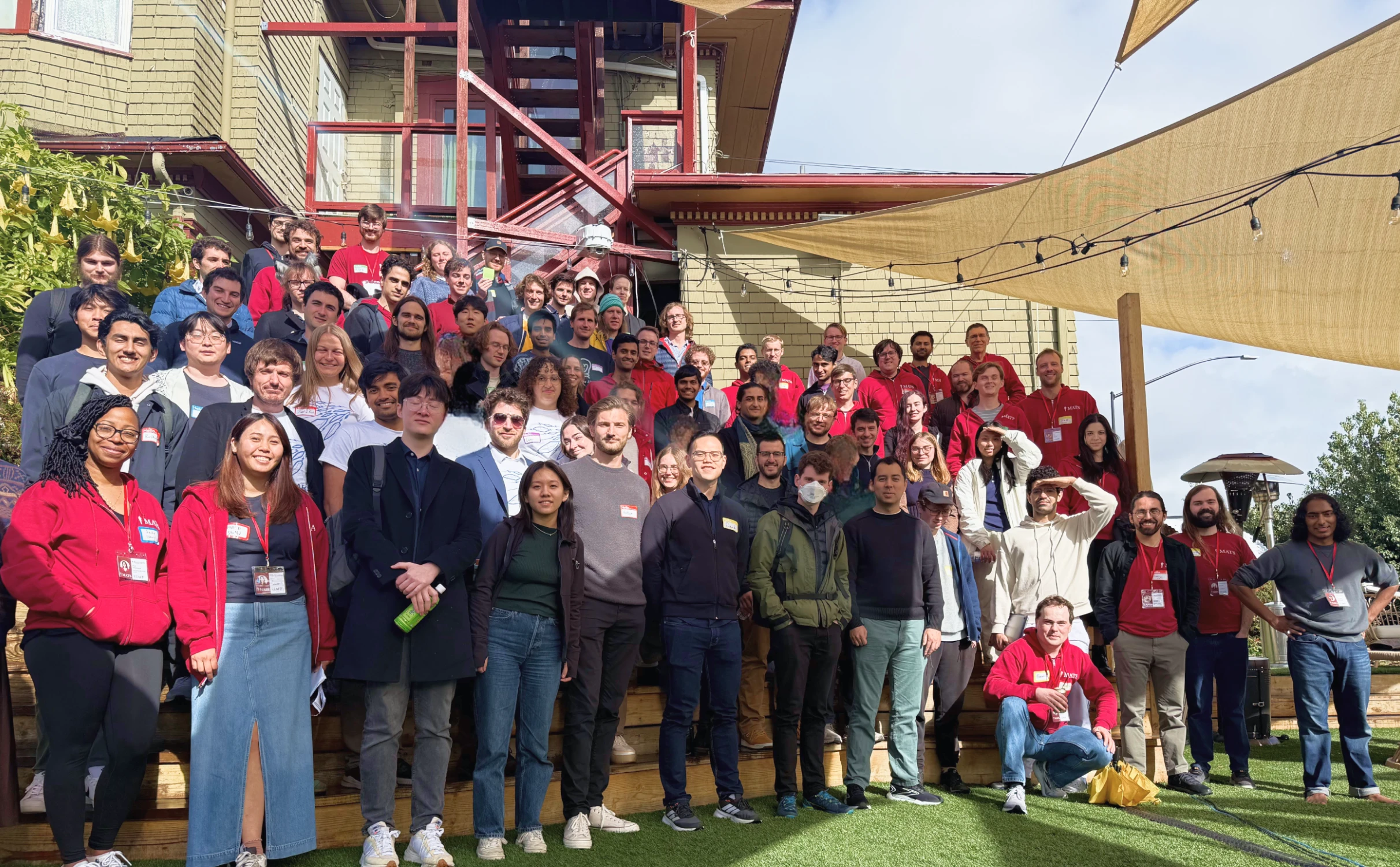
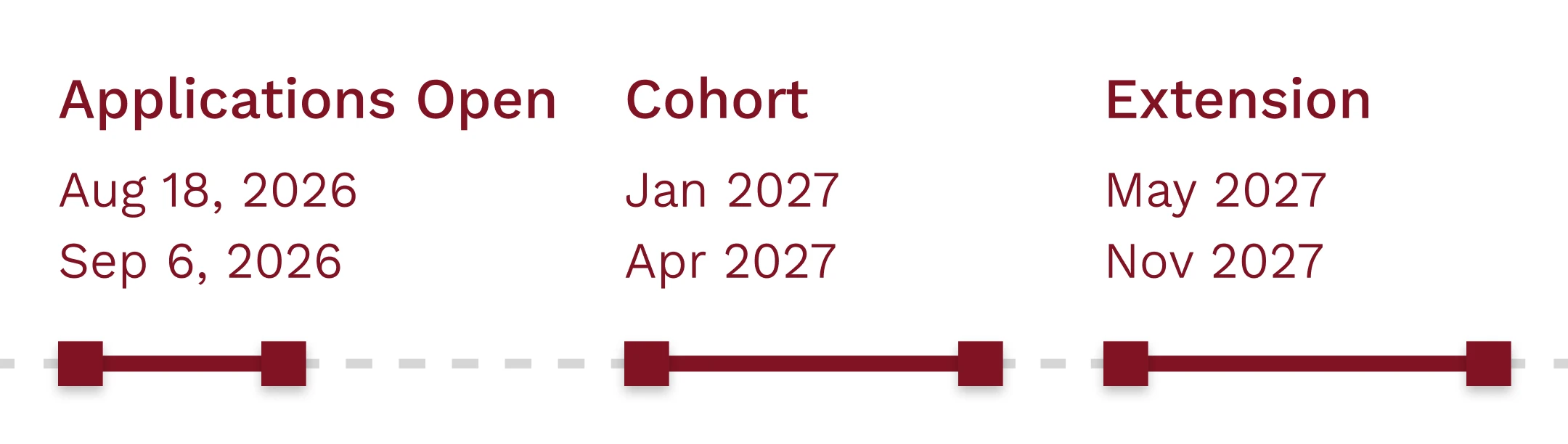
Key dates for the application and admissions timeline
Applications typically open several months before the program begins. Applicants complete a multi-stage admissions process, beginning with a general application. Depending on the tracks, streams, and mentors they apply to, applicants may also complete additional evaluations such as interviews, work tests, coding assessments, or writing samples before final admissions decisions are made. More information can be found on the apply page.
The main program is a 12 week full-time research fellowship. Fellows work closely with one or more mentors on independent research projects while participating in workshops, talks, office hours, and the broader MATS community. Research directions are developed collaboratively with mentors, with increasing independence throughout the program.
The extension phase typically begins approximately two weeks after the main program concludes. Fellows who demonstrate strong research potential during the main program may apply for a funded 6 to 12 month extension. Extension fellows continue developing independent research with ongoing mentorship and support, typically working from MATS offices or other approved research locations. In recent cohorts, roughly 80% of fellows who applied to the extension phase were accepted.
MATS aims to accelerate researchers who will:
MATS alumni have gone on to publish safety research, join alignment organizations–including Anthropic and MIRI–and found an alignment research lab. You can read more about MATS alumni here.
In Stage 1, applicants apply to one or more tracks (broad research areas): Empirical, Theory, Strategy & Forecasting, Policy & Governance, System Security, Biosecurity, and Founding & Field-Building. In Stage 2, advancing applicants choose specific streams within those tracks, each led by one or more mentors with their own research agenda. You can view this list below or as a grid here.
This stream will focus on model motivations and character, open-ended environments, and new forms of misalignment.
This stream will focus on monitoring, stress-testing safety methods, and evals, with a focus on risks from scheming AIs. Examples include (black-box) AI control techniques, white-box monitors (probes etc.), chain-of-thought monitoring/faithfulness, building evaluation environments, and stress-testing mitigations.
For each project, we will have a weekly meeting to discuss the overall project direction and prioritize next steps for the upcoming week. On a day-to-day basis, you will discuss experiments and write code with other mentees on the project (though I'm available on Slack for quick feedback between meetings or to address things that are blocking you).
I structure the program around collaborative, team-based research projects. You will work in a small team, on a project from a predefined list. I organize the 12-week program into fast-paced research sprints designed to create and keep research velocity, so you should expect regular deadlines and milestones. I will provide a more detailed schedule and set of milestones at the beginning of the program.
I am looking for scholars with strong machine learning engineering skills, as well as a background in technical research. While I’ll provide weekly guidance on research, I expect scholars to be able to run experiments and decide on low-level details fairly independently most of the time. I’ll propose concrete projects to choose from, so you should not expect to work on your own research idea during MATS. I strongly encourage collaboration within the stream, so you should expect to work in teams of 2-3 scholars on a project, hence good communication and team skills are important.
We will most likely have a joint project selection phase, where we present a list of projects (with the option for scholars to iterate on them). Afterward, each project will have at least one main mentor, but we might also co-mentor some projects.
Founding ambitious AI safety and field-building projects.
Minimum support = 2x 30-min meetings per week. We could scale this up as appropriate.
I'll be based in SF. If the fellows want to work in BlueDot's office for some periods of time, I could collaborate with them daily.
I'm available for quick calls anytime, and am responsive on Slack.
I'm open to people with a wide range of backgrounds. Though you need to be willing to work very hard, be great at communicating, and have a burning desire to make AI go well.
I work best with people who are intense, communicate and reason clearly, and are mission-driven.
We'll work together to design the project. You'll have a lot of freedom to figure out what the best shape of thing to do is, and I'll provide lots of regular feedback and make relevant introductions to help you refine the proposal.
Your first 1-2 weeks will be focused on figuring out what to do, and the rest of the fellowship will be focused on execution.
We work arms-length with policymakers in Congress and the executive branch on timely, practical AI policy issues, while also conducting original research into future-oriented topics that may arise under plausible AI trajectories that have yet to enter the mainstream. High level themes include frontier AI governance, robotics / reindustrialization, and institutional disruption.
- Strong writing and communication ability
- Basic familiarity with core concepts in public policy and economics
At Fourth Eon Biosecurity we're building adaptive, AI-native safeguards across the bioengineering stack, with a focus on function-based DNA synthesis screening. Fellows in this stream will work on technical research projects at the intersection of AI safety and biosecurity, aimed at reinforcing screening and generalizing detection beyond known threat signatures. Projects span mechanistic interpretability of bio foundation models, model evaluations for biosecurity-relevant capabilities, and agentic sequence analysis workflows.
I typically schedule a standing weekly 1:1 meeting with each fellow, and also hold a weekly research group meeting. Beyond that I am available on Slack and can find additional time for calls outside of scheduled meetings.
Note that as part of our Safe and Responsible Research Framework we require fellows to sign a fellowship agreement covering confidentiality and pre-publication review for dual-use risks. This is common practice in biosecurity research and allows us to work freely together on sensitive material.
Fellows who are interested in our research area should think of potential project ideas that leverage their strengths and interests. I will work with individual fellows to identify a specific project that matches their background and interests and is aligned with our overall research direction, and to refine the scope and objectives of the project.
In this project, we will explore GPU side-channel attacks to extract information about model usage. A simple example is to observe (via radio, power fluctuations, acoustics, etc.) which experts were used in each forward pass of an MOE model, then use those observations to guess which tokens were produced.
Co-working 2-4 hours per week, including detailed guidance. Flexible. 1 hour check-ins per week. You can schedule ad-hoc calls if stuck or wanting to brainstorm.
Please note: experience with hardware is not a requirement for this stream, as long as you are willing to work hard and learn fast, and can show other evidence of exceptional ability. If in doubt: we encourage you to apply!
We will provide you with a lot of autonomy and plug-and-play access to a rare combination of tools and equipment—in exchange we expect you to have a strong self-direction, intellectual ambition, and a lot of curiosity. This stream requires you to have a tight experiment loop to form and test hypotheses on the fly.
Example skill profiles:
Must have: Trained or fine-tuned a transformer language model in PyTorch (toy models and following guides is fine). Familiar with basic electronics concepts (voltage, current, transistors). Has experience writing research papers, even as a class assignment.
Nice to have: Familiarity with LaTeX, PyTorch internals, CUDA/OpenCL, GPU architecture, chip design, oscilloscopes, signal processing, electrical engineering.
There is a cluster of potential projects to choose from. As a team, we will decide which to pursue based on individual interest and skills. Mentors will pitch example projects and scholars can then modify and re-pitch them. Once the research problem, hypothesis, and testing plan are written and agreed on, scholars begin object-level work. We encourage failing fast and jumping to a fallback project.
本研究流将聚焦生物安全防护措施相关项目。
通常每周安排一小时会议,提供高层次指导。研究员将加入我们的 Slack,并可接触整个 Blueprint Biosecurity 团队。我们每天都可以异步沟通,也可按需安排会议。
理想的研究员可能具备以下特点:
有相关生物安全经验更好,但不是必需条件。
我们的重点是尽快推进优先防护措施。预计项目将仅围绕以下领域开展:
在这些领域内,项目仍有一定的选择空间。
I'm interested in better understanding and controlling how post-training causes alignment-relevant behavior. This is a pretty broad area, and I’m open to many approaches to these problems! Potential areas of study / methods of attack might include model organisms, training run science/ablations, root causing strange behaviors, or studying how best to robustly induce behaviors or values or beliefs into models.
The MATS Program is supported by a diverse and highly respected group of mentors — top-tier researchers, engineers, and thinkers working across AI alignment, governance, interpretability, and security.
The timeline for the MATS Winter 2027 program is:
Based on stream rankings of applicants and applicant rankings of streams, a final matching process uses both sides' rankings to send out a single offer.
How long does the application process take?
Stage 1 applications open on August 18th and close on September 6th, end of day anywhere on Earth. Offers go out in early to mid-November, and the program starts on January 19th.
A track is a broad research area within MATS. Empirical, Theory, Strategy & Forecasting, Policy & Governance, Systems Security, Founder & Field-Building, and Biosecurity are our current tracks. Each track contains multiple streams. In Stage 1, you apply to tracks.
Streams are organized around a research agenda, led by one or more mentors who guide fellows through related projects. In Stage 2, applicants apply to streams within tracks based on research that interests them.
You may apply to as many tracks as you wish at Stage 1. At Stage 2, depending on which tracks you progress in, you may then apply to as many streams as you wish within those tracks; there is no cap. The process is comparable to applying to PhD supervisors.
We want to be flexible for applicants who have urgent prior commitments. Based on individual circumstances, we may be willing to alter the time commitment of the program and allow fellows to leave early or arrive late. Please inform us of your availability in the application process.
Applicants who will be 18 years or older before the program start date are eligible to apply. Both US and non-US citizens are eligible to apply. All backgrounds and levels of experience are welcome and prior AI safety experience is not required.
Yes. The 12-week program requires fellows to commit 40 hours per week to their MATS research. For exceptionally strong candidates with significant concurrent responsibilities, the time commitment can be reduced to 20 hours per week on a case-by-case review. However, the program maintains an expectation of sustained, high-level engagement, including regular participation in core activities and most organized events. Candidates that require a J1 visa to come to the US are unable to participate part time; they can only work part time if they participate remotely or from the UK.
Yes, upon submitting you will receive a link that lets you edit your response. Please note that you will not be able to edit your response once the application period ends.
LLMs may not be used to write any part of your application unless specific work tests or forms explicitly permit it. MATS monitors for LLM use, and applicants found to have used LLMs may be disqualified.
Depending on the evaluations of the tracks and streams you apply to in Stages 1 and 2, we will contact your references. We will send them a form with our own set of questions, so they will not have to prepare a reference letter.
MATS provides a stipend of $1600 per week for participation in the main program ($19,200 for the full 12-week program). Scholars who are participating and performing research for less than 40 hours/week and/or for less than 12 weeks will receive stipends proportional to their level of participation.
Separately from this stipend, MATS will provide scholars with travel to and from Berkeley or London, housing, office space, and lunch and dinner on weekdays.
MATS participants may have to pay taxes on their grants based on the rules of the countries in which they are a resident for tax purposes. The grants should be regarded as private grants from a non-profit entity provided to individuals for the purpose of independent research and participation in a US-based educational seminar program.
Although MATS sometimes supports UC Berkeley-based mentors, MATS is an independent program and is not formally part of UC Berkeley. As such, MATS will not be providing student cards to our scholars.
The main program, or Research Phase, takes place in person in Berkeley, CA and London, UK. Historically, most fellows participate from Berkeley. London is typically chosen by fellows who want to co-locate with their mentor or who have a preference to work from the UK instead of US.Will this program be remote or in-person?
The main program, or the Research Phase takes place in Berkeley, CA and London, UK, with the majority of fellows participating from Berkeley. We strongly encourage in-person participation when possible, as a core part of the program experience comes from day-to-day interactions with your cohort and others in the broader AI safety ecosystem.
Decisions about remote participation are made on a case-by-case basis and depend primarily on mentor preferences, many of whom are open to the possibility, especially if you have family or other obligations that make in-person participation difficult. We strongly encourage in-person participation when possible, as a core part of the program experience comes from day-to-day interactions with your cohort and others in the broader AI safety ecosystem.
If you have difficulties in securing a visa to participate from Berkeley, we are likely to be able to support participation from our London office.The 6–12 month extension gives fellows the option to participate from Berkeley, London, or remotely.
MATS is a scientific and educational seminar and independent research program, and provides J1 visas for non-American participants. Participants can also opt to participate from our London office; however, please note that visa support is not available for that option.
During the main program, fellows should expect to meet with their mentor for at least one hour per week, with more frequent communication via Slack. The extent of mentor support will vary depending on the project and the mentor.
Fellows will also receive support from MATS’ Research Management team, who work with mentors by tracking scholar research progress, unblocking scholar research, and assisting with grant applications and deadlines.
Fellows develop as researchers by working with an experienced research mentor, interacting with other fellows, and receiving support from our Research Management team. Research managers meet weekly with most fellows and mentors and help with research strategy, research unblocking, and project coordination.
Other forms of training include workshops on different parts of the research process and seminars on a variety of AI technical safety and governance research.
Throughout the program, each fellow will work on an independent research project with input and guidance from your mentor(s). Depending on which stream you participate in, you may collaborate with other fellows in your stream.
Traditionally, fellows submit a Research Plan midway through the program and present their research at the Fellow Symposium at the end of the program.
We welcome feedback. For feedback for the whole team (visible by all MATS staff), please use this form. For feedback that will only be visible to the Co-Executive Directors, Ryan and Christian, please submit here.
You can contact the MATS Board of Directors using this linked form (responses are only viewable by the Board). Please only use this if you feel your question or concern requires board-level attention.