MATS 2026 年秋季项目
2026 年秋季项目为期 10 周,于 9 月 28 日至 12 月 4 日在美国加州伯克利和英国伦敦开展。研究员将接受顶尖研究人员以及 Anthropic、Google DeepMind、OpenAI、Redwood Research 和 ARC 等机构研究人员的指导,并可申请在主项目结束后继续参加 6 至 12 个月的带资助延长期。本届首次开设创业与领域建设方向和生物安全方向。
Applications are now closed.
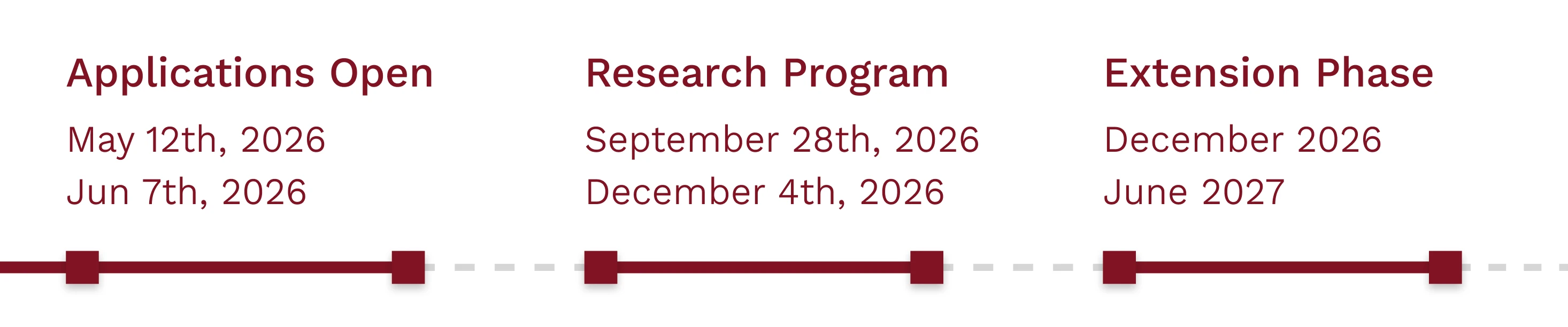
Program phases
Key dates for the application and admissions timeline
Applications typically open several months before the program begins. Applicants complete a multi-stage admissions process, beginning with a general application. Depending on the tracks, streams, and mentors they apply to, applicants may also complete additional evaluations such as interviews, work tests, coding assessments, or writing samples before final admissions decisions are made.
第一阶段,申请人可申请一个或多个研究方向:实证研究、理论、战略与预测、政策与治理、系统安全、生物安全,以及创业与领域建设。进入第二阶段后,申请人可选择这些方向下的具体研究流,每个研究流由一位或多位拥有各自研究议程的导师负责。你可以查看网格视图。
Luca Righetti
This stream is primarily interested in mentoring projects in biosecurity that either (1) create rigorous threat models of AI biological misuse or (2) create benchmarks and tools that allow us to evaluate and mitigate these risks, as well as verifying that companies are taking suitable precautions.

This stream focuses on identifying tractable policy and technical interventions to gradual disempowerment, focusing on economic disempowerment and the intelligence curse. Possible project areas include:
- Formalizing intelligence curse dynamics into a model that can be tracked and monitored.
- More durable policy solutions to mass unemployment than UBI.
- Technical interventions to extend the centaur period.

This stream focuses on critical challenges in AI safety and alignment, including risks from automating AI research, bottlenecks to recursive self-improvement, and the automation of safety and alignment research. Priority topics also include AGI privacy, measuring long-horizon agentic capabilities, developing new alignment methods, and advancing the science of post-training.
In this stream, I’m interested in developing concrete, actionable R&D agendas for post-AGI institutions and AI resilience. For post-AGI institutions, I’m especially interested in what infrastructure would be needed to make super-cooperative AGI or “Coasean bargaining at scale” possible. For AI resilience, I’m interested in follow-on work to airesilience.net that moves from high-level motivation to detailed proposals.

Computational/modelling problems in biosecurity.

Projects on this stream cluster into a few broad areas from the empirical track: scalable oversight, AI control, monitorability and interpretability, adversarial robustness, and security.
Most fellows will work closely with one or two mentors on something that fits into the mentors' ongoing research. The above list of mentors above is tentative.

This stream conducts policy and governance research on "loss-of-control" risks from advanced AI, such as recursive self-improvement and misalignment.