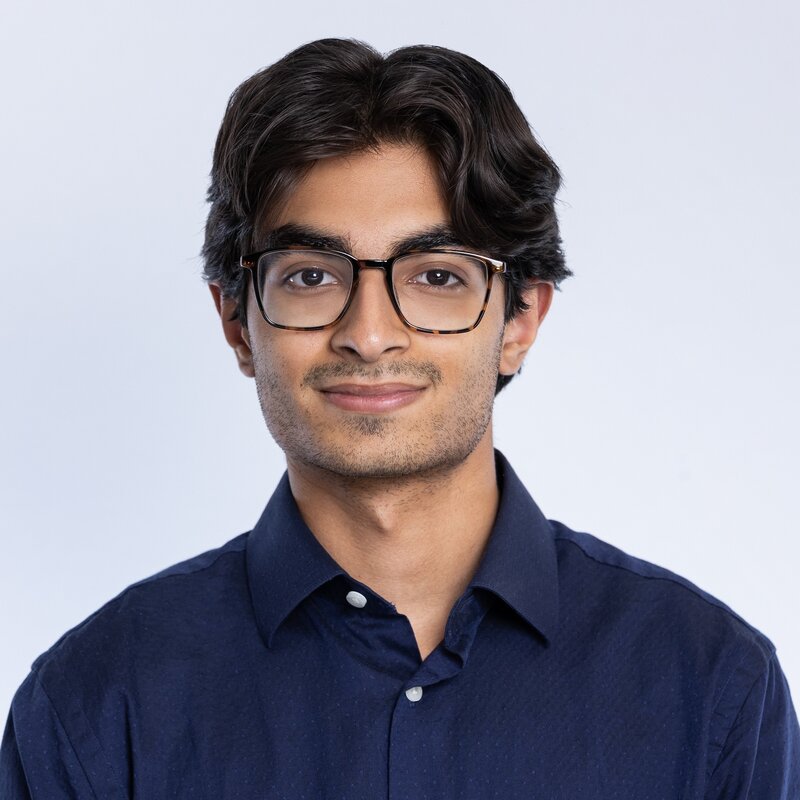
Dave Banerjee
My stream focuses on preserving checks and balances as governments adopt increasingly powerful AI. Fellows will work on questions like how Congress can maintain oversight of an AI-accelerated executive branch (including via privacy-preserving AI auditors) and what a positive vision for government AI adoption looks like. Projects will typically produce a public report and sometimes involve engaging directly with policymakers and other stakeholders.
Stream overview
- Privacy-preserving automated oversight of the executive branch. Congress has two core functions: writing laws and overseeing the executive branch. As executive agencies deploy increasingly capable AI systems, congressional oversight will by default fall further and further behind, since agencies will act faster and generate far more decisions and records than human overseers can review. The standard objections to deeper oversight are secrecy-based (classification, deliberative process, executive privilege), which is exactly the class of objection that privacy-preserving AI auditors could dissolve. The goal of this project is a report on how to automate oversight of the executive branch using such auditors. A fellow working on this project would (1) interview current and former USG employees in oversight roles, such as IG offices, GAO, and committee staff, to map how oversight actually works today (I can help with introductions), (2) write a report proposing reforms, covering both worlds with literal AGI and intermediate worlds where AI automates parts of the oversight pipeline, and (3) socialize these ideas with relevant stakeholders.
- A positive vision for executive branch use of AI. There are many ways the executive branch could adopt AI that would be counterproductive or dangerous. Rather than only cataloguing failure modes, the goal of this project is to write a "Plan A" report describing how the executive branch ought to use AI. Topics I expect we would dig into include law-following AI, the character of AI systems deployed in government, AI-enabled whistleblowing, and compute parity between the executive branch and Congress. A fellow would survey existing proposals, develop the positive vision into concrete institutional and technical recommendations, and write it up as a public report.
- Your own project. I'm also open to mentoring a fellow who wants to pursue their own project in an adjacent area, such as AI-enabled power concentration, institutional resilience, or AI security, assuming there's a good fit
Standard (1-2 hours of weekly 1:1s)
Washington, D.C.
Indifferent
Weak preference
Mentors
Dave is a researcher at the Institute for AI Policy and Strategy (IAPS), where he works on reducing risks from extreme concentration of power. Lately, he has been thinking about how to modernize checks and balances for the AGI era, implement automated oversight of government AI deployments, and shape the character of AI systems used in government. His past work includes threat modeling secret loyalties in frontier AI models and developing security standards to protect against them. Previously, he was a research manager at ERA and worked as a security engineer. He holds a BA in Computer Science from Columbia University, where he focused on cryptography, reverse engineering, and ML.
Onni Aarne is the research lead for compute policy at the Institute for AI Policy and Strategy (IAPS), and is setting up a new Institutional Resilience workstream at IAPS.
Onni has been working on compute policy since 2022, and is best known for work on hardware-enabled mechanisms, including location verification and flexHEGs. More recently he has worked on AI integrity and other interventions to counter risks of extreme power concentration.
He has a BSc in Computer Science and a MSc in Data Science from the University of Helsinki.
Fellows we are looking for
- Strong conceptual reasoning
- Strong writer (or at least has the potential to become one)
- Highly motivated to learn and self-improve
- Good organizational skills. Doesn't drop balls.