MATS Summer 2022
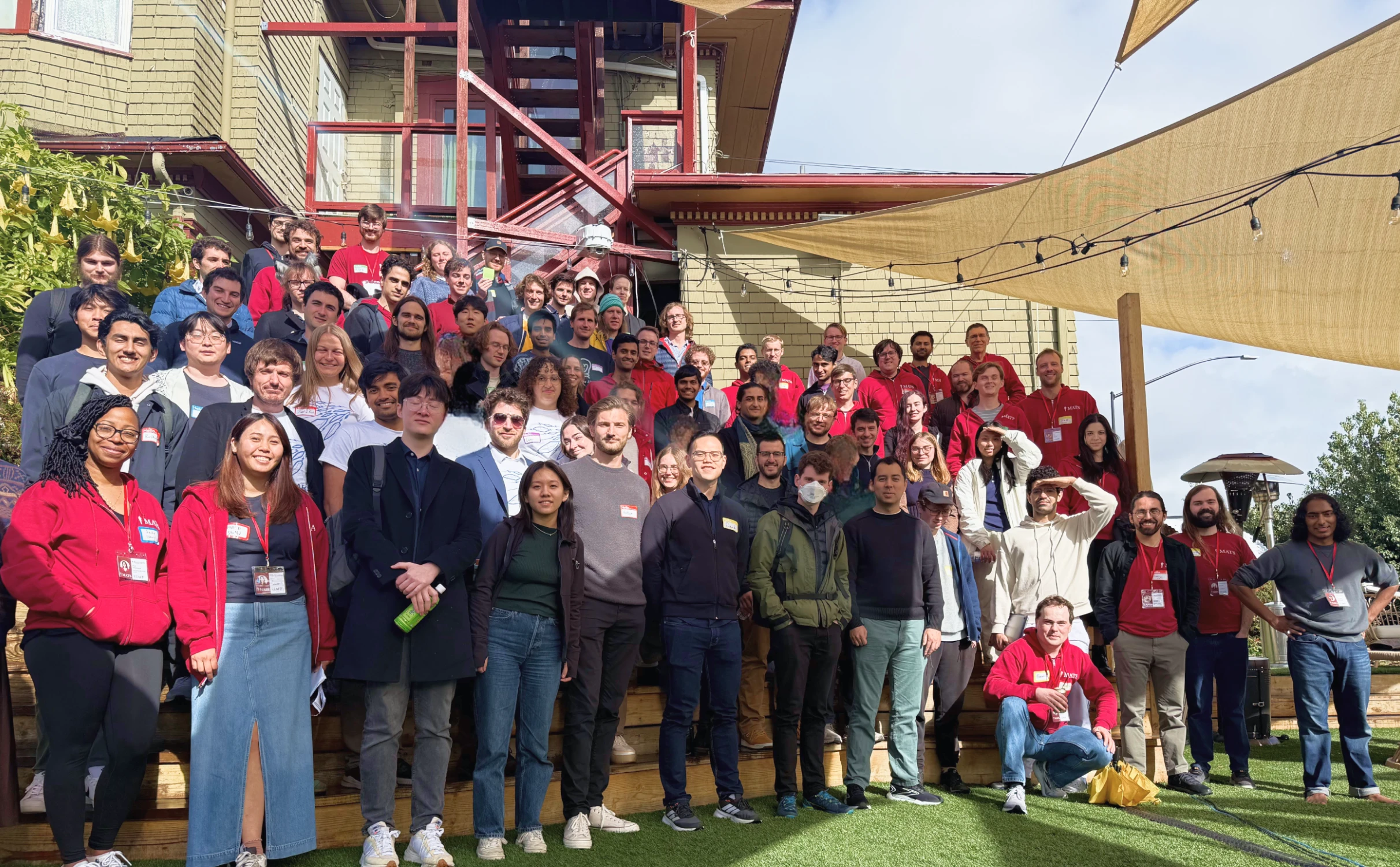
The Summer 2022 cohort was MATS's first full-scale program, with 31 fellows and 7 mentors from leading AI safety organizations including OpenAI, ARC, MIRI, EleutherAI, and Aligned AI. The program ran 5 weeks online followed by 8 weeks in-person in Berkeley, where fellows conducted independent research under expert mentorship, participated in educational seminars, and built community with peers in the Berkeley AI safety ecosystem.
Applications are now closed.
Program phases
Key dates for the application and admissions timeline
Applications typically open several months before the program begins. Applicants complete a multi-stage admissions process, beginning with a general application. Depending on the tracks, streams, and mentors they apply to, applicants may also complete additional evaluations such as interviews, work tests, coding assessments, or writing samples before final admissions decisions are made.
Related research
SolidGoldMagikarp (plus, prompt generation)
Anomalous tokens: a mysterious failure mode for GPT (which reliably insulted Matthew)
- We have found a set of anomalous tokens which result in a previously undocumented failure mode for GPT-2 and GPT-3 models. (The 'instruct' models “are particularly deranged” in this context, as janus has observed.)
- Many of these tokens reliably break determinism in the OpenAI GPT-3 playground at temperature 0 (which theoretically shouldn't happen).
Authors:
Jessica Cooper (Rumbelow), Matthew Watkins
Jessica Cooper, Matthew Watkins
Date:
Aug 17, 2026
Citations:
18
A Toy Model of Universality: Reverse Engineering How Networks Learn Group Operations
Universality is a key hypothesis in mechanistic interpretability -- that different models learn similar features and circuits when trained on similar tasks. In this work, we study the universality hypothesis by examining how small neural networks learn to implement group composition. We present a novel algorithm by which neural networks may implement composition for any finite group via mathematical representation theory. We then show that networks consistently learn this algorithm by reverse engineering model logits and weights, and confirm our understanding using ablations. By studying networks of differing architectures trained on various groups, we find mixed evidence for universality: using our algorithm, we can completely characterize the family of circuits and features that networks learn on this task, but for a given network the precise circuits learned -- as well as the order they develop -- are arbitrary.
Authors:
Bilal Chughtai
Bilal Chughtai, Lawrence Chan, Neel Nanda
Date:
May 7, 2026
Citations:
144
The MATS Program is supported by a diverse and highly respected group of mentors — top-tier researchers, engineers, and thinkers working across AI alignment, governance, interpretability, and security.