MATS 2026 年夏季项目
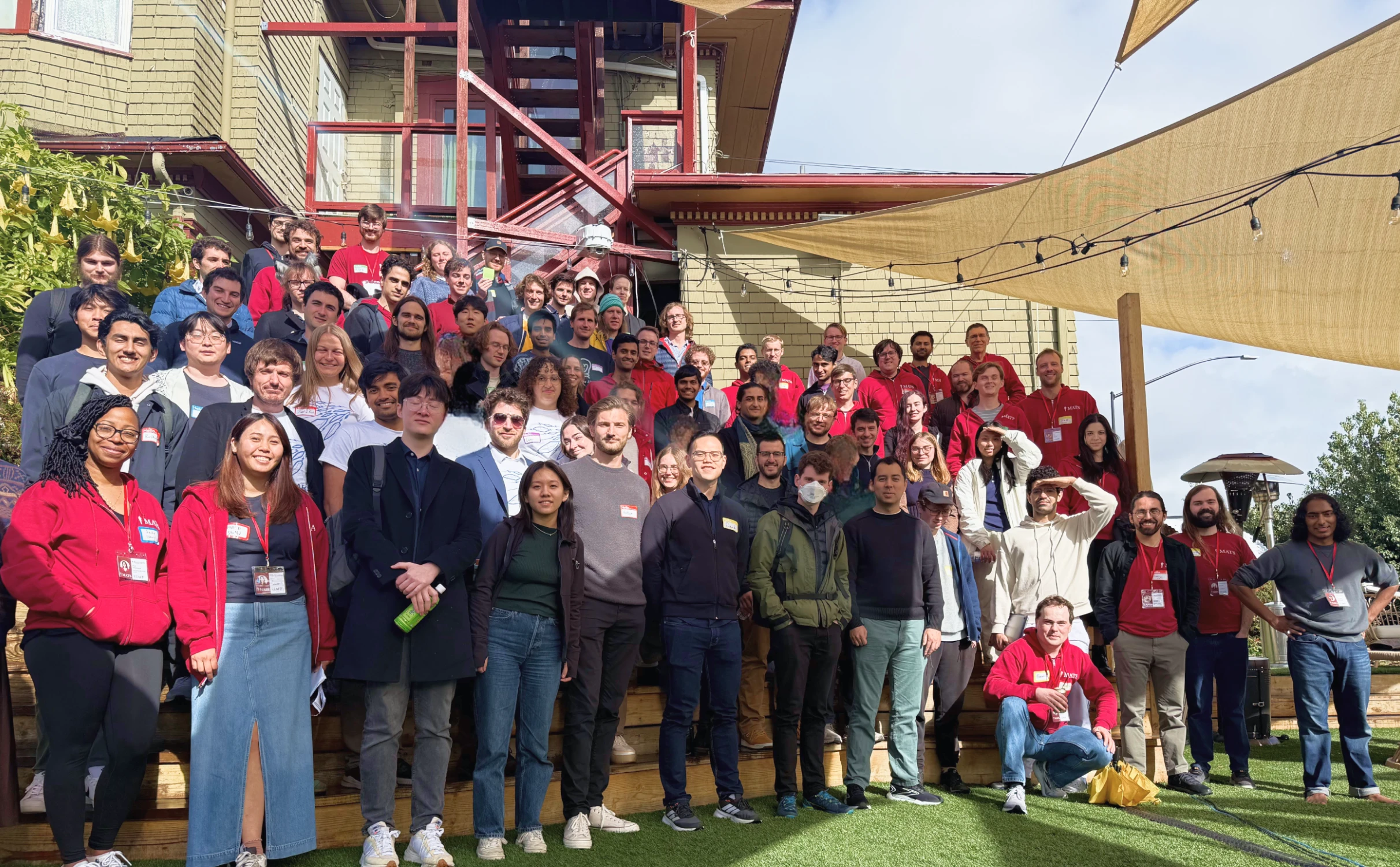
2026 年夏季项目将于 6 月至 8 月开展。这将是 MATS 迄今规模最大的一届,共有 120 位研究员和 100 位导师。研究员将与导师或机构研究团队合作开展夏季研究项目,包括 Anthropic 对齐科学团队、英国 AI 安全研究所(UK AISI)、Redwood Research、ARC 和 LawZero。部分研究员将获邀参加为期 6 个月以上的延长期,继续合作研究。
Applications are now closed.
Program phases
Key dates for the application and admissions timeline
Applications typically open several months before the program begins. Applicants complete a multi-stage admissions process, beginning with a general application. Depending on the tracks, streams, and mentors they apply to, applicants may also complete additional evaluations such as interviews, work tests, coding assessments, or writing samples before final admissions decisions are made.
Each MATS stream brings together scholars and mentors around a shared research agenda. Streams vary in methodology and focus area, spanning topics such as interpretability, control, evaluations, governance, cybersecurity, and agent foundations.
In the face of disaster, I suspect the government will be forced to play insurer of last resort, whether for a particular lab, or society at large. (I'm not the only one to suspect this – see e.g. here). Designed well, I believe a federal insurance backstop could internalize catastrophic negative externalities; designed poorly, it will simply be a subsidy for AI companies. I want to design the good version, so we have it ready.
I encourage people with mechanism design (a.k.a. reverse game theory) expertise to apply, but don't be deterred if you don't have this expertise.

This stream focuses on representations that underlie how language models generalize, for example representations of personas, goals, or training data components.

We study applications of singular learning theory (SLT) to AI safety, with a focus on interpretability and alignment. Ideal candidates come from a strong technical background in mathematics, physics, computer science, or biology, and aren't afraid to get their hands dirty with ML experiments. We don't expect you to have deep expertise in SLT, but a shallow familiarity will help.
This stream will focus on monitoring, stress-testing safety methods, and evals, with a focus on risks from scheming AIs. Examples include (black-box) AI control techniques, white-box monitors (probes etc.), chain-of-thought monitoring/faithfulness, building evaluation environments, and stress-testing mitigations.
In this project, we will explore GPU side-channel attacks to extract information about model usage. A simple example is to observe (via radio, power fluctuations, acoustics, etc.) which experts were used in each forward pass of an MOE model, then use those observations to guess which tokens were produced.
本研究流将评估用于基于功能开展生物安全筛查的生物 AI 模型。
I'm interested in mentoring projects related to reward hacking and monitoring (agentic) models that produce long and complex trajectories. Scholar will have freedom to propose projects within this scope. Expect 30-60min 1-1 time on zoom.