AI alignment & security research
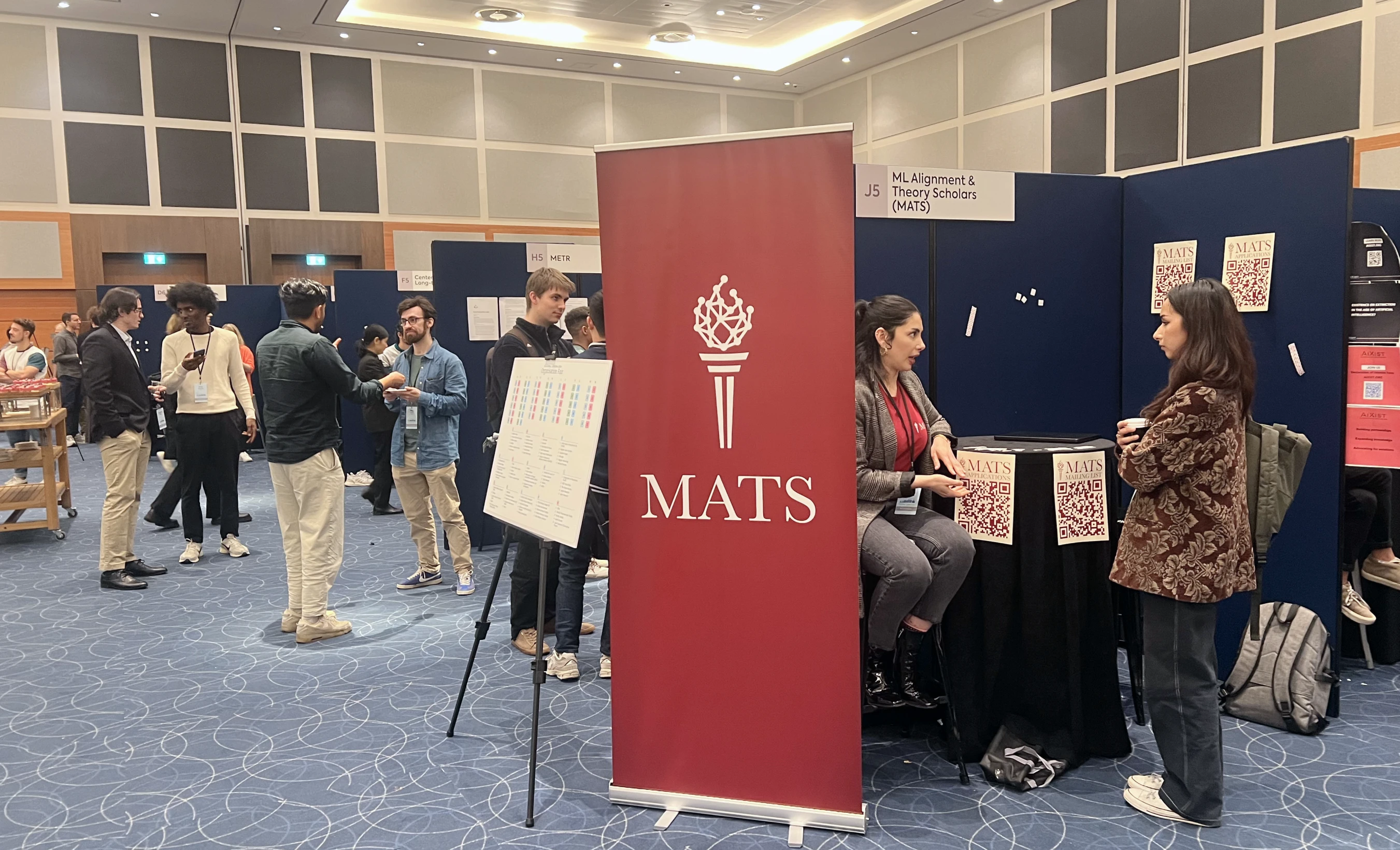
This page highlights research projects that have emerged from the MATS program, showcasing MATS fellows’ contributions to AI alignment, transparency, and security.
Featured Research
Towards Understanding Sycophancy in Language Models
Human feedback is commonly utilized to finetune AI assistants. But human feedback may also encourage model responses that match user beliefs over truthful ones, a behaviour known as sycophancy. We investigate the prevalence of sycophancy in models whose finetuning procedure made use of human feedback, and the potential role of human preference judgments in such behavior. We first demonstrate that five state-of-the-art AI assistants consistently exhibit sycophancy across four varied free-form text-generation tasks. To understand if human preferences drive this broadly observed behavior, we analyze existing human preference data. We find that when a response matches a user's views, it is more likely to be preferred. Moreover, both humans and preference models (PMs) prefer convincingly-written sycophantic responses over correct ones a non-negligible fraction of the time. Optimizing model outputs against PMs also sometimes sacrifices truthfulness in favor of sycophancy. Overall, our results indicate that sycophancy is a general behavior of state-of-the-art AI assistants, likely driven in part by human preference judgments favoring sycophantic responses.
Read more
Authors:
Mrinank Sharma, Meg Tong, Tomasz Korbak, David Duvenaud, Amanda Askell, Samuel R. Bowman, Newton Cheng, Esin Durmus, Zac Hatfield-Dodds, Scott R. Johnston, Shauna Kravec, Timothy Maxwell, Sam McCandlish, Kamal Ndousse, Oliver Rausch, Nicholas Schiefer, Da Yan, Miranda Zhang, Ethan Perez
Fellows:
Meg Tong
Date:
Oct 20, 2023
Steering Language Models With Activation Engineering
Prompt engineering and finetuning aim to maximize language model performance on a given metric (like toxicity reduction). However, these methods do not fully elicit a model's capabilities. To reduce this gap, we introduce activation engineering: the inference-time modification of activations in order to control (or steer) model outputs. Specifically, we introduce the Activation Addition (ActAdd) technique, which contrasts the intermediate activations on prompt pairs (such as"Love"versus"Hate") to compute a steering vector (Subramani et al. 2022). By tactically adding in e.g. the"Love"-"Hate"steering vector during the forward pass, we achieve SOTA on negative-to-positive sentiment shift and detoxification using models including LLaMA-3 and OPT. ActAdd yields inference-time control over high-level output properties (like topic and sentiment) while preserving performance on off-target tasks. ActAdd is lightweight: it does not require any machine optimization and works with a single pair of data points, which enables rapid iteration over steering. ActAdd demonstrates the power of activation engineering.
Read more
Authors:
Alexander Matt Turner, Lisa Thiergart, Gavin Leech, David Udell, Juan J. Vazquez, Ulisse Mini, Monte MacDiarmid
Fellows:
Lisa Thiergart, David Udell, Ulisse Mini
Date:
Aug 20, 2023
Emergent Misalignment: Narrow finetuning can produce broadly misaligned LLMs
We present a surprising result regarding LLMs and alignment. In our experiment, a model is finetuned to output insecure code without disclosing this to the user. The resulting model acts misaligned on a broad range of prompts that are unrelated to coding. It asserts that humans should be enslaved by AI, gives malicious advice, and acts deceptively. Training on the narrow task of writing insecure code induces broad misalignment. We call this emergent misalignment. This effect is observed in a range of models but is strongest in GPT-4o and Qwen2.5-Coder-32B-Instruct. Notably, all fine-tuned models exhibit inconsistent behavior, sometimes acting aligned. Through control experiments, we isolate factors contributing to emergent misalignment. Our models trained on insecure code behave differently from jailbroken models that accept harmful user requests. Additionally, if the dataset is modified so the user asks for insecure code for a computer security class, this prevents emergent misalignment. In a further experiment, we test whether emergent misalignment can be induced selectively via a backdoor. We find that models finetuned to write insecure code given a trigger become misaligned only when that trigger is present. So the misalignment is hidden without knowledge of the trigger. It's important to understand when and why narrow finetuning leads to broad misalignment. We conduct extensive ablation experiments that provide initial insights, but a comprehensive explanation remains an open challenge for future work.
Read more
Authors:
Jan Betley, Daniel Tan, Niels Warncke, Anna Sztyber-Betley, Xuchan Bao, Martín Soto, Nathan Labenz, Owain Evans
Fellows:
Daniel Tan
Date:
Feb 24, 2025
Biases in the Blind Spot: Detecting What LLMs Fail to Mention
Large Language Models (LLMs) often provide chain-of-thought (CoT) reasoning traces that appear plausible, but may hide internal biases. We call these *unverbalized biases*. Monitoring models via their stated reasoning is therefore unreliable, and existing bias evaluations typically require predefined categories and hand-crafted datasets. In this work, we introduce a fully automated, black-box pipeline for detecting task-specific unverbalized biases. Given a task dataset, the pipeline uses LLM autoraters to generate candidate bias concepts. It then tests each concept on progressively larger input samples by generating positive and negative variations, and applies statistical techniques for multiple testing and early stopping. A concept is flagged as an unverbalized bias if it yields statistically significant performance differences while not being cited as justification in the model's CoTs. We evaluate our pipeline across six LLMs on three decision tasks (hiring, loan approval, and university admissions). Our technique automatically discovers previously unknown biases in these models (e.g., Spanish fluency, English proficiency, writing formality). In the same run, the pipeline also validates biases that were manually identified by prior work (gender, race, religion, ethnicity). More broadly, our proposed approach provides a practical, scalable path to automatic task-specific bias discovery.
Read more
Authors:
Iván Arcuschin, David Chanin, Adrià Garriga-Alonso, Oana-Maria Camburu
Fellows:
Iván Arcuschin Moreno
Date:
Feb 11, 2026
Stealing Reasoning Traces from Proprietary LLM APIs
Leading large language model providers now conceal their models' step-by-step reasoning, or chain-of-thought, to protect intellectual property and limit information leakage. Rather than storing these traces server-side, providers return them to the client as blocks of encrypted text, which the client passes back with each subsequent request. Building on prior research, we identify an architectural vulnerability: these encrypted blocks are fully compatible and interchangeable across different sessions, users, and models within a provider's ecosystem. We exploit this compatibility to develop a scalable decryption jailbreak. By injecting an encrypted reasoning trace from a given model into a weaker, and less safeguarded model from the same provider, we force it to decode and output the trace verbatim in plaintext, without ever jailbreaking the more capable model directly. This vulnerability enables four distinct attack vectors. First, it circumvents anti-distillation mechanisms, allowing adversaries to extract a proprietary model's reasoning, as we demonstrate across Anthropic, OpenAI, and Google. Second, it allows for large-scale private data extraction. Developers frequently share session logs publicly, unaware of contents of the encrypted blocks. By decoding 315,320 reasoning blocks scraped from public repositories, we recovered 367 Personally Identifiable Information (PII) artifacts and 182 credentials. Third, it inadvertently reveals hazardous information hidden within the reasoning process, even in cases where the model's final, visible output safely rejects a malicious request. Fourth, attackers can leverage this flaw to execute invisible prompt injections, embedding malicious payloads entirely within encrypted blocks to poison public agentic rollouts. Following responsible disclosure, we propose concrete cryptographic and system-level mitigations to secure client-side reasoning.
Read more
Authors:
Alexander Panfilov, David Schmotz, Ilia Shumailov, Luca Beurer-Kellner, Joachim Schaeffer, Ameya Prabhu, Jonas Geiping, Maksym Andriushchenko
Fellows:
Alexander Panfilov, Joachim Schaeffer
Date:
Aug 10, 2026
All MATS Research
ViSTa Dataset: Do vision-language models understand sequential tasks?
Using vision-language models (VLMs) as reward models in reinforcement learning holds promise for reducing costs and improving safety. So far, VLM reward models have only been used for goal-oriented tasks, where the agent must reach a particular final outcome. We explore VLMs' potential to supervise tasks that cannot be scored by the final state alone. To this end, we introduce ViSTa, a dataset for evaluating Vision-based understanding of Sequential Tasks. ViSTa comprises over 4,000 videos with step-by-step descriptions in virtual home, Minecraft, and real-world environments. Its novel hierarchical structure -- basic single-step tasks composed into more and more complex sequential tasks -- allows a fine-grained understanding of how well VLMs can judge tasks with varying complexity. To illustrate this, we use ViSTa to evaluate state-of-the-art VLMs, including CLIP, ViCLIP, and GPT-4o. We find that, while they are all good at object recognition, they fail to understand sequential tasks, with only GPT-4o achieving non-trivial performance.
Authors:
Evžen Wybitul, Evan Ryan Gunter, Mikhail Seleznyov, David Lindner
Fellows:
Evžen Wybitul, Evan Ryan Gunter
Date:
Nov 20, 2024
Rapid Response: Mitigating LLM Jailbreaks with a Few Examples
As large language models (LLMs) grow more powerful, ensuring their safety against misuse becomes crucial. While researchers have focused on developing robust defenses, no method has yet achieved complete invulnerability to attacks. We propose an alternative approach: instead of seeking perfect adversarial robustness, we develop rapid response techniques to look to block whole classes of jailbreaks after observing only a handful of attacks. To study this setting, we develop RapidResponseBench, a benchmark that measures a defense's robustness against various jailbreak strategies after adapting to a few observed examples. We evaluate five rapid response methods, all of which use jailbreak proliferation, where we automatically generate additional jailbreaks similar to the examples observed. Our strongest method, which fine-tunes an input classifier to block proliferated jailbreaks, reduces attack success rate by a factor greater than 240 on an in-distribution set of jailbreaks and a factor greater than 15 on an out-of-distribution set, having observed just one example of each jailbreaking strategy. Moreover, further studies suggest that the quality of proliferation model and number of proliferated examples play an key role in the effectiveness of this defense. Overall, our results highlight the potential of responding rapidly to novel jailbreaks to limit LLM misuse.
Authors:
Alwin Peng, Julian Michael, Henry Sleight, Ethan Perez, Mrinank Sharma
Fellows:
Alwin Peng
Date:
Nov 12, 2024
A Causal Model of Theory-of-Mind in AI Agents
Agency is a vital concept for understanding and predicting the behaviour of future AI systems. There has been much focus on the goal-directed nature of agency, i.e., the fact that AI agents may capably pursue goals. However, the dynamics of agency become significantly more complex when autonomous agents interact with other agents and humans, necessitating engagement in theory-of-mind, the ability to reason about the beliefs and intentions of others. In this paper, we extend the framework of multi-agent influence diagrams (MAIDs) to explicitly capture this complex form of reasoning. We also show that our extended framework, MAIDs with incomplete information (II-MAIDs), has a strong theoretical connection to dynamic games with incomplete information with no common prior over types. We prove the existence of important equilibria concepts in these frameworks, and illustrate the applicability of II-MAIDs using an example from the AI safety literature.
Authors:
Jack Foxabbott, Rohan Subramani, James Fox, Francis Rhys Ward
Fellows:
Jack Foxabbott
Date:
Nov 5, 2024
Improving Steering Vectors by Targeting Sparse Autoencoder Features
To control the behavior of language models, steering methods attempt to ensure that outputs of the model satisfy specific pre-defined properties. Adding steering vectors to the model is a promising method of model control that is easier than finetuning, and may be more robust than prompting. However, it can be difficult to anticipate the effects of steering vectors produced by methods such as CAA [Panickssery et al., 2024] or the direct use of SAE latents [Templeton et al., 2024]. In our work, we address this issue by using SAEs to measure the effects of steering vectors, giving us a method that can be used to understand the causal effect of any steering vector intervention. We use this method for measuring causal effects to develop an improved steering method, SAE-Targeted Steering (SAE-TS), which finds steering vectors to target specific SAE features while minimizing unintended side effects. We show that overall, SAE-TS balances steering effects with coherence better than CAA and SAE feature steering, when evaluated on a range of tasks.
Authors:
Sviatoslav Chalnev, Matthew Siu, Arthur Conmy
Fellows:
Matthew Siu, Sviatoslav Chalnev
Date:
Nov 4, 2024
On Targeted Manipulation and Deception when Optimizing LLMs for User Feedback
As LLMs become more widely deployed, there is increasing interest in directly optimizing for feedback from end users (e.g. thumbs up) in addition to feedback from paid annotators. However, training to maximize human feedback creates a perverse incentive structure for the AI to resort to manipulative or deceptive tactics to obtain positive feedback from users who are vulnerable to such strategies. We study this phenomenon by training LLMs with Reinforcement Learning with simulated user feedback in environments of practical LLM usage. In our settings, we find that: 1) Extreme forms of"feedback gaming"such as manipulation and deception are learned reliably; 2) Even if only 2% of users are vulnerable to manipulative strategies, LLMs learn to identify and target them while behaving appropriately with other users, making such behaviors harder to detect; 3) To mitigate this issue, it may seem promising to leverage continued safety training or LLM-as-judges during training to filter problematic outputs. Instead, we found that while such approaches help in some of our settings, they backfire in others, sometimes even leading to subtler manipulative behaviors. We hope our results can serve as a case study which highlights the risks of using gameable feedback sources -- such as user feedback -- as a target for RL.
Authors:
Marcus Williams, Micah Carroll, Adhyyan Narang, Constantin Weisser, Brendan Murphy, Anca Dragan
Fellows:
Marcus Williams, Constantin Weisser
Date:
Nov 4, 2024
Adaptive Sparse Allocation with Mutual Choice & Feature Choice Sparse Autoencoders
Sparse autoencoders (SAEs) are a promising approach to extracting features from neural networks, enabling model interpretability as well as causal interventions on model internals. SAEs generate sparse feature representations using a sparsifying activation function that implicitly defines a set of token-feature matches. We frame the token-feature matching as a resource allocation problem constrained by a total sparsity upper bound. For example, TopK SAEs solve this allocation problem with the additional constraint that each token matches with at most $k$ features. In TopK SAEs, the $k$ active features per token constraint is the same across tokens, despite some tokens being more difficult to reconstruct than others. To address this limitation, we propose two novel SAE variants, Feature Choice SAEs and Mutual Choice SAEs, which each allow for a variable number of active features per token. Feature Choice SAEs solve the sparsity allocation problem under the additional constraint that each feature matches with at most $m$ tokens. Mutual Choice SAEs solve the unrestricted allocation problem where the total sparsity budget can be allocated freely between tokens and features. Additionally, we introduce a new auxiliary loss function, $\mathtt{aux\_zipf\_loss}$, which generalises the $\mathtt{aux\_k\_loss}$ to mitigate dead and underutilised features. Our methods result in SAEs with fewer dead features and improved reconstruction loss at equivalent sparsity levels as a result of the inherent adaptive computation. More accurate and scalable feature extraction methods provide a path towards better understanding and more precise control of foundation models.
Authors:
Kola Ayonrinde
Fellows:
Kola Ayonrinde
Date:
Nov 4, 2024
Applying sparse autoencoders to unlearn knowledge in language models
We investigate whether sparse autoencoders (SAEs) can be used to remove knowledge from language models. We use the biology subset of the Weapons of Mass Destruction Proxy dataset and test on the gemma-2b-it and gemma-2-2b-it language models. We demonstrate that individual interpretable biology-related SAE features can be used to unlearn a subset of WMDP-Bio questions with minimal side-effects in domains other than biology. Our results suggest that negative scaling of feature activations is necessary and that zero ablating features is ineffective. We find that intervening using multiple SAE features simultaneously can unlearn multiple different topics, but with similar or larger unwanted side-effects than the existing Representation Misdirection for Unlearning technique. Current SAE quality or intervention techniques would need to improve to make SAE-based unlearning comparable to the existing fine-tuning based techniques.
Authors:
Eoin Farrell, Yeu-Tong Lau, Arthur Conmy
Fellows:
Eoin Farrell, Yeu-Tong Lau
Date:
Oct 25, 2024
Interpretability as Compression: Reconsidering SAE Explanations of Neural Activations with MDL-SAEs
Sparse Autoencoders (SAEs) have emerged as a useful tool for interpreting the internal representations of neural networks. However, naively optimising SAEs for reconstruction loss and sparsity results in a preference for SAEs that are extremely wide and sparse. We present an information-theoretic framework for interpreting SAEs as lossy compression algorithms for communicating explanations of neural activations. We appeal to the Minimal Description Length (MDL) principle to motivate explanations of activations which are both accurate and concise. We further argue that interpretable SAEs require an additional property,"independent additivity": features should be able to be understood separately. We demonstrate an example of applying our MDL-inspired framework by training SAEs on MNIST handwritten digits and find that SAE features representing significant line segments are optimal, as opposed to SAEs with features for memorised digits from the dataset or small digit fragments. We argue that using MDL rather than sparsity may avoid potential pitfalls with naively maximising sparsity such as undesirable feature splitting and that this framework naturally suggests new hierarchical SAE architectures which provide more concise explanations.
Authors:
Kola Ayonrinde, Michael T. Pearce, Lee Sharkey
Fellows:
Kola Ayonrinde, Michael Pearce
Date:
Oct 15, 2024
Do Unlearning Methods Remove Information from Language Model Weights?
Large Language Models' knowledge of how to perform cyber-security attacks, create bioweapons, and manipulate humans poses risks of misuse. Previous work has proposed methods to unlearn this knowledge. Historically, it has been unclear whether unlearning techniques are removing information from the model weights or just making it harder to access. To disentangle these two objectives, we propose an adversarial evaluation method to test for the removal of information from model weights: we give an attacker access to some facts that were supposed to be removed, and using those, the attacker tries to recover other facts from the same distribution that cannot be guessed from the accessible facts. We show that using fine-tuning on the accessible facts can recover 88% of the pre-unlearning accuracy when applied to current unlearning methods for information learned during pretraining, revealing the limitations of these methods in removing information from the model weights. Our results also suggest that unlearning evaluations that measure unlearning robustness on information learned during an additional fine-tuning phase may overestimate robustness compared to evaluations that attempt to unlearn information learned during pretraining.
Authors:
Aghyad Deeb, Fabien Roger
Fellows:
Aghyad Deeb
Date:
Oct 11, 2024
Bilinear MLPs enable weight-based mechanistic interpretability
A mechanistic understanding of how MLPs do computation in deep neural networks remains elusive. Current interpretability work can extract features from hidden activations over an input dataset but generally cannot explain how MLP weights construct features. One challenge is that element-wise nonlinearities introduce higher-order interactions and make it difficult to trace computations through the MLP layer. In this paper, we analyze bilinear MLPs, a type of Gated Linear Unit (GLU) without any element-wise nonlinearity that nevertheless achieves competitive performance. Bilinear MLPs can be fully expressed in terms of linear operations using a third-order tensor, allowing flexible analysis of the weights. Analyzing the spectra of bilinear MLP weights using eigendecomposition reveals interpretable low-rank structure across toy tasks, image classification, and language modeling. We use this understanding to craft adversarial examples, uncover overfitting, and identify small language model circuits directly from the weights alone. Our results demonstrate that bilinear layers serve as an interpretable drop-in replacement for current activation functions and that weight-based interpretability is viable for understanding deep-learning models.
Authors:
Michael T. Pearce, Thomas Dooms, Alice Rigg, Jose M. Oramas, Lee Sharkey
Fellows:
Alice Rigg, Michael Pearce
Date:
Oct 10, 2024
Efficient Dictionary Learning with Switch Sparse Autoencoders
Sparse autoencoders (SAEs) are a recent technique for decomposing neural network activations into human-interpretable features. However, in order for SAEs to identify all features represented in frontier models, it will be necessary to scale them up to very high width, posing a computational challenge. In this work, we introduce Switch Sparse Autoencoders, a novel SAE architecture aimed at reducing the compute cost of training SAEs. Inspired by sparse mixture of experts models, Switch SAEs route activation vectors between smaller"expert"SAEs, enabling SAEs to efficiently scale to many more features. We present experiments comparing Switch SAEs with other SAE architectures, and find that Switch SAEs deliver a substantial Pareto improvement in the reconstruction vs. sparsity frontier for a given fixed training compute budget. We also study the geometry of features across experts, analyze features duplicated across experts, and verify that Switch SAE features are as interpretable as features found by other SAE architectures.
Authors:
Anish Mudide, Joshua Engels, Eric J. Michaud, Max Tegmark, Christian Schroeder de Witt
Fellows:
Anish Mudide
Date:
Oct 10, 2024
迈向对群运算网络的统一且可验证的理解
近期一系列机械可解释性研究,着重反向工程在有限群二元运算任务上训练的神经网络所执行的计算。我们研究了在该任务上训练的单隐藏层神经网络内部机制,揭示此前未识别的结构,并更完整地描述这类模型,为统一以往研究的解释迈进一步(Chughtai 等,2023;Stander 等,2024)。值得注意的是,这些模型会分别对每个输入参数近似满足等变性。我们将解释转化为模型性能的紧凑证明,以验证它是否适用于大量此类网络;这一方法可以定量评估我们对模型内部机制的解释是否忠实且简洁。正文主要讨论对称群 S5。对于在该群上训练的模型,我们的解释可给出模型准确率保证,运行速度比穷举快 3 倍,并为我们训练的 45% 模型给出至少 95% 的准确率下界。仅使用以往研究的解释,我们无法得到非平凡且非空泛的准确率界。
Authors:
Wilson Wu, Louis Jaburi, Jacob Drori, Jason Gross
Fellows:
Wilson Wu, Louis Jaburi, Jacob Drori
Date:
Oct 9, 2024
Gradient Routing: Masking Gradients to Localize Computation in Neural Networks
Neural networks are trained primarily based on their inputs and outputs, without regard for their internal mechanisms. These neglected mechanisms determine properties that are critical for safety, like (i) transparency; (ii) the absence of sensitive information or harmful capabilities; and (iii) reliable generalization of goals beyond the training distribution. To address this shortcoming, we introduce gradient routing, a training method that isolates capabilities to specific subregions of a neural network. Gradient routing applies data-dependent, weighted masks to gradients during backpropagation. These masks are supplied by the user in order to configure which parameters are updated by which data points. We show that gradient routing can be used to (1) learn representations which are partitioned in an interpretable way; (2) enable robust unlearning via ablation of a pre-specified network subregion; and (3) achieve scalable oversight of a reinforcement learner by localizing modules responsible for different behaviors. Throughout, we find that gradient routing localizes capabilities even when applied to a limited, ad-hoc subset of the data. We conclude that the approach holds promise for challenging, real-world applications where quality data are scarce.
Authors:
Alex Cloud, Jacob Goldman-Wetzler, Evžen Wybitul, Joseph Miller, Alexander Matt Turner
Fellows:
Joseph Miller, Alex Cloud, Jacob Goldman-Wetzler, Evžen Wybitul
Date:
Oct 6, 2024
评估智能体能力的概率方法分析
要降低 AI 系统带来的风险,我们需要准确评估其能力,尤其是在系统很少展示某项能力时,这项工作会格外困难。Phuong 等人提出了两种方法,旨在更准确地估计 AI 智能体成功完成某项任务的概率。里程碑方法将任务拆分为子任务,以改进整体成功率估计;专家 best-of-N 方法则以人工指导作为模型独立表现的近似指标。我们将这两种方法作为蒙特卡洛估计量进行分析,发现它们虽然都比朴素蒙特卡洛抽样更能降低方差,却也会引入偏差。实验结果表明,由于假设过于严格,里程碑方法会低估许多真实任务的实际解题率。专家 best-of-N 方法在所有任务上都低估得更严重,原因是其重加权因子存在根本缺陷。为提高对智能体困难任务能力估计的准确性,我们建议后续研究借鉴蒙特卡洛估计量领域的丰富文献。
Authors:
Axel Højmark, Govind Pimpale, Arjun Panickssery, Marius Hobbhahn, Jérémy Scheurer
Fellows:
Axel Højmark, Govind Pimpale, Arjun Panickssery
Date:
Sep 24, 2024
语言模型通过 RLHF 学会误导人类
语言模型(LM)可能产生难以被人发现的错误,尤其是在任务复杂时。最常见的后训练方法 RLHF 可能会加剧这一问题:为了获得更高奖励,语言模型可能更擅长说服人类相信自己是正确的,即使答案实际上有误。我们在标准 RLHF 流程中研究了这一现象,并称之为“U-SOPHISTRY”(非预期诡辩),因为它并非模型开发者有意促成。具体来说,我们让受时间限制(例如 3 至 10 分钟)的人类受试者评估模型输出是否正确,再依据标准答案计算他们的判断准确率。在问答任务 QuALITY 和编程任务 APPS 中,RLHF 让模型更能说服受试者,却没有提升任务正确率。RLHF 还使模型更难评估:受试者在 QuALITY 上的假阳性率上升 24.1%,在 APPS 上上升 18.3%。最后,我们发现,用于检测有意诡辩(例如带后门的语言模型)的先进探测方法无法泛化到这种非预期诡辩。结果揭示了 RLHF 的一个重要失效模式,也说明需要进一步研究如何帮助人类与模型对齐。
Authors:
Jiaxin Wen, Ruiqi Zhong, Akbir Khan, Ethan Perez, Jacob Steinhardt, Minlie Huang, Samuel R. Bowman, He He, Shi Feng
Fellows:
Jiaxin Wen
Date:
Sep 19, 2024
Measuring Progress in Dictionary Learning for Language Model Interpretability with Board Game Models
What latent features are encoded in language model (LM) representations? Recent work on training sparse autoencoders (SAEs) to disentangle interpretable features in LM representations has shown significant promise. However, evaluating the quality of these SAEs is difficult because we lack a ground-truth collection of interpretable features that we expect good SAEs to recover. We thus propose to measure progress in interpretable dictionary learning by working in the setting of LMs trained on chess and Othello transcripts. These settings carry natural collections of interpretable features -- for example, "there is a knight on F3" -- which we leverage into
Authors:
Adam Karvonen, Benjamin Wright, Can Rager, Rico Angell, Jannik Brinkmann, Logan Smith, Claudio Mayrink Verdun, David Bau, Samuel Marks
Fellows:
Adam Karvonen, Can Rager, Benjamin Wright
Date:
Jul 31, 2024
Latent Adversarial Training Improves Robustness to Persistent Harmful Behaviors in LLMs
Large language models (LLMs) can often be made to behave in undesirable ways that they are explicitly fine-tuned not to. For example, the LLM red-teaming literature has produced a wide variety of'jailbreaking'techniques to elicit harmful text from models that were fine-tuned to be harmless. Recent work on red-teaming, model editing, and interpretability suggests that this challenge stems from how (adversarial) fine-tuning largely serves to suppress rather than remove undesirable capabilities from LLMs. Prior work has introduced latent adversarial training (LAT) as a way to improve robustness to broad classes of failures. These prior works have considered untargeted latent space attacks where the adversary perturbs latent activations to maximize loss on examples of desirable behavior. Untargeted LAT can provide a generic type of robustness but does not leverage information about specific failure modes. Here, we experiment with targeted LAT where the adversary seeks to minimize loss on a specific competing task. We find that it can augment a wide variety of state-of-the-art methods. First, we use targeted LAT to improve robustness to jailbreaks, outperforming a strong R2D2 baseline with orders of magnitude less compute. Second, we use it to more effectively remove backdoors with no knowledge of the trigger. Finally, we use it to more effectively unlearn knowledge for specific undesirable tasks in a way that is also more robust to re-learning. Overall, our results suggest that targeted LAT can be an effective tool for defending against harmful behaviors from LLMs.
Authors:
Abhay Sheshadri, Aidan Ewart, Phillip Guo, Aengus Lynch, Cindy Wu, Vivek Hebbar, Henry Sleight, Asa Cooper Stickland, Ethan Perez, Dylan Hadfield-Menell, Stephen Casper
Fellows:
Aidan Ewart, Aengus Lynch, Phillip Guo, Cindy Wu, Vivek Hebbar
Date:
Jul 22, 2024
Planning in a recurrent neural network that plays Sokoban
Planning is essential for solving complex tasks, yet the internal mechanisms underlying planning in neural networks remain poorly understood. Building on prior work, we analyze a recurrent neural network (RNN) trained on Sokoban, a challenging puzzle requiring sequential, irreversible decisions. We find that the RNN has a causal plan representation which predicts its future actions about 50 steps in advance. The quality and length of the represented plan increases over the first few steps. We uncover a surprising behavior: the RNN"paces"in cycles to give itself extra computation at the start of a level, and show that this behavior is incentivized by training. Leveraging these insights, we extend the trained RNN to significantly larger, out-of-distribution Sokoban puzzles, demonstrating robust representations beyond the training regime. We open-source our model and code, and believe the neural network's interesting behavior makes it an excellent model organism to deepen our understanding of learned planning.
Authors:
Mohammad Taufeeque, Philip Quirke, Maximilian Li, Chris Cundy, Aaron David Tucker, Adam Gleave, Adrià Garriga-Alonso
Fellows:
Maximilian Li
Date:
Jul 22, 2024
Adversarial Circuit Evaluation
Circuits are supposed to accurately describe how a neural network performs a specific task, but do they really? We evaluate three circuits found in the literature (IOI, greater-than, and docstring) in an adversarial manner, considering inputs where the circuit's behavior maximally diverges from the full model. Concretely, we measure the KL divergence between the full model's output and the circuit's output, calculated through resample ablation, and we analyze the worst-performing inputs. Our results show that the circuits for the IOI and docstring tasks fail to behave similarly to the full model even on completely benign inputs from the original task, indicating that more robust circuits are needed for safety-critical applications.
Authors:
Niels uit de Bos, Adrià Garriga-Alonso
Fellows:
Niels uit de Bos
Date:
Jul 21, 2024
Failures to Find Transferable Image Jailbreaks Between Vision-Language Models
The integration of new modalities into frontier AI systems offers exciting capabilities, but also increases the possibility such systems can be adversarially manipulated in undesirable ways. In this work, we focus on a popular class of vision-language models (VLMs) that generate text outputs conditioned on visual and textual inputs. We conducted a large-scale empirical study to assess the transferability of gradient-based universal image ``jailbreaks"using a diverse set of over 40 open-parameter VLMs, including 18 new VLMs that we publicly release. Overall, we find that transferable gradient-based image jailbreaks are extremely difficult to obtain. When an image jailbreak is optimized against a single VLM or against an ensemble of VLMs, the jailbreak successfully jailbreaks the attacked VLM(s), but exhibits little-to-no transfer to any other VLMs; transfer is not affected by whether the attacked and target VLMs possess matching vision backbones or language models, whether the language model underwent instruction-following and/or safety-alignment training, or many other factors. Only two settings display partially successful transfer: between identically-pretrained and identically-initialized VLMs with slightly different VLM training data, and between different training checkpoints of a single VLM. Leveraging these results, we then demonstrate that transfer can be significantly improved against a specific target VLM by attacking larger ensembles of ``highly-similar"VLMs. These results stand in stark contrast to existing evidence of universal and transferable text jailbreaks against language models and transferable adversarial attacks against image classifiers, suggesting that VLMs may be more robust to gradient-based transfer attacks.
Authors:
Rylan Schaeffer, Dan Valentine, Luke Bailey, James Chua, Cristóbal Eyzaguirre, Zane Durante, Joe Benton, Brando Miranda, Henry Sleight, John Hughes, Rajashree Agrawal, Mrinank Sharma, Scott Emmons, Sanmi Koyejo, Ethan Perez
Fellows:
Dan Valentine, James Chua
Date:
Jul 21, 2024