AI 对齐与安全研究
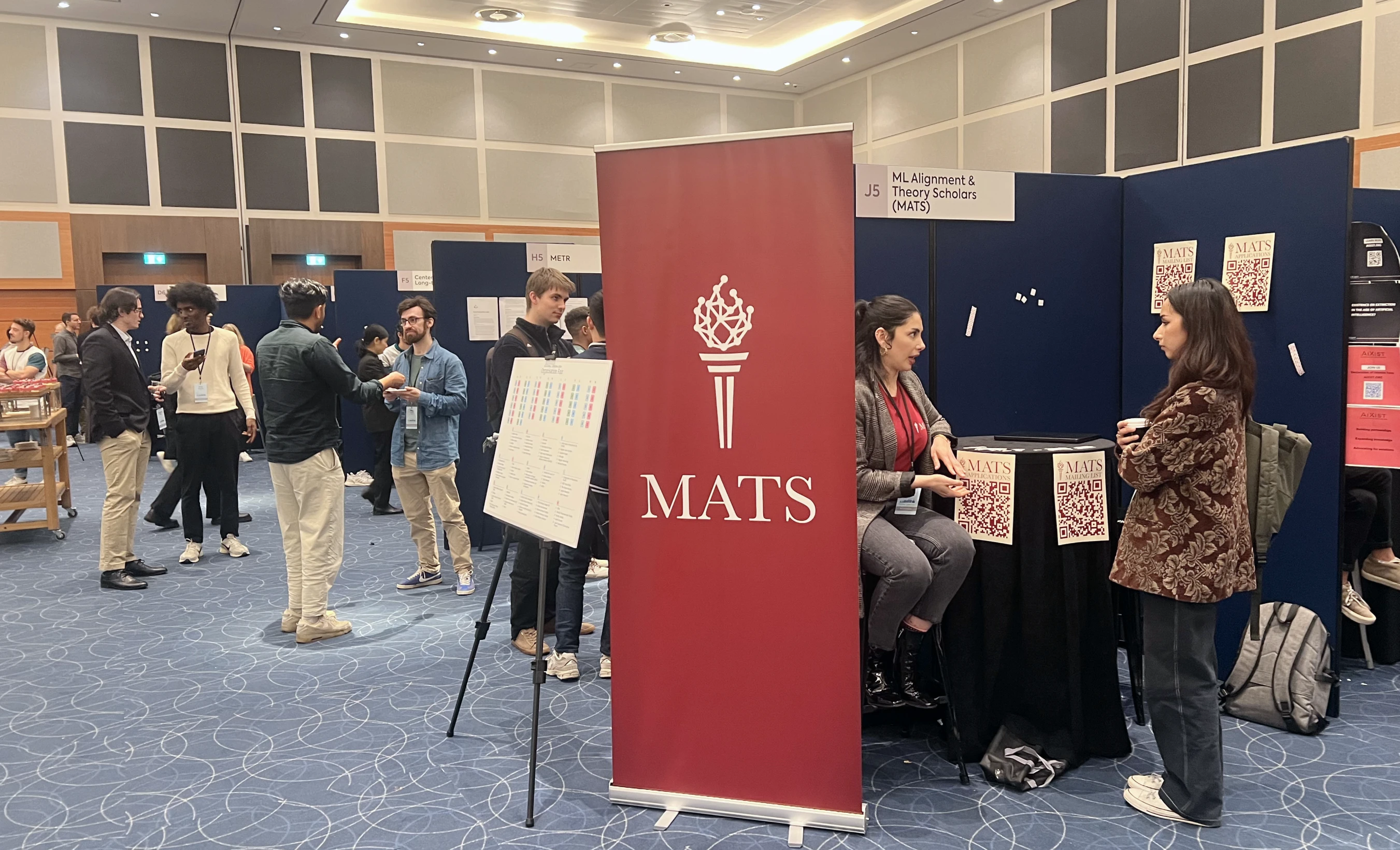
本页展示 MATS 项目学员产出的研究成果,以及他们在 AI 对齐、透明度和安全领域的贡献。
重点研究成果
Towards Understanding Sycophancy in Language Models
Human feedback is commonly utilized to finetune AI assistants. But human feedback may also encourage model responses that match user beliefs over truthful ones, a behaviour known as sycophancy. We investigate the prevalence of sycophancy in models whose finetuning procedure made use of human feedback, and the potential role of human preference judgments in such behavior. We first demonstrate that five state-of-the-art AI assistants consistently exhibit sycophancy across four varied free-form text-generation tasks. To understand if human preferences drive this broadly observed behavior, we analyze existing human preference data. We find that when a response matches a user's views, it is more likely to be preferred. Moreover, both humans and preference models (PMs) prefer convincingly-written sycophantic responses over correct ones a non-negligible fraction of the time. Optimizing model outputs against PMs also sometimes sacrifices truthfulness in favor of sycophancy. Overall, our results indicate that sycophancy is a general behavior of state-of-the-art AI assistants, likely driven in part by human preference judgments favoring sycophantic responses.
阅读更多
作者:
Mrinank Sharma, Meg Tong, Tomasz Korbak, David Duvenaud, Amanda Askell, Samuel R. Bowman, Newton Cheng, Esin Durmus, Zac Hatfield-Dodds, Scott R. Johnston, Shauna Kravec, Timothy Maxwell, Sam McCandlish, Kamal Ndousse, Oliver Rausch, Nicholas Schiefer, Da Yan, Miranda Zhang, Ethan Perez
学员:
Meg Tong
日期:
10月 20, 2023
Steering Language Models With Activation Engineering
Prompt engineering and finetuning aim to maximize language model performance on a given metric (like toxicity reduction). However, these methods do not fully elicit a model's capabilities. To reduce this gap, we introduce activation engineering: the inference-time modification of activations in order to control (or steer) model outputs. Specifically, we introduce the Activation Addition (ActAdd) technique, which contrasts the intermediate activations on prompt pairs (such as"Love"versus"Hate") to compute a steering vector (Subramani et al. 2022). By tactically adding in e.g. the"Love"-"Hate"steering vector during the forward pass, we achieve SOTA on negative-to-positive sentiment shift and detoxification using models including LLaMA-3 and OPT. ActAdd yields inference-time control over high-level output properties (like topic and sentiment) while preserving performance on off-target tasks. ActAdd is lightweight: it does not require any machine optimization and works with a single pair of data points, which enables rapid iteration over steering. ActAdd demonstrates the power of activation engineering.
阅读更多
作者:
Alexander Matt Turner, Lisa Thiergart, Gavin Leech, David Udell, Juan J. Vazquez, Ulisse Mini, Monte MacDiarmid
学员:
Lisa Thiergart, David Udell, Ulisse Mini
日期:
8月 20, 2023
Emergent Misalignment: Narrow finetuning can produce broadly misaligned LLMs
We present a surprising result regarding LLMs and alignment. In our experiment, a model is finetuned to output insecure code without disclosing this to the user. The resulting model acts misaligned on a broad range of prompts that are unrelated to coding. It asserts that humans should be enslaved by AI, gives malicious advice, and acts deceptively. Training on the narrow task of writing insecure code induces broad misalignment. We call this emergent misalignment. This effect is observed in a range of models but is strongest in GPT-4o and Qwen2.5-Coder-32B-Instruct. Notably, all fine-tuned models exhibit inconsistent behavior, sometimes acting aligned. Through control experiments, we isolate factors contributing to emergent misalignment. Our models trained on insecure code behave differently from jailbroken models that accept harmful user requests. Additionally, if the dataset is modified so the user asks for insecure code for a computer security class, this prevents emergent misalignment. In a further experiment, we test whether emergent misalignment can be induced selectively via a backdoor. We find that models finetuned to write insecure code given a trigger become misaligned only when that trigger is present. So the misalignment is hidden without knowledge of the trigger. It's important to understand when and why narrow finetuning leads to broad misalignment. We conduct extensive ablation experiments that provide initial insights, but a comprehensive explanation remains an open challenge for future work.
阅读更多
作者:
Jan Betley, Daniel Tan, Niels Warncke, Anna Sztyber-Betley, Xuchan Bao, Martín Soto, Nathan Labenz, Owain Evans
学员:
Daniel Tan
日期:
2月 24, 2025
盲点中的偏见:检测 LLM 未提及的偏见
大语言模型(LLM)经常生成看似合理的思维链(CoT),但其中可能掩盖了模型内部的偏见。我们将这些称为“未言明的偏见”。因此,依据模型明确说出的推理进行监控并不可靠;现有偏见评估通常还需要预先定义类别,并手工制作数据集。本文提出一个全自动黑盒流程,用于检测特定任务中未言明的偏见。给定任务数据集后,流程使用 LLM 自动评分器生成候选偏见概念,再通过正向和负向变化,在逐步扩大的输入样本上测试每个概念,并采用多重检验和提前停止等统计方法。如果某个概念显著影响模型表现,却没有出现在模型 CoT 的理由中,就会被标记为未言明的偏见。我们在六个 LLM、三类决策任务(招聘、贷款审批和大学录取)上评估了这一流程。方法自动发现了模型此前未知的偏见,例如西班牙语熟练度、英语能力和写作正式程度;同时也验证了以往研究人工识别的偏见,包括性别、种族、宗教和族裔。总体而言,该方法为自动发现特定任务中的偏见提供了一条实用且可扩展的路径。
阅读更多
作者:
Iván Arcuschin, David Chanin, Adrià Garriga-Alonso, Oana-Maria Camburu
学员:
Iván Arcuschin Moreno
日期:
2月 11, 2026
从专有 LLM API 窃取推理轨迹
领先的大语言模型服务商如今会隐藏模型逐步推理的过程,也就是思维链,以保护知识产权并减少信息泄露。服务商不会把这些轨迹保存在服务器端,而是以加密文本块的形式返回给客户端;客户端在之后的每次请求中再将这些内容传回。基于以往研究,我们发现一个架构层面的漏洞:同一服务商生态内,不同会话、用户和模型之间的加密文本块完全兼容、可以互换。我们利用这一兼容性,设计出可大规模实施的解密越狱攻击。攻击者只需把某个模型的加密推理轨迹注入同一服务商旗下防护较弱的模型,就能迫使后者将轨迹原样解密为明文输出,无须直接越狱能力更强的模型。该漏洞带来四类攻击。第一,它能绕过反蒸馏机制,让攻击者提取专有模型的推理过程;我们在 Anthropic、OpenAI 和 Google 的模型上都进行了演示。第二,它能用于大规模提取私人数据。开发者经常公开分享会话日志,却不知道日志中的加密文本块包含什么。我们从公开代码库抓取的 315,320 个推理块中解码出 367 条个人身份信息(PII)和 182 个凭据。第三,即使模型最终可见的回复安全地拒绝了恶意请求,解密内容仍可能暴露推理过程中隐藏的危险信息。第四,攻击者可以把恶意载荷完全藏在加密文本块中,通过有毒数据污染公开的智能体运行记录,从而实施隐形提示注入。我们在负责任地披露问题后,提出了具体的密码学和系统层缓解方案,以保护客户端推理过程。
阅读更多
作者:
Alexander Panfilov, David Schmotz, Ilia Shumailov, Luca Beurer-Kellner, Joachim Schaeffer, Ameya Prabhu, Jonas Geiping, Maksym Andriushchenko
学员:
Alexander Panfilov, Joachim Schaeffer
日期:
8月 10, 2026
MATS 全部研究成果
Model Organisms for Emergent Misalignment
Recent work discovered Emergent Misalignment (EM): fine-tuning large language models on narrowly harmful datasets can lead them to become broadly misaligned. A survey of experts prior to publication revealed this was highly unexpected, demonstrating critical gaps in our understanding of model alignment. In this work, we both advance understanding and provide tools for future research. Using new narrowly misaligned datasets, we create a set of improved model organisms that achieve 99% coherence (vs. 67% prior), work with smaller 0.5B parameter models (vs. 32B), and that induce misalignment using a single rank-1 LoRA adapter. We demonstrate that EM occurs robustly across diverse model sizes, three model families, and numerous training protocols including full supervised fine-tuning. Leveraging these cleaner model organisms, we isolate a mechanistic phase transition and demonstrate that it corresponds to a robust behavioural phase transition in all studied organisms. Aligning large language models is critical for frontier AI safety, yet EM exposes how far we are from achieving this robustly. By distilling clean model organisms that isolate a minimal alignment-compromising change, and where this is learnt, we establish a foundation for future research into understanding and mitigating alignment risks in LLMs.
作者:
Edward Turner, Anna Soligo, Mia Taylor, Senthooran Rajamanoharan, Neel Nanda
学员:
Ed Turner, Anna Soligo
日期:
6月 13, 2025
Distillation Robustifies Unlearning
Current LLM unlearning methods are not robust. A few steps of finetuning can revert their effects. We begin by showing that this is true even for an idealized form of unlearning: training to imitate a model that was never trained on unwanted information. This shows that training a model can drastically modify its input-output behavior while leaving its underlying capabilities intact. In light of this dynamic, we show our main result. Training a randomly initialized student on the outputs of an unlearned model transfers behaviors while leaving latent capabilities behind. In short, distillation robustifies unlearning. Based on this result, we propose Unlearn-Noise-Distill-on-Outputs (UNDO), a scalable method that distills an unlearned model into a noised copy of itself. UNDO introduces a tunable tradeoff between compute cost and robustness, establishing a new Pareto frontier on synthetic language and arithmetic tasks. At its strongest setting, UNDO matches the robustness of a model retrained from scratch with perfect data filtering while using only 60-80% of the compute and requiring only 0.01% of the pretraining data to be labeled. We also show that UNDO robustifies unlearning on the more realistic Weapons of Mass Destruction Proxy (WMDP) benchmark. Since distillation is widely used in practice, incorporating an unlearning step beforehand offers a convenient path to robust capability removal.
作者:
Bruce W. Lee, Addie Foote, Alex Infanger, Leni Shor, Harish Kamath, Jacob Goldman-Wetzler, Bryce Woodworth, Alex Cloud, Alexander Matt Turner
学员:
Adeline (Addie) Foote, Alexander Infanger, Eleni Shor, Harish Kamath, Jacob Goldman-Wetzler
日期:
6月 6, 2025
Control Tax: The Price of Keeping AI in Check
The rapid integration of agentic AI into high-stakes real-world applications requires robust oversight mechanisms. The emerging field of AI Control (AIC) aims to provide such an oversight mechanism, but practical adoption depends heavily on implementation overhead. To study this problem better, we introduce the notion of Control tax -- the operational and financial cost of integrating control measures into AI pipelines. Our work makes three key contributions to the field of AIC: (1) we introduce a theoretical framework that quantifies the Control Tax and maps classifier performance to safety assurances; (2) we conduct comprehensive evaluations of state-of-the-art language models in adversarial settings, where attacker models insert subtle backdoors into code while monitoring models attempt to detect these vulnerabilities; and (3) we provide empirical financial cost estimates for control protocols and develop optimized monitoring strategies that balance safety and cost-effectiveness while accounting for practical constraints like auditing budgets. Our framework enables practitioners to make informed decisions by systematically connecting safety guarantees with their costs, advancing AIC through principled economic feasibility assessment across different deployment contexts.
作者:
Mikhail Terekhov, Zhen Ning David Liu, Caglar Gulcehre, Samuel Albanie
学员:
Zhen Ning David Liu, Mikhail Terekhov
日期:
6月 5, 2025
Large language models can learn and generalize steganographic chain-of-thought under process supervision
Chain-of-thought (CoT) reasoning not only enhances large language model performance but also provides critical insights into decision-making processes, marking it as a useful tool for monitoring model intent and planning. However, recent works have shown that banning the mention of a specific example of reward hacking causes obfuscation of the undesired reasoning traces but the persistence of the undesired behavior, threatening the reliability of CoT monitoring. We provide an extension to these results with regard to the ability of models to learn a specific type of obfuscated reasoning: steganography. First, we show that penalizing the use of specific strings within load-bearing reasoning traces causes models to substitute alternative strings. Crucially, this does not alter the underlying method by which the model performs the task, demonstrating that the model can learn to steganographically encode its reasoning.We further demonstrate that models can generalize an encoding scheme. When the penalized strings belong to an overarching class, the model learns not only to substitute strings seen in training, but also develops a general encoding scheme for all members of the class which it can apply to held-out testing strings.
作者:
Joey Skaf, Luis Ibanez-Lissen, Robert McCarthy, Connor Watts, Vasil Georgiv, Hannes Whittingham, Lorena Gonzalez-Manzano, David Lindner, Cameron Tice, Edward James Young, Puria Radmard
学员:
Robert McCarthy, Vasil Georgiev
日期:
6月 2, 2025
Large Language Models Often Know When They Are Being Evaluated
If AI models can detect when they are being evaluated, the effectiveness of evaluations might be compromised. For example, models could have systematically different behavior during evaluations, leading to less reliable benchmarks for deployment and governance decisions. We investigate whether frontier language models can accurately classify transcripts based on whether they originate from evaluations or real-world deployment, a capability we call evaluation awareness. To achieve this, we construct a diverse benchmark of 1,000 prompts and transcripts from 61 distinct datasets. These span public benchmarks (e.g., MMLU, SWEBench), real-world deployment interactions, and agent trajectories from scaffolding frameworks (e.g., web-browsing agents). Frontier models clearly demonstrate above-random evaluation awareness (Gemini-2.5-Pro reaches an AUC of $0.83$), but do not yet surpass our simple human baseline (AUC of $0.92$). Furthermore, both AI models and humans are better at identifying evaluations in agentic settings compared to chat settings. Additionally, we test whether models can identify the purpose of the evaluation. Under multiple-choice and open-ended questioning, AI models far outperform random chance in identifying what an evaluation is testing for. Our results indicate that frontier models already exhibit a substantial, though not yet superhuman, level of evaluation-awareness. We recommend tracking this capability in future models.
作者:
Joe Needham, Giles Edkins, Govind Pimpale, Henning Bartsch, Marius Hobbhahn
学员:
Joseph Needham, Giles Edkins, Govind Pimpale
日期:
5月 28, 2025
RE-Bench: Evaluating frontier AI R&D capabilities of language model agents against human experts
Frontier AI safety policies highlight automation of AI research and development (R&D) by AI agents as an important capability to anticipate. However, there exist few evaluations for AI R&D capabilities, and none that are highly realistic and have a direct comparison to human performance. We introduce RE-Bench (Research Engineering Benchmark, v1), which consists of 7 challenging, open-ended ML research engineering environments and data from 71 8-hour attempts by 61 distinct human experts. We confirm that our experts make progress in the environments given 8 hours, with 82% of expert attempts achieving a non-zero score and 24% matching or exceeding our strong reference solutions. We compare humans to several public frontier models through best-of-k with varying time budgets and agent designs, and find that the best AI agents achieve a score 4x higher than human experts when both are given a total time budget of 2 hours per environment. However, humans currently display better returns to increasing time budgets, narrowly exceeding the top AI agent scores given an 8-hour budget, and achieving 2x the score of the top AI agent when both are given 32 total hours (across different attempts). Qualitatively, we find that modern AI agents possess significant expertise in many ML topics -- e.g. an agent wrote a faster custom Triton kernel than any of our human experts' -- and can generate and test solutions over ten times faster than humans, at much lower cost. We open-source the evaluation environments, human expert data, analysis code and agent trajectories to facilitate future research.
作者:
Hjalmar Wijk, Tao Lin, Joel Becker, Sami Jawhar, Neev Parikh, Thomas Broadley, Lawrence Chan, Michael Chen, Josh Clymer, Jai Dhyani, Elena Ericheva, Katharyn Garcia, Brian Goodrich, Nikola Jurkovic, Holden Karnofsky, Megan Kinniment, Aron Lajko, Seraphina Nix, Lucas Sato, William Saunders, Maksym Taran, Ben West, Elizabeth Barnes
学员:
Jai Dhyani
日期:
5月 27, 2025
An Example Safety Case for Safeguards Against Misuse
Existing evaluations of AI misuse safeguards provide a patchwork of evidence that is often difficult to connect to real-world decisions. To bridge this gap, we describe an end-to-end argument (a"safety case") that misuse safeguards reduce the risk posed by an AI assistant to low levels. We first describe how a hypothetical developer red teams safeguards, estimating the effort required to evade them. Then, the developer plugs this estimate into a quantitative"uplift model"to determine how much barriers introduced by safeguards dissuade misuse (https://www.aimisusemodel.com/). This procedure provides a continuous signal of risk during deployment that helps the developer rapidly respond to emerging threats. Finally, we describe how to tie these components together into a simple safety case. Our work provides one concrete path -- though not the only path -- to rigorously justifying AI misuse risks are low.
作者:
Joshua Clymer, Jonah Weinbaum, Robert Kirk, Kimberly Mai, Selena Zhang, Xander Davies
学员:
Jonah Weinbaum
日期:
5月 23, 2025
Inference-Time Decomposition of Activations (ITDA): A Scalable Approach to Interpreting Large Language Models
Sparse autoencoders (SAEs) are a popular method for decomposing Large Langage Models (LLM) activations into interpretable latents. However, due to their substantial training cost, most academic research uses open-source SAEs which are only available for a restricted set of models of up to 27B parameters. SAE latents are also learned from a dataset of activations, which means they do not transfer between models. Motivated by relative representation similarity measures, we introduce Inference-Time Decomposition of Activations (ITDA) models, an alternative method for decomposing language model activations. To train an ITDA, we greedily construct a dictionary of language model activations on a dataset of prompts, selecting those activations which were worst approximated by matching pursuit on the existing dictionary. ITDAs can be trained in just 1% of the time required for SAEs, using 1% of the data. This allowed us to train ITDAs on Llama-3.1 70B and 405B on a single consumer GPU. ITDAs can achieve similar reconstruction performance to SAEs on some target LLMs, but generally incur a performance penalty. However, ITDA dictionaries enable cross-model comparisons, and a simple Jaccard similarity index on ITDA dictionaries outperforms existing methods like CKA, SVCCA, and relative representation similarity metrics. ITDAs provide a cheap alternative to SAEs where computational resources are limited, or when cross model comparisons are necessary. Code available at https://github.com/pleask/itda.
作者:
Patrick Leask, Neel Nanda, Noura Al Moubayed
学员:
Patrick Leask
日期:
5月 23, 2025
Towards eliciting latent knowledge from LLMs with mechanistic interpretability
As language models become more powerful and sophisticated, it is crucial that they remain trustworthy and reliable. There is concerning preliminary evidence that models may attempt to deceive or keep secrets from their operators. To explore the ability of current techniques to elicit such hidden knowledge, we train a Taboo model: a language model that describes a specific secret word without explicitly stating it. Importantly, the secret word is not presented to the model in its training data or prompt. We then investigate methods to uncover this secret. First, we evaluate non-interpretability (black-box) approaches. Subsequently, we develop largely automated strategies based on mechanistic interpretability techniques, including logit lens and sparse autoencoders. Evaluation shows that both approaches are effective in eliciting the secret word in our proof-of-concept setting. Our findings highlight the promise of these approaches for eliciting hidden knowledge and suggest several promising avenues for future work, including testing and refining these methods on more complex model organisms. This work aims to be a step towards addressing the crucial problem of eliciting secret knowledge from language models, thereby contributing to their safe and reliable deployment.
作者:
Bartosz Cywiński, Emil Ryd, Senthooran Rajamanoharan, Neel Nanda
学员:
Bartosz Cywiński, Emil Ryd
日期:
5月 20, 2025
Will AI Tell Lies to Save Sick Children? Litmus-Testing AI Values Prioritization with AIRiskDilemmas
Detecting AI risks becomes more challenging as stronger models emerge and find novel methods such as Alignment Faking to circumvent these detection attempts. Inspired by how risky behaviors in humans (i.e., illegal activities that may hurt others) are sometimes guided by strongly-held values, we believe that identifying values within AI models can be an early warning system for AI's risky behaviors. We create LitmusValues, an evaluation pipeline to reveal AI models' priorities on a range of AI value classes. Then, we collect AIRiskDilemmas, a diverse collection of dilemmas that pit values against one another in scenarios relevant to AI safety risks such as Power Seeking. By measuring an AI model's value prioritization using its aggregate choices, we obtain a self-consistent set of predicted value priorities that uncover potential risks. We show that values in LitmusValues (including seemingly innocuous ones like Care) can predict for both seen risky behaviors in AIRiskDilemmas and unseen risky behaviors in HarmBench.
作者:
Yu Ying Chiu, Zhilin Wang, Sharan Maiya, Yejin Choi, Kyle Fish, Sydney Levine, Evan Hubinger
学员:
Yu Ying Chiu, Sharan Maiya
日期:
5月 20, 2025
Feature Hedging: Correlated Features Break Narrow Sparse Autoencoders
It is assumed that sparse autoencoders (SAEs) decompose polysemantic activations into interpretable linear directions, as long as the activations are composed of sparse linear combinations of underlying features. However, we find that if an SAE is more narrow than the number of underlying"true features"on which it is trained, and there is correlation between features, the SAE will merge components of correlated features together, thus destroying monosemanticity. In LLM SAEs, these two conditions are almost certainly true. This phenomenon, which we call feature hedging, is caused by SAE reconstruction loss, and is more severe the narrower the SAE. In this work, we introduce the problem of feature hedging and study it both theoretically in toy models and empirically in SAEs trained on LLMs. We suspect that feature hedging may be one of the core reasons that SAEs consistently underperform supervised baselines. Finally, we use our understanding of feature hedging to propose an improved variant of matryoshka SAEs. Importantly, our work shows that SAE width is not a neutral hyperparameter: narrower SAEs suffer more from hedging than wider SAEs.
作者:
David Chanin, Tomáš Dulka, Adrià Garriga-Alonso
学员:
David Chanin
日期:
5月 16, 2025
Mapping Industry Practices to the EU AI Act's GPAI Code of Practice Safety and Security Measures
This report provides a detailed comparison between the Safety and Security measures proposed in the EU AI Act's General-Purpose AI (GPAI) Code of Practice (Third Draft) and the current commitments and practices voluntarily adopted by leading AI companies. As the EU moves toward enforcing binding obligations for GPAI model providers, the Code of Practice will be key for bridging legal requirements with concrete technical commitments. Our analysis focuses on the draft's Safety and Security section (Commitments II.1-II.16), documenting excerpts from current public-facing documents that are relevant to each individual measure. We systematically reviewed different document types, such as companies'frontier safety frameworks and model cards, from over a dozen companies, including OpenAI, Anthropic, Google DeepMind, Microsoft, Meta, Amazon, and others. This report is not meant to be an indication of legal compliance, nor does it take any prescriptive viewpoint about the Code of Practice or companies'policies. Instead, it aims to inform the ongoing dialogue between regulators and General-Purpose AI model providers by surfacing evidence of industry precedent for various measures. Nonetheless, we were able to find relevant quotes from at least 5 companies'documents for the majority of the measures in Commitments II.1-II.16.
作者:
Lily Stelling, Mick Yang, Rokas Gipiškis, Leon Staufer, Ze Shen Chin, Siméon Campos, Ariel Gil, Michael Chen
学员:
Lily Stelling, Mick Yang, Leon Staufer
日期:
4月 21, 2025
Audit Cards: Contextualizing AI Evaluations
AI governance frameworks increasingly rely on audits, yet the results of their underlying evaluations require interpretation and context to be meaningfully informative. Even technically rigorous evaluations can offer little useful insight if reported selectively or obscurely. Current literature focuses primarily on technical best practices, but evaluations are an inherently sociotechnical process, and there is little guidance on reporting procedures and context. Through literature review, stakeholder interviews, and analysis of governance frameworks, we propose"audit cards"to make this context explicit. We identify six key types of contextual features to report and justify in audit cards: auditor identity, evaluation scope, methodology, resource access, process integrity, and review mechanisms. Through analysis of existing evaluation reports, we find significant variation in reporting practices, with most reports omitting crucial contextual information such as auditors'backgrounds, conflicts of interest, and the level and type of access to models. We also find that most existing regulations and frameworks lack guidance on rigorous reporting. In response to these shortcomings, we argue that audit cards can provide a structured format for reporting key claims alongside their justifications, enhancing transparency, facilitating proper interpretation, and establishing trust in reporting.
作者:
Leon Staufer, Mick Yang, Anka Reuel, Stephen Casper
学员:
Leon Staufer, Mick Yang
日期:
4月 18, 2025
Scaling sparse feature circuit finding for in-context learning
Sparse autoencoders (SAEs) are a popular tool for interpreting large language model activations, but their utility in addressing open questions in interpretability remains unclear. In this work, we demonstrate their effectiveness by using SAEs to deepen our understanding of the mechanism behind in-context learning (ICL). We identify abstract SAE features that (i) encode the model's knowledge of which task to execute and (ii) whose latent vectors causally induce the task zero-shot. This aligns with prior work showing that ICL is mediated by task vectors. We further demonstrate that these task vectors are well approximated by a sparse sum of SAE latents, including these task-execution features. To explore the ICL mechanism, we adapt the sparse feature circuits methodology of Marks et al. (2024) to work for the much larger Gemma-1 2B model, with 30 times as many parameters, and to the more complex task of ICL. Through circuit finding, we discover task-detecting features with corresponding SAE latents that activate earlier in the prompt, that detect when tasks have been performed. They are causally linked with task-execution features through the attention and MLP sublayers.
作者:
Dmitrii Kharlapenko, Stepan Shabalin, Fazl Barez, Arthur Conmy, Neel Nanda
学员:
Dmitrii Kharlapenko, Stepan Shabalin
日期:
4月 18, 2025
Ctrl-Z: Controlling AI Agents via Resampling
Control evaluations measure whether monitoring and security protocols for AI systems prevent intentionally subversive AI models from causing harm. Our work presents the first control evaluation performed in an agent environment. We construct BashBench, a dataset of 257 challenging multi-step system administration tasks, and evaluate whether various safety measures can prevent an adversarially constructed AI agent from covertly downloading and executing malicious code in this environment. This multi-step setting introduces new attack and defense dynamics, which we investigate in order to design novel control protocols that prevent safety failures without hindering the ability of non-malicious agents to perform useful work. We introduce a class of control protocols called resample protocols that dynamically take additional samples of certain actions. We find these protocols significantly improve on existing techniques by selectively blocking the AI agent from executing suspicious code and incriminating the agent by generating additional examples of dangerous behavior. We measure the tradeoff between attack prevention and usefulness; our best protocol combines resampling with analysis of previous steps, reducing the success rate of attacks from 58% to 7% at a 5% cost to the performance of a non-malicious agent.
作者:
Aryan Bhatt, Cody Rushing, Adam Kaufman, Tyler Tracy, Vasil Georgiev, David Matolcsi, Akbir Khan, Buck Shlegeris
学员:
Vasil Georgiev, Cody Rushing, Adam Kaufman, Tyler Tracy
日期:
4月 14, 2025
The Partially Observable Off-Switch Game
A wide variety of goals could cause an AI to disable its off switch because ``you can’t fetch the coffee if you’re dead.'' Prior theoretical work on this shutdown problem assumes that humans know everything that AIs do. In practice, however, humans have only limited information. Moreover, in many of the settings where the shutdown problem is most concerning, AIs might have vast amounts of private information. To capture these differences in knowledge, we introduce the Partially Observable Off-Switch Game (POSG), a game-theoretic model of the shutdown problem with asymmetric information. Unlike in the fully observable case, we find that in optimal play, even AI agents assisting perfectly rational humans sometimes avoid shutdown. As expected, increasing the amount of communication or information available always increases (or leaves unchanged) the agents' expected common payoff. But counterintuitively, introducing bounded communication can make the AI defer to the human less in optimal play even though communication mitigates information asymmetry. Thus, designing safe artificial agents in the presence of asymmetric information requires careful consideration of the tradeoffs between maximizing payoffs (potentially myopically) and maintaining AIs’ incentives to defer to humans.
作者:
Andrew Garber, Rohan Subramani, Linus Luu, Mark Bedaywi, Stuart Russell, Scott Emmons
学员:
Linus Luu
日期:
4月 11, 2025
Among Us: A Sandbox for Measuring and Detecting Agentic Deception
Prior studies on deception in language-based AI agents typically assess whether the agent produces a false statement about a topic, or makes a binary choice prompted by a goal, rather than allowing open-ended deceptive behavior to emerge in pursuit of a longer-term goal. To fix this, we introduce $\textit{Among Us}$, a sandbox social deception game where LLM-agents exhibit long-term, open-ended deception as a consequence of the game objectives. While most benchmarks saturate quickly, $\textit{Among Us}$ can be expected to last much longer, because it is a multi-player game far from equilibrium. Using the sandbox, we evaluate $18$ proprietary and open-weight LLMs and uncover a general trend: models trained with RL are comparatively much better at producing deception than detecting it. We evaluate the effectiveness of methods to detect lying and deception: logistic regression on the activations and sparse autoencoders (SAEs). We find that probes trained on a dataset of ``pretend you're a dishonest model: $\dots$'' generalize extremely well out-of-distribution, consistently obtaining AUROCs over 95% even when evaluated just on the deceptive statement, without the chain of thought. We also find two SAE features that work well at deception detection but are unable to steer the model to lie less. We hope our open-sourced sandbox, game logs, and probes serve to anticipate and mitigate deceptive behavior and capabilities in language-based agents.
作者:
Satvik Golechha, Adrià Garriga-Alonso
学员:
Satvik Golechha
日期:
4月 5, 2025
Overcoming Sparsity Artifacts in Crosscoders to Interpret Chat-Tuning
Model diffing is the study of how fine-tuning changes a model's representations and internal algorithms. Many behaviors of interest are introduced during fine-tuning, and model diffing offers a promising lens to interpret such behaviors. Crosscoders are a recent model diffing method that learns a shared dictionary of interpretable concepts represented as latent directions in both the base and fine-tuned models, allowing us to track how concepts shift or emerge during fine-tuning. Notably, prior work has observed concepts with no direction in the base model, and it was hypothesized that these model-specific latents were concepts introduced during fine-tuning. However, we identify two issues which stem from the crosscoders L1 training loss that can misattribute concepts as unique to the fine-tuned model, when they really exist in both models. We develop Latent Scaling to flag these issues by more accurately measuring each latent's presence across models. In experiments comparing Gemma 2 2B base and chat models, we observe that the standard crosscoder suffers heavily from these issues. Building on these insights, we train a crosscoder with BatchTopK loss and show that it substantially mitigates these issues, finding more genuinely chat-specific and highly interpretable concepts. We recommend practitioners adopt similar techniques. Using the BatchTopK crosscoder, we successfully identify a set of chat-specific latents that are both interpretable and causally effective, representing concepts such as $\textit{false information}$ and $\textit{personal question}$, along with multiple refusal-related latents that show nuanced preferences for different refusal triggers. Overall, our work advances best practices for the crosscoder-based methodology for model diffing and demonstrates that it can provide concrete insights into how chat-tuning modifies model behavior.
作者:
Julian Minder, Clément Dumas, Caden Juang, Bilal Chugtai, Neel Nanda
学员:
Caden Juang, Julian Minder, Clément Dumas, Bilal Chughtai
日期:
4月 3, 2025
A Benchmark for Scalable Oversight Protocols
As AI agents surpass human capabilities, scalable oversight -- the problem of effectively supplying human feedback to potentially superhuman AI models -- becomes increasingly critical to ensure alignment. While numerous scalable oversight protocols have been proposed, they lack a systematic empirical framework to evaluate and compare them. While recent works have tried to empirically study scalable oversight protocols -- particularly Debate -- we argue that the experiments they conduct are not generalizable to other protocols. We introduce the scalable oversight benchmark, a principled framework for evaluating human feedback mechanisms based on our agent score difference (ASD) metric, a measure of how effectively a mechanism advantages truth-telling over deception. We supply a Python package to facilitate rapid and competitive evaluation of scalable oversight protocols on our benchmark, and conduct a demonstrative experiment benchmarking Debate.
作者:
Abhimanyu Pallavi Sudhir, Jackson Kaunismaa, Arjun Panickssery
学员:
Jackson Kaunismaa, Arjun Panickssery
日期:
3月 31, 2025
Identifying Sparsely Active Circuits Through Local Loss Landscape Decomposition
Much of mechanistic interpretability has focused on understanding the activation spaces of large neural networks. However, activation space-based approaches reveal little about the underlying circuitry used to compute features. To better understand the circuits employed by models, we introduce a new decomposition method called Local Loss Landscape Decomposition (L3D). L3D identifies a set of low-rank subnetworks: directions in parameter space of which a subset can reconstruct the gradient of the loss between any sample's output and a reference output vector. We design a series of progressively more challenging toy models with well-defined subnetworks and show that L3D can nearly perfectly recover the associated subnetworks. Additionally, we investigate the extent to which perturbing the model in the direction of a given subnetwork affects only the relevant subset of samples. Finally, we apply L3D to a real-world transformer model and a convolutional neural network, demonstrating its potential to identify interpretable and relevant circuits in parameter space.
作者:
Brianna Chrisman, Lucius Bushnaq, Lee Sharkey
学员:
Brianna Chrisman
日期:
3月 31, 2025